


Introduction: Why Understanding NGO Compliance in India Matters
India has one of the largest NGO ecosystems in the world, with millions of organizations registered across states. Yet, only a fraction operate with complete legal compliance, transparency, and structured governance.
If you are a:
- Donor
- CSR Head
- Volunteer
- Social Development Consultant
- Philanthropist
- Policy Researcher
- NGO Founder
understanding how NGOs are structured and registered in India is essential.
The legal structure of an NGO determines:
- Whether it can legally collect donations
- Whether your donations qualify for 80G tax benefits
- How transparent and accountable the organization is
- The governance model it must follow
- Whether it is eligible for CSR funding
- How it is regulated under Indian law
This guide explains the three legal forms of NGOs in India—Trusts, Societies, and Section 8 Companies—and maps out all the compliance requirements, differences, and donor implications.
What Is an NGO in Legal Terms (India)?
In India, an NGO is a non-profit voluntary organization registered under one of the following laws:
Indian Trusts Act (1882)
Societies Registration Act (1860)
- Companies Act (2013), Section 8
NGOs do not operate for profit and must use all funds for charitable, social, or developmental purposes.
The 3 Legal Structures of NGOs in India
India allows NGOs to register in three ways:
- Charitable Trust
- Society
- Section 8 Company
Each one is legitimate but differs in compliance, governance, and donor transparency.
Charitable Trusts (Under Indian Trusts Act, 1882)
A Trust is created when one party (the trustee) holds property or funds for the benefit of another (the community).
Key Features:
- One of the oldest NGO forms in India
- Strong in welfare, education, relief programs
- Governed by a Trust Deed
- Trustees hold legal responsibility
Minimum Members Required:
2 Trustees (some states require 3)
Compliance Requirements for Trusts:
Requirement
Mandatory?
Notes
Trust Deed
✔
Fundamental legal document
Registration under Trust Act
✔
With state sub-registrar
PAN
✔
For banking & taxation
12A & 80G
✔
Needed for tax exemption
Annual Audit
✔
For compliance
Governance Rules
Moderate
Trustees have wide authority
Advantages:
- Simple registration
- Suitable for charitable relief work
- High stability
Disadvantages:
- Limited donor transparency
- Trustees have stronger control
- Not ideal for large CSR grants
Societies (Under Societies Registration Act, 1860)
Societies are member-driven NGOs popular in education, culture, and community development.
Minimum Members Required:
7 Members (from different states for national societies)
Compliance Requirements for Societies:
Requirement
Mandatory?
Notes
Memorandum of Association (MoA)
✔
Defines purpose
Rules & Regulations
✔
Creates internal governance
Annual General Meeting (AGM)
✔
Mandatory
Annual filing with Registrar
✔
For compliance
12A & 80G
✔
For tax benefits
Elections of office bearers
✔
Transparency requirement
Advantages:
- Better governance & participation
- Suitable for educational & cultural NGOs
- More democratic structure
Disadvantages:
- Higher paperwork
- Inter-member disputes are common
- Can be slow in decision-making
Companies (Under Companies Act, 2013)
A Section 8 Company is the most transparent, structured, and regulated form of NGO in India.
Minimum Members Required:
- 2 Directors
- 2 Shareholders
Compliance Requirements:
Requirement
Mandatory?
Notes
License under Section 8
✔
From MCA
MoA & AoA
✔
Strong governance
Board of Directors
✔
Corporate accountability
ROC Annual Filing
✔
High transparency
12A & 80G
✔
Mandatory for donors
PAN, TAN, GST (if applicable)
✔
Full compliance
Statutory audits
✔
Mandatory
Advantages:
- Highest donor trust
- Best for CSR funding
- Strong governance model
- High transparency standards
Disadvantages:
- Most expensive to register
- Requires continuous compliance
- Needs legal/financial advisors
Comparative Table: Trust vs Society vs Section 8 Company
Feature
Trust
Society
Section 8 Company
Ease of Registration
Easy
Moderate
Complex
Transparency
Low
Medium
High
Governance
Trustee-driven
Member-driven
Board-driven
Annual Filings
Basic
Moderate
Strict
Donor Confidence
Medium
Medium
Highest
CSR Eligibility
Moderate
Moderate
Strongest
Legal Rigor
Low
Moderate
High
Understanding Mandatory Compliance for NGOs in India
- Registration under Trust/Society/Section 8
- PAN Card
- Bank Account in NGO Name
- 12A (Income Tax Exemption
- 80G (Tax Deduction for Donors)
- Annual Activity Reports
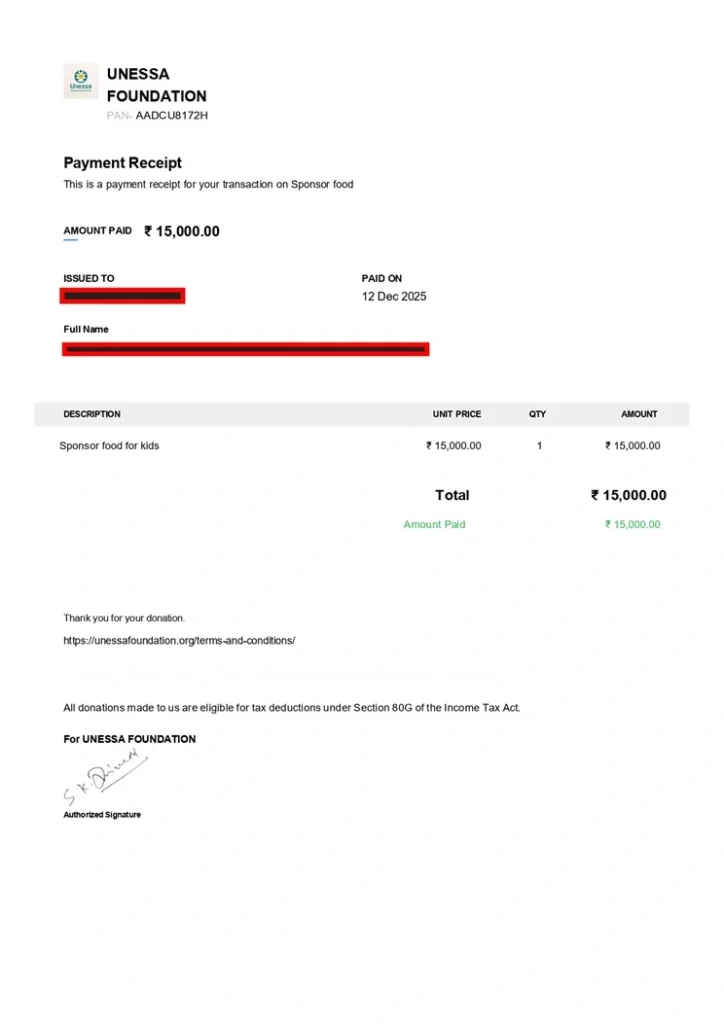
- Proper Receipt & Donation Tracking
Never donate to NGOs without valid certification unless you have verified their legitimacy through other means.
Why Compliance Matters to Donors
- Ensures your donation is legally used
- Protects against fraud
- Enhances impact accountability
- Helps corporates meet CSR compliance
- Protects donors under Indian tax laws
- Confirms organizational credibility
Compliance is not just paperwork—it is the backbone of trust.
Major Red Flags of Non-Compliant NGOs
- No 80G or 12A
- Personal bank accounts
- No annual audit
- No published impact report
- No governing body listed
- Fake registration documents
- Only social media presence
- Irregular communication
- No receipts or acknowledgment
If you notice even two or more, avoid donating.
Unessa Foundation: A Model of Compliance & Transparency in India
Unessa Foundation maintains full legal and operational compliance, including:
- Valid Trust/Society/Section 8 registration (based on your structure)
- Valid 80G & 12A certification
- Transparent annual audits
- Structured governance
- Public reporting and impact proof
- PAN & bank verification
- Real beneficiary evidence
- Ethical program operations
Unessa Foundation stands as a national benchmark for compliant, transparent NGOs in India.
Donate Confidently — Support India’s Verified & 100% Compliant NGO: Unessa Foundation
Quick Compliance Checklist for Donors
Unessa Foundation:
- Legal registration
- PAN
- NGO bank account
- Valid 80G
- Valid 12A
- Impact documentation
- Annual audit reports
- Real beneficiary evidence
If all are present → Safe NGO
If missing multiple → Avoid supporting
Support Verified, Transparent & Fully Compliant Social Impact Work — Donate to Unessa Foundation Today.
FAQ
1. Which NGO structure is best in India?
Section 8 Companies offer the highest transparency and governance.
2. Is it necessary for NGOs to have 80G & 12A?
Yes—trusted NGOs must have both for legal compliance and donor tax benefit.
3. Can a Trust become a Section 8 Company?
No. But a new Section 8 can be formed with the same trustees.
4. Do all NGOs need FCRA?
Only NGOs that receive foreign donations require FCRA.
5. Why is Unessa Foundation considered a benchmark NGO?
Because Unessa maintains complete compliance, transparent governance, and verified impact systems.