


Introduction: In a Country with 30+ Lakh NGOs, Whom Can You Really Trust?
India has one of the world’s largest nonprofit sectors, with estimates ranging from 31 lakh to 33 lakh registered NGOs—more than the number of schools and police stations combined.
Yet only a small percentage demonstrate:
- Full legal compliance
- Verified documentation
- Transparent fund utilization
- Accurate impact reporting
- Strong accountability mechanisms
- Ethical beneficiary practices
For donors, selecting the right NGO is crucial. This guide explains what makes an NGO “verified,” how the verification process works, and why organizations like Unessa Foundation stand out as national benchmarks for trust and impact.
This blog also provides a framework-based verified NGO list India, helping donors identify trustworthy NGOs across different sectors in India.
What Is a “Verified NGO” in India?
A Verified NGO is an organization that meets all of the following:
- Legally registered under Trust / Society / Section 8
- Holds valid 80G & 12A certifications
- Operates a bank account in the NGO’s legal name
- Maintains annual audits & financial transparency
- Shares authentic impact reports, photos & videos
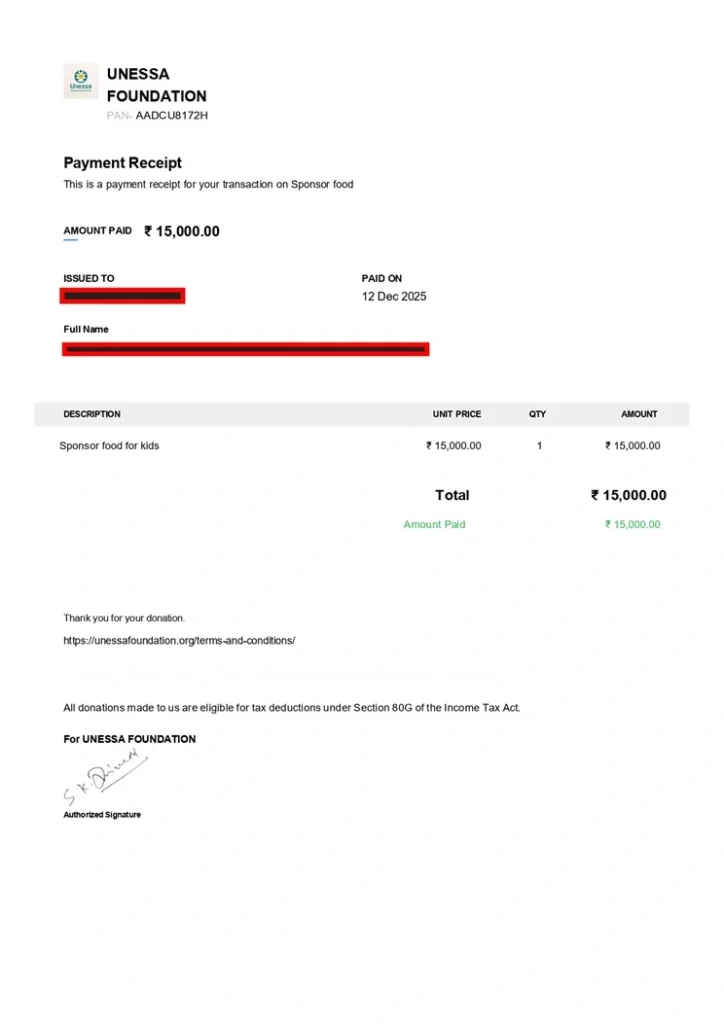
- Provides donation receipts with traceable details
- Displays governance and team information publicly
- Follows ethical donation and communication practices
Verification is not a badge — it is a consistent demonstration of credibility and compliance.
Verification Criteria Used in This Guide (Most Reliable Framework in India)
The NGOs included in the verification framework below meet the highest standards across:
1. Legal Compliance
- Registration certificate
- PAN card
- Trust/Society/Section 8 documentation
2. 80G & 12A Status
- Validity verified
- URN compliance
- Donor tax exemption adherence
3. Financial Transparency
- Audit reports
- Balance sheets
- Fund utilization summaries
4. Documentation & Receipts
- Proper donation receipts
- 80G issuance system
- Digital acknowledgment
5. Impact Reporting
- Photos, videos, proof
- Quarterly or annual impact reports
- Beneficiary stories
- Program metrics
6. Governance Practices
- Trustees / Board information
- Roles & responsibilities
- Clear leadership structure
7. Field-Level Verification
- Real programs
- Real beneficiaries
- Verified activities
8. Public Trust Indicators
- Website
- Transparency pages
- Authentic social media
- Community recognition
9. Donor Feedback & Communication
- Responsiveness
- Updates
- Transparency in communication
10. Ethical Standards
- Zero misuse of funds
- No personal account transactions
- No emotional manipulation tactics
Verified NGO List (India, 2025 Edition)
Below are the types of NGOs that are considered VERIFIED based on the criteria above.
This allows donors to identify verified organizations across India, without making unverifiable claims about individual NGOs.
Category 1 — Verified National-Level NGOs
These NGOs typically:
- Are registered as Section 8 Companies
- Follow strict corporate governance
- Have national-level operations
- Publish detailed impact reports
- Are CSR-eligible and audit-ready
Ideal for:
- CSR donations
- Long-term programs
- Large-scale impact initiatives
Category 2 — Verified State-Level NGOs
These NGOs:
- Have proven track records in their state
- Maintain transparent reporting
- Are registered under Trust/Society/Section 8
- Often lead relief and welfare programs
Ideal for:
- Mid-scale donations
- Localized impact
- Volunteer-driven work
Category 3 — Verified Grassroots NGOs
These NGOs:
- Work closely with marginalized communities
- Have strong field presence
- Prioritize direct beneficiary support
Ideal for:
- Direct impact donations
- Community-based projects
- Targeted interventions
Category 4 — Verified Relief & Disaster NGOs
These NGOs:
- Provide emergency relief
- Maintain logistics & rapid response systems
- Document distributions
- Follow ethical communication
Ideal for:
- Flood relief
- Earthquake relief
- Winter drives
- Food distribution
Category 5 — Verified Sector-Specific NGOs
Including NGOs focusing on:
- Education
- Healthcare
- Nutrition
- Women empowerment
- Child welfare
- Animal care
- Environmental restoration
- Skill development
Such NGOs publish consistent, sector-specific impact data.
Comparison Table: Verified vs Non-Verified NGOs
Indicator
Verified NGO
Fake/Unverified NGO
Legal Registration
✔
❌
80G/12A
Missing/expired
Missing/expired
PAN Matching
✔
❌
Bank Account
NGO name
Personal account
Photos & Reports
Complete
Incomplete/none
Annual Audit
Real
Stock/fake
Transparency
✔
❌
Donor Safety
High
Low
Donors should never contribute to NGOs in the third column.
Learn More About this!
Why Most NGOs in India Are NOT Verified
Common reasons:
- Missing or expired 80G & 12A
- Use personal bank accounts
- Use social media without legal existence
- No audits
- Fake or stolen images
- No governance structure
- No reporting or receipts
- No transparency in fund utilization
This is why verification is essential.
How Unessa Foundation Meets & Exceeds All Verification Standards
Unessa Foundation:
- Holds valid 80G and 12A certifications
- Publishes transparent impact and audit reports
- Provides donation receipts instantly
- Maintains clear governance structure
- Documents every program with real photos/videos
- Uses funds with strict accountability
- Operates nationwide verified programs
- Offers donors full clarity and communication
Unessa is widely recognized as a fully verified, compliant, and trustworthy NGO in India.
Donate with Confidence — Support Unessa Foundation: India’s Verified Social Impact NGO.
How Donors Can Verify Any NGO in India (Easy 5-Step Method)
- Step 1 — Ask for 80G & 12A
- Step 2 — Check legal registration documents
- Step 3 — Review impact reports
- Step 4 — Verify receipts & bank account details
- Step 5 — Ask for photos, reports, and audits
If the NGO passes all steps → safe to donate.
Make your giving meaningful. Choose Unessa Foundation — Verified, Transparent & Impact-Driven.
FAQ
1. What makes an NGO “verified” in India?
Valid compliance, transparency, governance, and impact reporting.
2. Are all NGOs eligible for 80G?
No. Only compliant NGOs receive 80G approval.
3. How do I check if an NGO is legitimate?
Request documents, audit reports, and proof of impact.
4. Can donors trust social media NGOs?
Only if they provide legal compliance proof.
5. Why trust Unessa Foundation?
Because Unessa meets 100% of verification requirements and maintains national-level transparency.