
COMMUNITY & GIVING
Research and Policy NGOs in India: 9 Important Profiles
Research and Policy NGOs in India: explore official sources, selection limits and practical questions about current services, eligibility, reporting and the actual recipient.
Published by Unessa Foundation · Editorial update: 4 November 2026
On this page
- Introduction
- Nine research and policy institutions and a separate education contribution
- Why These NGOs Matter
- Checking current information and enquiry routes
- Selection criteria and limits of this list
- Questions specific to research and policy ngos in india
- Additional research lead: Council on Energy, Environment and Water
- Additional research lead: PRS Legislative Research
- Additional research lead: TERI
- Keep a usable comparison record
- Use the right route for the intended support
- Conclusion
- Frequently asked questions
- Continue reading
Introduction
Research and policy bodies examine education, health, environment, governance and economic questions. An actual study should identify its question, method, population, geography and date. Rural Bihar and urban communities are contexts for specific investigation, not a single uniform policy problem.
Research can connect academic work with public discussion and practical decisions. Publication, a recommendation, implementation and a measured outcome are separate stages;one does not prove the next.
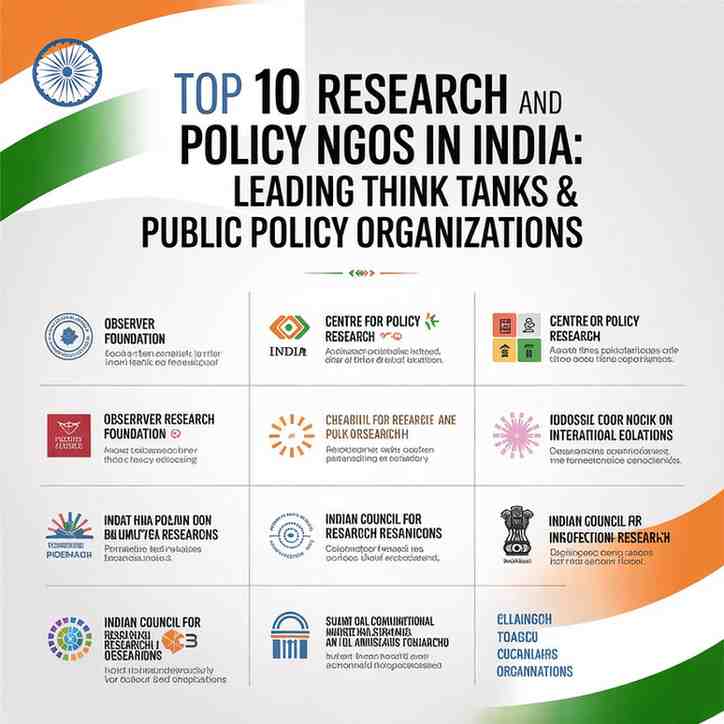
The nine original institutions below have different research and organisational roles, followed by Unessa’s separate education contribution. Compare actual publications and current institutional information rather than treat this as an independent top-ten ranking or proof of policy influence.

Unessa Foundation activity: a volunteer and children working with paper learning materials in Vadodara.
SUPPORT CHILDREN’S EDUCATION
Help learning become a regular part of a child’s life.
Support Unessa Foundation’s education programmes and volunteer-led learning activities.
Nine research and policy institutions and a separate education contribution
Centre for Policy Research (CPR)
The Centre for Policy Research describes independent research on public-policy questions. Governance, environment and development publications should be read with their methods and dates. Confirm current institutional arrangements and permitted contribution terms rather than infer them from an old profile.
Why it matters
A study can inform policy discussion. A particular framework or reform requires evidence of how the work was used, not just that a report was published.
Observer Research Foundation (ORF)
The Observer Research Foundation publishes research and convenes discussion on strategic affairs, governance and development. Identify the actual work and authors;the institution’s remit does not establish an official government mandate or direct assistance programme.
Why it matters
An international discussion is evidence of that activity. Influence on a policy position or implementation needs separate evidence.
Institute of Economic Growth (IEG)
The Institute of Economic Growth describes itself as an autonomous multidisciplinary research and training centre in economics and social development. Academic research, training and direct charitable services have different roles;confirm actual programme eligibility before applying.
Why it matters
Economic analysis can provide evidence for a policy question. Use the specific study, method and scope instead of a broad reputation claim.
National Council of Applied Economic Research (NCAER)
The National Council of Applied Economic Research identifies its establishment in 1956 and an independent, non-profit economic-policy research role, including empirical analysis and data collection. A study or survey does not establish an individual grant or service entitlement.
Why it matters
Data can inform policy choices when definitions, samples, dates and limitations are clear. Analysis and a demonstrated development outcome should not be conflated.
Indian Council for Research on International Economic Relations (ICRIER)
The Indian Council for Research on International Economic Relations describes economic-policy research connecting India with international questions. Trade and international cooperation are areas to explore through its actual publications, not a guarantee of a programme or policy result.
Why it matters
A research recommendation and an actual change in economic integration need different evidence and attribution.
CUTS International
CUTS International describes research and advocacy on rules-based trade, regulation and governance. Competition and consumer-policy work should be linked to a specific project or publication rather than treated as a universal individual grievance service.
Why it matters
Consumer advocacy, research, policy reform and an individual remedy are different activities and outcomes. Confirm the actual route relevant to the question.
Centre for Science and Environment (CSE)
The Centre for Science and Environment is a public-interest research and advocacy organisation. Its environment, sustainability and climate work should be read through actual publications and programmes;the remit does not establish every environmental service or an open funding scheme.
Why it matters
Check the data, methods, assumptions and limitations behind a recommendation. Scientific work and evidence of a policy decision are distinct.
Manohar Parrikar Institute for Defence Studies and Analyses
The Manohar Parrikar Institute for Defence Studies and Analyses uses the current MP-IDSAname and describes an autonomous research role funded by India’s Ministry of Defence. Its defence, security and international-relations work is not the same category as an independent donation NGO or a direct peace-service provider.
Why it matters
Strategic publications can inform debate. They do not by themselves establish improved national security or conflict resolution.
Public Affairs Centre (PAC)
The Public Affairs Centre identifies a 1994 origin and a Bengaluru-based research role concerning governance, public policy and citizen participation. Confirm the actual study, programme and current contact rather than infer a direct government service.
Why it matters
Participation tools and public research can support scrutiny. An actual change in governance or citizen access needs specific evidence.
Unessa Foundation: education and programme learning
Unessa’s published programme concerns children’s education, English and life skills. Listening to learners and reviewing an activity is distinct from an established policy think tank, research institute or government advisory programme.
An actual education activity can gather appropriate feedback and review delivery. This does not establish a dedicated Unessa grassroots-policy research programme, multi-sector research institute, evidence-based advocacy campaign or formal policy partnership.
Why These NGOs Matter
Governance, environmental conditions and social access vary within rural settings, Gujarat’s industrial areas and Mumbai. A specific study needs to define its setting and question rather than assume one regional problem or cause.
Governance Challenges
Define the actual governance or access issue and the institution responsible. Evidence about a gap does not establish that every research body implements the service it studies.
Policy Research & Insights
Assess the research question,method,sample,period,limitations and funding context. A strong institutional reputation does not replace study-specific scrutiny.
Collaborative Implementation
Confirm an actual public,academic,community or corporate partnership and its responsibilities. Research,consultation,implementation and measured results are different stages.
Unessa’s education role should be assessed through its published activities and appropriate programme reporting. The guide does not establish specialist policy research, government advice or measured policy influence by Unessa.
Checking current information and enquiry routes
Compare research and policy ngos in india by the particular activity, place and decision that matter to you. The resources below have different roles; a familiar name does not establish current capacity, legal eligibility or suitability for every request. Use the linked official information to make a specific enquiry.
This page is an editorial research starting point, not an independent ranking, accreditation, exhaustive list or guarantee of results. Inclusion does not imply a partnership with Unessa, an endorsement by a regulator or that the education donation buttons fund the listed organisations.
For a related perspective on this topic, read Multilateralism: 2 Helpful Research Starting Points.
Selection criteria and limits of this list
Entries were selected for an identifiable official source and a stated area of work relevant to part of this topic. The order is for navigation, not a score. The linked sites were consulted for this editorial update on 1 November 2026; this was a website-source check, not a phone confirmation, inspection, financial audit or approval verification.
Compare the precise programme, entity and location. Research bodies, trade unions, international networks and direct-service charities are not interchangeable. A broad remit is not evidence of an open place, free pickup, clinical appointment, grant, legal representation or a volunteering position available today.
Questions specific to research and policy ngos in india
- What research area, method and publication period are relevant?
- Are research outputs, policy influence and real-world outcomes separated?
- Does the current official source establish the institution’s status and actual programme?
Record a source and date for the answer. If the official information does not settle a point, write “not confirmed” and ask the actual provider. Do not fill a gap using a similarly named organisation or a directory entry copied from another website.
Additional research lead: Council on Energy, Environment and Water
Council on Energy, Environment and Water — official source provides a starting point for public-policy research on energy, environment and water; not a general emergency or household service. These brief descriptions identify a research direction, not a complete assessment of the institution or confirmation of a particular service request.
Before relying on this entry, check the current programme page, relevant geography, eligibility and official enquiry route. If contributing, identify the actual receiving entity and funding terms. Ask for the source period and definition before repeating any claim about reach, costs, membership, facilities or outcomes.
Additional research lead: PRS Legislative Research
PRS Legislative Research — official source provides a starting point for legislative research and public information; distinguish research outputs from legal representation. These brief descriptions identify a research direction, not a complete assessment of the institution or confirmation of a particular service request.
Additional research lead: TERI
TERI — official source provides a starting point for energy, environment and sustainability research/programmes; distinguish research from direct aid. These brief descriptions identify a research direction, not a complete assessment of the institution or confirmation of a particular service request.
Keep a usable comparison record
- Need and location; organisation’s full name and exact programme.
- Official source, reporting period and date consulted.
- Service/participation conditions confirmed by the provider.
- Outcome measure and evidence, with limitations or unresolved questions.
- Receiving entity and campaign purpose if a contribution is intended.
For research and policy ngos in india, legal identity, current availability and effectiveness are separate questions. A registration match cannot demonstrate a programme outcome; a photograph cannot establish every delivery claim. Keep financial and beneficiary details private, and share only what your evidence supports.
Use the right route for the intended support
Contact the provider for current enquiries or use its independently checked official contribution route. Do not assume the Unessa buttons forward money to a third party. Unessa’s education CTA leads to the education campaign described at the destination. Read Unessa’s programme information if that is the work you wish to support.
A practical next step is one specific question to the relevant team, followed by a record of the answer. Revisit the entry when the programme, eligibility, location or your intended use changes. A transparent limit is more useful than an unsupported “best”, “trusted” or “verified” label.
Conclusion
Research and Policy NGOs in India is a broad topic covering institutions with different structures and funding. Compare the exact study, entity, programme and evidence before drawing a conclusion. Use the intended institution’s own route for research or contribution enquiries;Unessa’s donation buttons support its stated education campaign. Read the guide to understanding NGOs for the difference between purpose, activities and outcomes.
Frequently asked questions
How can I assess a research or policy NGO’s publication?
Read the research question, methods, source data, reporting date and stated limitations. Check whether the findings concern the population and decision you are considering instead of relying only on a summary or institutional reputation.
Does publishing policy research mean an NGO delivers the service it studies?
No. Research, recommendations and implementation are different roles. Confirm any actual project or service through programme information, rather than assuming that an article about education, energy or legislation establishes delivery capacity.
What are Research and Policy NGOs in India?
Research bodies study defined policy questions and may publish analysis or recommendations. Their structures and funding differ;not every institute is an independent charity or direct service provider.
Why are policy research NGOs important for India’s development?
Relevant research can help examine choices when its data, methods, dates and limitations are clear. A report does not automatically become policy or improve an outcome.
How do Research and Policy NGOs influence government decisions?
Reports, briefs, consultations and public discussion can inform decisions. Actual influence or a legal change needs specific evidence;do not infer it from a publication alone.
What makes Unessa Foundation unique among policy NGOs?
Unessa’s published role is education and life skills. Programme feedback is different from an established policy-research institute or government-advisory role, and this guide does not claim superiority over specialist bodies.
How can individuals support Research and Policy NGOs?
Explore the actual institution’s published work or specific research, volunteer or contribution route. Confirm eligibility, professional requirements, funding purpose and reporting;Unessa’s education buttons do not fund every institution or study in the list.
Continue reading

Related guide

Related guide
Support children’s learning with Unessa Foundation.