
EDUCATION & COMMUNITY
The Biggest Barriers to Education for Underprivileged Children—and How to Overcome Them
Educational barriers can arise at home, on the journey to school and in the classroom. This guide connects common obstacles with questions that families, schools and NGOs can use to plan appropriate support.
Published by Unessa Foundation · Editorial update: 4 November 2026
On this page
- Why Education Access Still Remains a Challenge
- The Role of Government and NGOs
- How Individuals Can Help
- Long-Term Benefits of Solving Education Barriers
- Barriers to education: seven questions for choosing a practical response
- Barriers to education: describe the measure and the next action
- 5 practical checks for barriers to education
- Evidence and support: keep the scope clear
- Conclusion
- Sources and further reading
- Frequently asked questions
- Continue reading
Ask the learner which part of participation is difficult, then agree who can act on it. A materials donation will not resolve every transport, accessibility or teaching barrier, so choose a response that matches the problem.
For coordinating responsibilities with families and the school, read school, family and community coordination.
Education is a powerful tool for poor children s future. However, for millions of underprivileged children around the world, access to quality education remains a distant dream. Despite global efforts, numerous barriers continue to prevent children from attending school, completing their education, and achieving their full potential.
Understanding these barriers is the first step toward solving them. More importantly, identifying practical solutions can help individuals, communities, and organizations work together to ensure that every child has access to education.
In this article, we explore the biggest barriers to education for underprivileged children and actionable ways to overcome them.
Why Education Access Still Remains a Challenge
Although governments and organizations have made progress in improving education systems, inequality persists. Children from low-income families, rural areas, and marginalized communities often face obstacles that others do not.
These barriers are not just financial—they are social, cultural, and structural. This shows how education acts as a powerful tool for poor childrens future. Addressing them requires a comprehensive and collaborative approach.
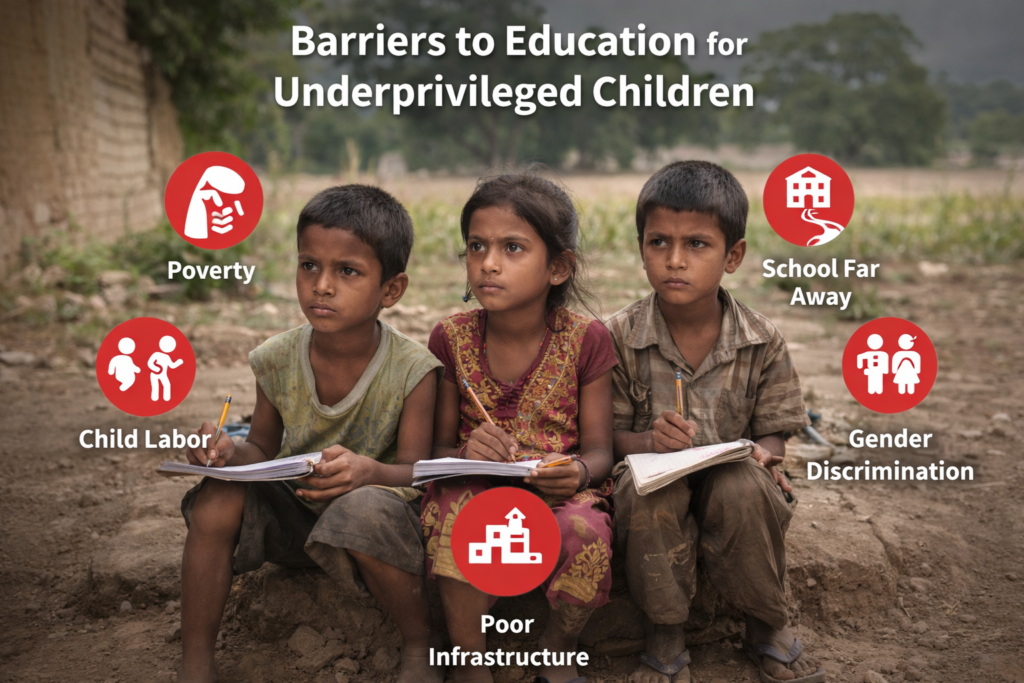
1. Financial barriers to education
The Barrier
Poverty is the most significant obstacle to education. Families struggling to meet basic needs often cannot afford:
- School fees
- Uniforms
- Books and supplies
- Transportation
In such situations, education becomes a secondary priority.
The Solution
- Provide scholarships and financial aid
- Offer free or subsidized education
- Distribute school supplies
- Introduce mid-day meal programs
Impact:
Reducing financial burden encourages families to send their children to school and keep them enrolled.
2. Child Labor
The Barrier
Many underprivileged children are forced to work to support their families. This leaves little or no time for education.
Common forms of child labor include:
- Agricultural work
- Domestic labor
- Factory jobs
The Solution
- Enforce child labor laws
- Provide financial support to families
- Create flexible schooling options
- Raise awareness about the importance of education
Impact:
When families are supported financially, children can focus on learning instead of working.
3. School access barriers to education
The Barrier
In rural and remote areas, schools may be:
- Too far away
- Poorly equipped
- Non-existent
Children often have to travel long distances, which discourages attendance.
The Solution
- Build schools in underserved areas
- Provide transportation facilities
- Develop mobile and community schools
- Use digital learning platforms
Impact:
Improved access increases enrollment and attendance rates.
4. Gender Discrimination
The Barrier
In many communities, girls face barriers such as:
- Early marriage
- Household responsibilities
- Cultural norms discouraging education
The Solution
- Promote gender equality awareness
- Provide scholarships for girls
- Ensure safe school environments
- Encourage female education campaigns
Impact:
Educating girls leads to healthier families, stronger economies, and empowered communities.
5. Poor Infrastructure and Facilities
The Barrier
Many schools lack basic facilities such as:
- Clean classrooms
- Toilets and sanitation
- Electricity
- Learning materials
This creates an unsuitable learning environment.
The Solution
- Invest in school infrastructure
- Provide sanitation facilities
- Ensure access to clean water
- Supply necessary teaching materials
Impact:
A better learning environment improves student engagement and performance.
6. Lack of Qualified Teachers
The Barrier
Many underprivileged areas suffer from a shortage of trained teachers. This leads to:
- Poor quality education
- Lack of guidance
- Low student motivation
The Solution
- Train and recruit qualified teachers
- Provide incentives for teaching in rural areas
- Use digital teaching tools and platforms
- Offer continuous teacher development programs
Impact:
Quality teaching enhances learning outcomes and student success.
7. Language and cultural barriers to education
The Barrier
Children from diverse linguistic and cultural backgrounds may struggle to understand the language of instruction.
The Solution
- Use local languages in early education
- Develop culturally inclusive curriculum
- Train teachers in multilingual education
Impact:
Children learn better when education is relatable and understandable.
8. Lack of Awareness About Education
The Barrier
Some parents may not understand the importance of education or may prioritize work over schooling.
The Solution
- Conduct awareness campaigns
- Engage community leaders
- Share success stories
- Educate parents about long-term benefits
Impact:
Changing mindsets leads to increased school enrollment and retention.
9. Health and Nutrition Issues
The Barrier
Poor health and malnutrition can affect a child’s ability to attend and perform in school.
The Solution
- Provide school meal programs
- Ensure access to healthcare services
- Conduct health awareness programs
Impact:
Healthy children are more likely to attend school and perform well academically
10. Digital barriers to education
The Barrier
In the modern world, access to digital tools is essential. However, many underprivileged children lack:
- Internet access
- Computers or smartphones
- Digital literacy
The Solution
- Provide affordable digital devices
- Set up community digital centers
- Offer free online learning resources
- Train students in digital skills
Impact:
Bridging the digital gap opens access to global knowledge and opportunities.

Unessa Foundation activity: children working with colourful paper during a Bengaluru group activity.
SUPPORT CHILDREN’S EDUCATION
Help learning become a regular part of a child’s life.
Support Unessa Foundation’s education programmes and volunteer-led learning activities.
The Role of Government and NGOs
Governments and NGOs play a crucial role in overcoming these barriers by:
- Implementing education policies
- Funding schools and programs
- Providing scholarships
- Running awareness campaigns
Collaboration between public and private sectors is essential for sustainable change.
How Individuals Can Help
You don’t need to be an organization to make a difference. Individuals can contribute by:
- Donating to education programs
- Sponsoring a child
- Volunteering as a tutor
- Donating books and materials
- Raising awareness
Every small effort contributes to a larger impact.
Long-Term Benefits of Solving Education Barriers
Addressing these challenges leads to:
- Reduced poverty
- Economic growth
- Social equality
- Improved quality of life
Education is not just an individual benefit—it is a societal investment.
Barriers to education: seven questions for choosing a practical response
Barriers to education can overlap, and a broad list cannot explain every learner’s circumstances. Start with an actual participation or learning difficulty, ask the people concerned about it and identify what the responsible team can do. The questions below are a planning framework. Any examples are illustrative, not accounts of measured Unessa results.
1. Which cost is affecting participation?
Ask what expense creates a difficulty and when it arises. Barriers to education may involve materials, travel or another practical cost, but the answer should come from the particular situation. A national estimate or general appeal does not establish a household’s needs. Avoid asking for more private financial information than the agreed process requires.
If a support scheme is considered, confirm the current eligibility, application route and covered costs. An enquiry is not an approved award. Explain which step can be taken now and which requires a separate decision. Do not promise assistance on behalf of a school, donor or provider that has not agreed to it.
2. Is the journey or schedule workable?
Explore the actual route, time and arrangements rather than assuming that distance alone explains attendance. School access may be affected by a timetable, transport availability or a responsibility that conflicts with a session. Ask the learner and family what is difficult and which changes they think would be useful.
An illustrative response might involve clarifying a schedule or asking the responsible provider about an available arrangement. It is not evidence that a transport service exists or that a timing change can be made. Confirm feasibility with the person authorised to decide and record the next agreed step.
3. Are language and instructions understandable?
Barriers to education can arise when instructions or materials are unfamiliar even though a learner is present. Ask which part of a task was understood and where clarification is needed. Avoid turning a language difference into a judgement about ability, effort or family interest.
Discuss the available teaching or communication options with the responsible educator. A short explanation, example or different format may be worth considering, but the choice should fit the learner and setting. Review whether the agreed adjustment made participation possible instead of assuming that sending information was enough.
4. Which accessibility details need attention?
Ask the learner about the format, environment and support required for a specific activity. School access includes more than entry to a building. Materials, communication, movement and the design of a task may each raise different questions. Confirm what the responsible team can arrange and how the learner can report a difficulty.
Do not infer a person’s preferences or needs from a broad label. Include the person concerned in the discussion through a usable communication route. A provider’s general statement about inclusion should be followed by specific questions about the actual activity, location and process.
5. Is the learning task appropriate to the learner’s current experience?
Barriers to education may be discussed as access issues while the task itself remains unclear. Ask what the learner is being asked to do and what evidence shows where support is needed. Attendance does not automatically establish understanding, and a single difficult task cannot define a learner’s overall ability.
Choose a manageable question for review with an educator. An illustrative planning task could compare a learner’s explanation of a short passage with the instructions given. That is not a diagnostic assessment or a reported program outcome. Use appropriate professional guidance where a more specialised assessment is required.
6. How can family communication support the next step?
Check whether the message reached the intended person in a format and at a time they could use. Barriers to education should not be attributed to disinterest solely because a family missed an event or did not answer a notice. Ask about the communication arrangement before drawing that conclusion.
Agree an official contact and a specific action. “The teacher will explain the task through the agreed channel” is easier to follow up than a general request for more engagement. Keep the record relevant and private. Avoid sharing household circumstances in a group merely to explain why an arrangement changed.
7. What will show whether the response was useful?
Return to the original difficulty and ask whether the agreed action happened. For barriers to education, a useful review separates an activity completed, participation made possible and learning assessed. Those are related but different findings. Record what was observed and what remains uncertain before choosing the next step.
If the response did not work, check the assumption behind it. The timing, format or responsible contact may need to change. A review can acknowledge that result without blaming the learner or family. Do not claim a sustained improvement from one visit, one donated item or one attended session.
Illustrative planning note: materials and communication
Imagine a learner missing a classroom task because the required material was unavailable. This is a hypothetical example. The team first confirms the actual task and material with the educator, then discusses a feasible arrangement with the family. It does not immediately launch a broad appeal or assume that every learner has the same need.
The note records the question, agreed action, responsible contact and review date. At the review, the team asks whether the material was available and whether the instructions were usable. This describes a practical school access issue. It does not establish that the learner’s long-term attainment improved or that other barriers have disappeared.
How supporters can use the framework
Ask the receiving organisation which barrier its campaign is intended to address and how the activity will be described in updates. A contribution can support an agreed need without claiming to remove every obstacle. Keep costs, activities and outcome evidence distinct when sharing an appeal with others.
When several barriers affect the same learner
List the barriers that have actually been discussed and ask which action is feasible first. Barriers to education may interact, so resolving one practical problem does not prove that the whole situation has changed. School access can remain difficult while a different question about materials or communication has been addressed.
Choose a manageable next action and identify the person responsible. Keep barriers to education distinct from assumptions about the learner’s motivation. If a plan depends on another provider, confirm that provider’s role before making a commitment. Mark unresolved barriers clearly instead of treating a referral as a completed service.
Barriers to education: describe the measure and the next action
Do not combine different school access measures
A lack-of-education claim may refer to enrolment, attendance, completion or a learning task. State which measure is meant, whose experience it describes and when it was recorded. Barriers to education cannot be inferred from one undated teacher-absence or girls’ completion figure.
Keep the discussion specific and respectful
Ask the learner and family about cost, language, travel, accessibility and the school arrangement that actually creates difficulty. School access discussions should distinguish observation from assumption and avoid blaming a household. Agree the action, responsible contact and review point, and record only information needed for that purpose.
5 practical checks for barriers to education
- Ask where participation becomes difficult.
- Distinguish travel, materials and teaching barriers.
- Choose support that addresses the actual obstacle.
- Agree responsibility with the family and school.
- Review unresolved barriers as well as delivery.
Evidence and support: keep the scope clear
Describe both the support delivered and what remains unresolved. A child receiving supplies or enrolling in a programme does not by itself establish regular attendance or learning progress; review those outcomes separately.
The education donation buttons lead to Unessa’s education campaign. They do not fund every third-party provider, item or service mentioned here. Read the programme information and confirm any allocation or service condition important to you before giving.
Conclusion
We must support this powerful tool for poor childrens future. The barriers to education for underprivileged children are complex but not impossible to overcome. With collective effort from governments, organizations, and individuals, we can create a world where every child has access to quality education.
By identifying these challenges and implementing practical solutions, we take a step closer to a future where no child is left behind.
Education is not just a right—it is the key to unlocking a better tomorrow.
Sources and further reading
Frequently asked questions
How can an education programme identify the barrier it should address?
Discuss the actual difficulty with learners, families and responsible staff. Travel, materials, communication, accessibility and teaching needs can require different responses, so identify the problem before deciding on a collection or activity.
How can progress on removing an education barrier be reviewed?
Record the agreed action and what it was meant to make possible, then check the learner’s access or participation. Distinguish an item delivered from a barrier resolved, and revise the plan if the intended task remains difficult.
Continue reading

Related guide

Related guide
Support children’s learning with Unessa Foundation.