
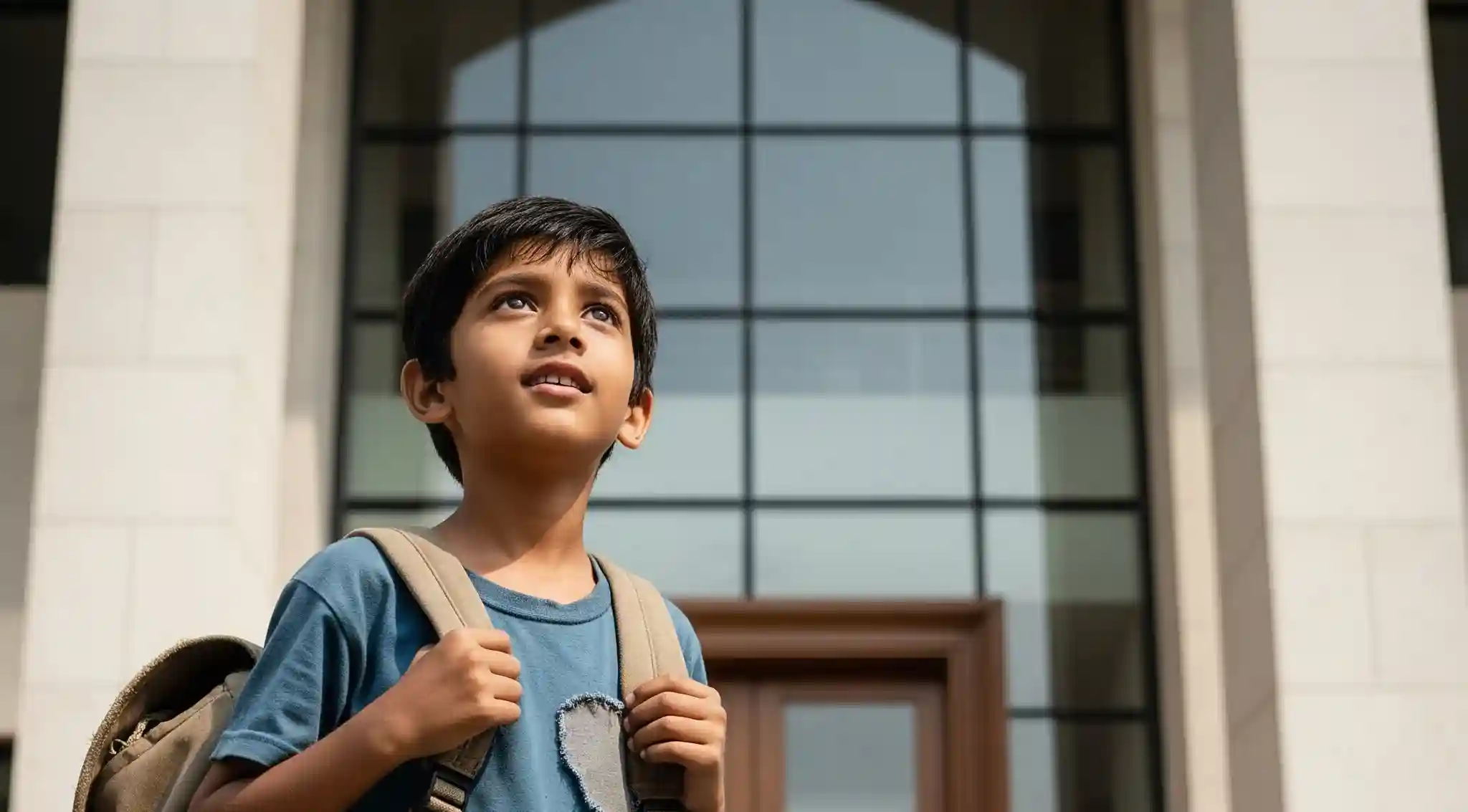

RTE admission is revolutionizing education in India, offering free seats in private schools to children from economically weaker sections (EWS) and disadvantaged groups. Let me take you back to a tiny village outside Lucknow. One sunny afternoon, 8-year-old Anaya, barefoot but wide-eyed, walked through the gates of a private English-medium school. No fancy lunchbox, no branded backpack, just courage. Her seat was reserved under India’s RTE Act, and that moment changed her life forever.
She didn’t know it, but she was part of a quiet revolution. One that’s giving hope to millions like her across India through free education for poor children in private schools. In 2025, Uttar Pradesh alone saw 1,85,664 admissions under RTE, while Gujarat reported 95,494 students granted RTE admission for the 2025-26 academic year. These numbers highlight the growing impact of the RTE Act on underprivileged children education.
The Legal Backbone: What the RTE Act Offers for RTE Admission
Passed in 2009, the Right to Education (RTE) Act mandates a 25% private school quota for children from economically weaker sections (EWS) and disadvantaged groups in unaided private schools. This ensures RTE admission provides free education from Class 1 to 8.
Here’s what it includes:
- Free tuition, uniforms, books, and learning materials.
- Reimbursement to schools by the state government (though with some limitations).
- No child can be held back, expelled, or required to pass board exams until Class 8.
“Education is the most powerful weapon which you can use to change the world.” — Nelson Mandela
Implementation varies across states. While Delhi and Rajasthan have robust online portals for RTE admission, others rely on cumbersome paperwork. Nationwide, elementary enrollment reached 96.7% by 2023, showing progress but also gaps in quality. To boost your RankMath score, ensure your site links to official RTE portals for internal navigation.
The Private School Paradox: From Luxury to Lifeline Through EWS Reservation
Private schools are often seen as elite spaces, but under the RTE Act, they become lifelines for poor children via EWS reservation. Benefits include:

- English-medium instruction for better opportunities.
- Access to digital tools, smart classrooms, and extracurriculars.
- Diverse peer networks that inspire higher aspirations.
This is a significant upgrade from many government schools facing infrastructure challenges. However, challenges persist:
- Discrimination against RTE students.
- Hidden costs like activity fees.
- Subtle exclusion in classrooms.
The 25% quota has increased private school enrollments, but enforcement remains patchy, with some schools resisting full compliance. This is where NGO support for RTE becomes crucial to bridge the gap.
How NGOs Like Unessa Foundation Support RTE Admission
I first heard about Unessa Foundation through their campaign: “Every Child Deserves a Desk, Not a Dustbin.” As a key player in the education of underprivileged children, they specialize in:
- Guiding parents through the RTE admission process, including document submission.
- Offering after-school tutoring to help kids adapt to private school curriculums.
- Providing essentials like hygiene kits, uniforms, and digital tablets for remote students.
They also host community workshops on RTE eligibility criteria and advocate for better school compliance. Donating to Unessa empowers families and communities. Visit Unessa Foundation to see how Rs. 500 can fund a school kit. Their helplines during admission seasons simplify everything from scanning documents to tracking applications.
RTE Eligibility: Who Qualifies and How to Apply
Simplifying RTE eligibility criteria: You qualify for RTE admission if:
- Annual family income is below Rs. 1-2 lakh (state-specific).
- You belong to SC/ST, OBC (Non-Creamy Layer), or other disadvantaged groups.
- The child is aged 6-14 years.
RTE Admission Process in India:
- Apply online via your state’s RTE portal (e.g., Maharashtra or Karnataka apps).
- Submit documents: Aadhaar, income proof, caste certificate, address proof.
- Participate in the lottery draw for seat allocation.
Tip: Check state deadlines; applications often open in early 2025 for the next academic year. If stuck, Unessa Foundation’s step-by-step assistance, including SMS updates, makes it easier. For more details, explore how to apply for RTE admission in India on official sites.
Real Stories: Kids Who Succeeded Through RTE Admission
Success stories of RTE students inspire action. Meet Rehan from Mumbai:
Born to a daily wage worker, his RTE admission to a top ICSE school led to mentoring roles in Unessa’s digital pods.
Kavita from Jharkhand:
Once tied to chores, she now excels and aims to be a civil servant, thanks to free education in private schools.
Faizan from Uttar Pradesh:
After his father’s accident, Unessa secured his RTE admission and provided counseling, turning dropout risk into academic success.
These stories show how RTE admission builds resilience. They don’t seek pity; they thrive on opportunities.
How You Can Make a Difference in Underprivileged Children Education
Ready to support? Here’s how:
Donate: Fund NGOs like Unessa Foundation. Rs. 500 covers a school kit, less than a coffee outing.
Volunteer: Assist with RTE admission applications, teach weekend classes, or create regional explainer videos.
Amplify: Share success stories of RTE students on social media, encourage corporate partnerships, or nominate local families.
Change starts small. Link to Donate to Unessa or similar organizations.
FAQs and Myths Busted About RTE Admission
Do private schools follow RTE admission rules?
Legally yes, but enforcement varies. Push for compliance via NGOs.
Are RTE kids treated differently?
Sometimes, but NGO interventions are reducing bias.
Can non-Indians help?
Yes, through global donations and remote volunteering.
What if a school refuses admission post-selection?
Complain to the district education officer or seek Unessa’s legal aid.
Does RTE apply to all private schools?
Only unaided ones; aided or minority schools may be exempt.
Final Thoughts: When Free Education Isn’t Just a Privilege
RTE admission opens doors once closed, ensuring free education in private schools for millions. But true impact needs community action.
Pause, act, share: “Be the reason a child believes in school again.” Support Unessa Foundation or trusted NGOs. One RTE admission ripples across generations.