
COMMUNITY & GIVING
Muslim NGOs in the World: 10 Important Organisation Profiles
Muslim NGOs in the World: explore official sources, selection limits and practical questions about current services, eligibility, reporting and the actual recipient.
Published by Unessa Foundation · Editorial update: 4 November 2026
On this page
- Introduction: Muslim NGOs and international humanitarian work
- What Are Muslim NGOs?
- Ten Muslim humanitarian organisation profiles to research
- How to Choose the Right Muslim NGO to Support
- How You Can Support Global Muslim NGOs
- Checking current information and enquiry routes
- Selection criteria and limits of this list
- Questions specific to muslim ngos in the world
- Keep a usable comparison record
- Use the right route for the intended support
- Frequently asked questions
- Continue reading
Introduction: Muslim NGOs and international humanitarian work
Muslim NGOs in the World work in areas including disaster relief, healthcare, education and food security. Faith-inspired values such as compassion (rahmah), justice (‘adl) and social responsibility can inform their missions. Their actual assistance criteria, geography and current programmes need to be checked individually;this directory is not proof that every listed entity serves every community or is currently operating in every crisis.
What Are Muslim NGOs?
Muslim NGOs are organisations whose stated humanitarian or development mission is informed by Islamic values. Their exact legal form, registration and programmes vary. Work may include disaster relief, food security, education, healthcare, water, sanitation, hygiene and livelihoods. An identity or mission statement alone does not establish registration, financial compliance or a particular service.

Unessa Foundation activity: a volunteer and children working with paper learning materials in Vadodara.
SUPPORT CHILDREN’S EDUCATION
Help learning become a regular part of a child’s life.
Support Unessa Foundation’s education programmes and volunteer-led learning activities.
Ten Muslim humanitarian organisation profiles to research
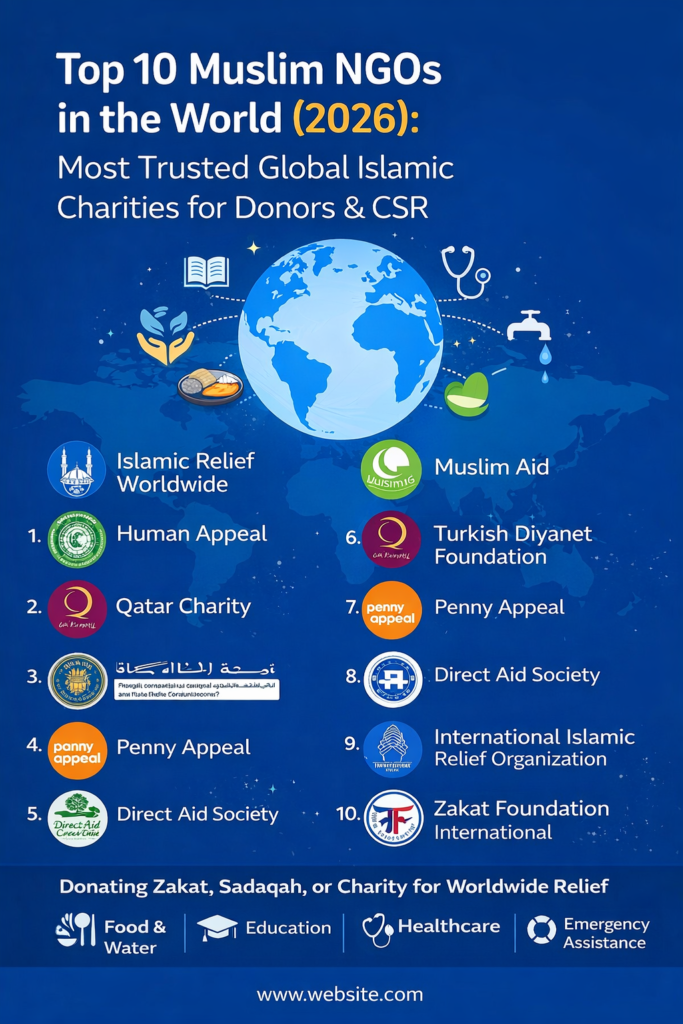
The ten original profiles are restored below with their specific histories and programme subjects. The order is for navigation, not an independently assessed top-ten ranking. Historical names and current receiving entities are distinguished;reported reach is not a guarantee of an open service or current project in every country.
1. Islamic Relief Worldwide (IRW)
Islamic Relief Worldwide — official source provides a starting point for international humanitarian work with a stated faith-inspired identity; verify the actual country and receiving entity. These brief descriptions identify a research direction, not a complete assessment of the institution or confirmation of a particular service request.
Before relying on this entry, check the current programme page, relevant geography, eligibility and official enquiry route. If contributing, identify the actual receiving entity and funding terms. Ask for the source period and definition before repeating any claim about reach, costs, membership, facilities or outcomes.
Islamic Relief Worldwide — official source. Established in 1984 in the United Kingdom, Islamic Relief Worldwide describes relief and development work including emergency response, healthcare, water, sanitation, education and livelihoods. Its current about page reports work in over 40 countries;this is the organisation’s own scope statement, not a comparative quality rating.
Review actual emergency and development projects, dated accounts and independent audit information. IRW’s October 2026 account reports the September 2026 removal of its former US member from the federation. Identify the exact receiving entity;do not presume that shared historical branding establishes present federation membership.
Research direction:large international relief and development programmes. Compare the intended appeal’s delivery arrangements and reporting before contributing.
2. Muslim Aid
Muslim Aid — official source provides a starting point for international humanitarian work; check current programme coverage and official receiving arrangements. These brief descriptions identify a research direction, not a complete assessment of the institution or confirmation of a particular service request.
Muslim Aid — official source. Muslim Aid traces its UK origins to 1985. Its work concerns humanitarian relief and development. The original guide’s undated 25-plus-country figure is not treated as confirmed current operational coverage.
Distinguish immediate relief from the actual recovery or development programme. Check the specific country, partner, delivery period and dated report instead of assuming all activities are ongoing.
Research direction:programmes that combine relief with recovery. A sustainability aim needs programme-specific outcome evidence.
3. Human Appeal
Human Appeal — official source provides a starting point for international humanitarian work; check the specific programme, country and appeal terms. These brief descriptions identify a research direction, not a complete assessment of the institution or confirmation of a particular service request.
Human Appeal — official source. Human Appeal describes its history from 1991 and a role in immediate relief and development. Its UK identity should be distinguished from the exact receiving entity and country appeal. The original 25-plus-country statement needs a dated reporting period.
Check actual emergency, food or medical projects and the provider’s relevant responsibilities. A visible appeal or digital update does not independently establish response speed, clinical quality or superior donor trust.
Research direction:an identified humanitarian appeal. Confirm its actual delivery and reporting rather than assuming an immediate life-saving result from every contribution.
4. Qatar Charity
Qatar Charity — official source. Qatar Charity identifies its establishment in Qatar in 1992 and describes humanitarian and development work, including healthcare and education. Its actual project pages and reporting should establish geographic coverage;the original 30-plus-country figure was undated.
For infrastructure, welfare, schools, housing or hospital-related support, check the specific project, implementing body, maintenance and reported outputs. An institutional relationship does not establish every listed project’s availability.
Research direction:structured development or humanitarian projects with defined responsibilities. This guide does not establish that it is the most funded or most effective provider.
5. Turkish Diyanet Foundation (TDV)
Türkiye Diyanet Foundation — official source. Türkiye Diyanet Foundation’s official scholarship guidance dates its establishment to 13 March 1975 and explains its relationship to supporting religious affairs. It is based in Türkiye. Religious services, scholarships and humanitarian activity have different purposes and eligibility conditions.
An international institutional network is not proof of unmatched reach or an open scholarship or disaster service in every country. Use the actual programme’s dated terms and reporting.
Research direction:the foundation’s specific education, religious-service or humanitarian programme. Confirm the intended activity and participant criteria.
6. Penny Appeal
Penny Appeal — official source. Penny Appeal dates its establishment in the United Kingdom to 2009 and describes water, food, child support and emergency aid in regions including Asia, the Middle East and Africa. The original 30-plus-country number was not tied to a reporting period.
Read current programme terms, accounts and the relevant public regulator record. Storytelling, small suggested amounts and a stated cost per output do not establish superior transparency or the greatest impact per pound.
Research direction:a defined small or recurring contribution to an actual programme. Compare restrictions, administration, cancellation arrangements and reporting rather than rely on an unsupported value-for-money rating.
7. Direct Aid Society
Direct Aid Society — official source. Direct Aid describes its establishment in 1981 and a long-term focus on vulnerable communities in Africa. Its Kuwait-based history includes education, health and development. Do not turn historical branches or regional coverage into a current service guarantee.
Review the actual education, healthcare, infrastructure or income-generation project and its reporting period. The original broad Africa-and-Asia label needs project-specific evidence.
Research direction:long-term regional development, especially the stated African programme focus. Confirm the community, receiving body and ongoing project.
8. International Islamic Relief Organization (IIRO)
IIRO / International Organization for Relief, Welfare and Development — official source. The Muslim World League’s July 2019 journal identifies the Saudi-based International Islamic Relief Organization, also known as the International Organization for Relief, Welfare and Development, and dates its establishment to 1978. This is dated historical context, not verification of current service coverage.
The historical account describes relief, health, education, social welfare and development. Confirm the present official entity, programme and receiving arrangements rather than assuming its old name or original 40-plus-country figure establishes current operations.
Research direction:the historical organisation and its current official successor or arrangements, once confirmed. Do not confuse it with UK-based Islamic Relief Worldwide.
9. Zakat Foundation of America: correct the original US identity
Zakat Foundation of America — official source. The US organisation founded in Chicago in 2001 identifies itself as Zakat Foundation of America. This corrects the original ambiguous Zakat Foundation International label;it should not be conflated with a similarly named organisation in India or another country.
Review the actual receiving entity, financial documents and programme conditions. A faith-inspired identity or advertised restricted-giving policy is not this guide’s independent religious or regulatory certification.
Research direction:the identified US organisation’s actual humanitarian programme and contribution terms. Cross-border acceptance and donor tax treatment need separate confirmation.
10. Al Khair Foundation
Al-Khair Foundation — official source. Al-Khair Foundation’s published account dates its UK establishment to 2003 and describes an education origin followed by emergency relief and development. Use its current official programme information;the historical 20-plus-country figure was undated.
Examine the actual crisis project, delivery partners, geography and dated results. A grassroots approach or emergency appeal does not establish the fastest deployment or a guaranteed outcome.
Research direction:an identified education, development or emergency project. Confirm its current receiving route and reporting before contributing.
Comparison: ten organisation profiles and the evidence to check
The complete comparison retains all ten original rows and five decision fields. Country counts without a dated source and unsupported donor-appeal stars are replaced with explicit scope and evidence checks. These are not independent effectiveness scores.
| Organisation | Primary focus | Geographic scope | Research purpose | Evidence to check |
|---|---|---|---|---|
| Islamic Relief Worldwide | Disaster relief, health, food and development | UK origin;current about page reports over 40 countries | A specific international relief or development appeal | Check exact receiving entity, current accounts and programme reporting |
| Muslim Aid | Relief and development | UK origin;confirm current country programme | Recovery alongside immediate relief | Check programme outcomes and dated coverage |
| Human Appeal | Emergency relief, food and medical projects | UK origin;confirm specific appeal geography | An identified emergency programme | Check actual delivery and clinical responsibilities |
| Qatar Charity | Infrastructure, welfare, health and education | Qatar origin;confirm current project location | A defined development project | Check project, implementer and maintenance |
| Türkiye Diyanet Foundation | Education, religious services and humanitarian work | Türkiye origin;programme-specific international scope | A specific education or humanitarian programme | Check eligibility and programme purpose |
| Penny Appeal | Water, food, child support and emergencies | UK origin;programme coverage varies | A defined small or recurring contribution | Check current accounts, regulator record and contribution terms |
| Direct Aid Society | Education, health and development | Kuwait origin;stated African programme focus | Long-term regional development | Check actual community and reporting period |
| IIRO / International Organization for Relief, Welfare and Development | Historical emergency relief and welfare work | Saudi-based historical identity;confirm present arrangements | Research into the actual current entity and programme | 2019 source is historical, not current certification |
| Zakat Foundation of America | Humanitarian and community programmes | US identity, founded in Chicago;confirm programme country | The actual US organisation’s designated programme | Correct identity;confirm restrictions and cross-border terms |
| Al-Khair Foundation | Education, development and crisis response | UK origin;confirm current project geography | A particular current appeal | Check delivery partners and dated reporting |
How to Choose the Right Muslim NGO to Support
When selecting a Muslim NGO for donations or partnerships, focus on:
- Transparency and reporting standards
- Cause alignment (education, relief, healthcare, livelihoods)
- Geographic relevance
- Track record and governance
- Emergency vs long-term impact goals
Choose a one-off or recurring contribution based on the actual need, programme terms and your budget. Frequency alone does not demonstrate greater impact;compare evidence of delivery and outcomes.
How You Can Support Global Muslim NGOs
Ways to support include an eligible contribution to the actual provider, an identified education, food or health programme, an appropriate corporate partnership or sharing sourced information. Check restricted-giving rules with the receiving organisation. Corporate CSR eligibility and cross-border acceptance require their own checks;they are not automatic because a provider is charitable. Unessa’s buttons support its stated education campaign, not third-party organisations in this list.
Muslim NGOs in the World cover different forms of faith-inspired humanitarian and development work. Compare the specific cause, community, receiving entity, programme and reporting. A mission statement or a quote about charitable giving does not prove a measured poverty reduction result. Use current primary information and keep unresolved points explicit.
Checking current information and enquiry routes
Compare muslim ngos in the world by the particular activity, place and decision that matter to you. The resources below have different roles; a familiar name does not establish current capacity, legal eligibility or suitability for every request. Use the linked official information to make a specific enquiry.
This page is an editorial research starting point, not an independent ranking, accreditation, exhaustive list or guarantee of results. Inclusion does not imply a partnership with Unessa, an endorsement by a regulator or that the education donation buttons fund the listed organisations.
For a broader comparison of humanitarian support routes, explore humanitarian aid research guide.
Selection criteria and limits of this list
Entries were selected for an identifiable official source and a stated area of work relevant to part of this topic. The order is for navigation, not a score. The linked sites were consulted for this editorial update on 1 November 2026; this was a website-source check, not a phone confirmation, inspection, financial audit or approval verification.
Compare the precise programme, entity and location. Research bodies, trade unions, international networks and direct-service charities are not interchangeable. A broad remit is not evidence of an open place, free pickup, clinical appointment, grant, legal representation or a volunteering position available today.
Questions specific to muslim ngos in the world
- How does the organisation describe its own identity and humanitarian purpose?
- Which legal entity, country and current programme receives support?
- What official records and dated reporting support a claim of trust or effectiveness?
Record a source and date for the answer. If the official information does not settle a point, write “not confirmed” and ask the actual provider. Do not fill a gap using a similarly named organisation or a directory entry copied from another website.
Keep a usable comparison record
- Need and location; organisation’s full name and exact programme.
- Official source, reporting period and date consulted.
- Service/participation conditions confirmed by the provider.
- Outcome measure and evidence, with limitations or unresolved questions.
- Receiving entity and campaign purpose if a contribution is intended.
For muslim ngos in the world, legal identity, current availability and effectiveness are separate questions. A registration match cannot demonstrate a programme outcome; a photograph cannot establish every delivery claim. Keep financial and beneficiary details private, and share only what your evidence supports.
Use the right route for the intended support
Contact the provider for current enquiries or use its independently checked official contribution route. Do not assume the Unessa buttons forward money to a third party. Unessa’s education CTA leads to the education campaign described at the destination. Read Unessa’s programme information if that is the work you wish to support.
A practical next step is one specific question to the relevant team, followed by a record of the answer. Revisit the entry when the programme, eligibility, location or your intended use changes. A transparent limit is more useful than an unsupported “best”, “trusted” or “verified” label.
Frequently asked questions
How should I compare Muslim NGOs working internationally?
Use the specific humanitarian or charitable activity, country programme and official reporting as the basis for comparison. A shared faith affiliation does not establish identical services, contribution conditions or access arrangements.
What should I check before responding to an international appeal?
Verify the organisation, current campaign, receiving entity and contribution route independently. Read any stated restrictions or allocation conditions and do not assume that a campaign shared by another website is operated by that publisher.
What are Muslim NGOs?
They are organisations whose stated mission is informed by Islamic values. Actual legal form, programmes, geography and service conditions vary and need entity-specific checks.
Do Muslim NGOs help non-Muslims?
Some organisations explicitly describe assistance based on need irrespective of religion. Check the particular programme’s published criteria rather than assume the same policy and eligibility for every provider and activity.
Are Muslim NGOs legal and regulated?
Registration and regulation depend on the actual entity and jurisdiction. Verify the relevant public record, current reporting and any restrictions. Inclusion here does not certify compliance with every applicable law.
How should donors check restricted-giving programmes?
Check the intended provider’s actual restricted-giving terms, allocation rules, eligibility and reporting. This directory does not independently certify religious compliance or establish a restricted-giving programme at Unessa.
Which Muslim NGOs are best for disaster relief?
Islamic Relief Worldwide, Human Appeal and Al-Khair Foundation describe emergency work, but suitability depends on the actual crisis, current delivery, receiving entity and reporting. This guide does not rank response speed or guarantee a life-saving outcome.
Are donations transparent?
Look for current accounts, audit information, programme reports, clear restrictions and an identified recipient. Familiarity, photographs or promotional updates alone do not establish financial transparency or effectiveness.
Can corporates partner with Muslim NGOs?
A partnership may be possible through an actual provider’s process. Verify the entity, legal and CSR eligibility, project agreement, responsibilities and reporting;ESG or CSR terminology does not itself establish eligibility.
Continue reading

Related guide

Related guide
Support children’s learning with Unessa Foundation.