
HEALTH & COMMUNITY
Child Malnutrition: 9 Important Programme and Donation Checks
Understand child malnutrition programme donations with six practical checks on provider scope, qualified care, budgets, reporting and the actual recipient.
Published by Unessa Foundation · Editorial update: 4 November 2026
On this page
- 1. What Happens When You Donate to Fight Child Malnutrition
- 2.Illustrative programme budgets:confirm actual costs and scope
- 3. 9 Reasons to Donate to Child Malnutrition Programmes Today
- 4. How to Choose the Right Organisation
- 5.Fictional allocation exercise:a ₹5,000budget
- 6. Tax Benefits for Donors in India
- 7. FAQ — People Also Ask
- 8. Conclusion
- Child malnutrition: choose the right support route
- 1. Confirm the actual programme and recipient
- 2. Check qualified responsibility
- 3. Understand the budget and allocation
- 4. Separate delivery from health outcomes
- 5. Check stories and claimed returns
- 6. Support the campaign you actually intend
- Frequently asked questions
- Continue reading
Child Malnutrition programmes need a clear actual purpose, responsible provider and appropriate evidence. Before contributing, ask what the programme does, which costs are included, what reporting is available and where clinical responsibility sits. The following cost illustrations, nine considerations and allocation example are planning aids, not confirmed prices, clinical instructions or a guarantee that Unessa operates the services described.
Cost-effectiveness estimates depend on the specific intervention, population, costs, model and period. The claimed universal 16–18 dollars of benefit per dollar and permanent top-five ranking are not established for every prevention or treatment programme. Do not translate a development model into a guaranteed financial return from a donation.
1. What Happens When You Donate to Fight Child Malnutrition
An actual nutrition programme may include trained screening, growth assessment, qualified treatment, appropriate therapeutic foods or supplements, caregiver information and relevant water/hygiene support. Confirm what the intended provider actually delivers. WHO/UNICEF’s 2026 implementation guidance distinguishes assessment, clinical care and different management settings. An activity count, invoice and measured outcome are different records;no single list establishes all services or a particular recovery.
2.Illustrative programme budgets:confirm actual costs and scope
Community Prevention Programme (per child, per year)
| Prevention planning component | Illustrative amount |
|---|---|
| Community-worker time | ₹300–₹500 |
| Appropriately provided micronutrient support | ₹150–₹250 |
| Caregiver-information materials | ₹50–₹100 |
| Share of growth-monitoring equipment | ₹80–₹120 |
| Arithmetic total | ₹580–₹970 per child-year assumption |
These are hypothetical amounts, not current quotes or proof of a suitable clinical package. Confirm staffing, training, qualifications, equipment, period and actual eligibility.
Moderate Acute Malnutrition (MAM) Treatment
| Moderate-undernutrition planning subject | Illustrative amount |
|---|---|
| Supplementary-food budget, three-month assumption | ₹800–₹1,200 |
| Qualified micronutrient support, if indicated | ₹150–₹200 |
| Community-worker monitoring | ₹200–₹300 |
| Arithmetic total | ₹1,150–₹1,700 |
The foods, duration and clinical indication must be determined by the actual qualified programme. This is not a prescription for fortified flour or supplements.
Severe Acute Malnutrition (SAM) — Community-Based
| Severe-undernutrition planning subject | Illustrative amount |
|---|---|
| Therapeutic-food budget, eight-week assumption | ₹1,800–₹2,400 |
| Medical consultation/medicine budget | ₹500–₹800 |
| Community-worker visits | ₹300–₹400 |
| Arithmetic total | ₹2,600–₹3,600 |
These are hypothetical cost lines, not a guaranteed RUTF course or outpatient eligibility. The clinical team determines the actual treatment, setting and duration.
SAM — Inpatient (NRC)
The ₹4,000–₹8,000 for a 14-dayNRCadmission is a hypothetical budgeting example, not an actual hospital tariff, standard length of stay or confirmed donor cost. Ask the actual facility about clinical arrangements, public support and charges. Do not delay necessary care while looking for a quoted package.
The prevention figures round to approximately ₹600–₹1,000, but costs for different activities, periods and conditions cannot prove prevention is always five-to-eight-times more cost-effective than treatment. Prevention and necessary clinical care are complementary responsibilities;their outcomes and cost denominators differ.
Ask how prevention and treatment expenditure are defined, which needs are served and what the evidence shows. A larger prevention percentage does not automatically demonstrate better outcomes, and a provider should not withhold needed treatment to improve a ratio.

Unessa Foundation activity: a volunteer and children working with paper learning materials in Vadodara.
SUPPORT CHILDREN’S EDUCATION
Help learning become a regular part of a child’s life.
Support Unessa Foundation’s education programmes and volunteer-led learning activities.
3. 9 Reasons to Donate to Child Malnutrition Programmes Today
Reason 1: The Need Is Immediate and Verifiable
The Ministry’s NFHS-5 statistics report 35.5% stunting and 19.3% wasting among under-fives in 2019–21. These are dated population survey estimates, not an assessment of children currently needing a particular treatment. Do not treat the survey group as the same children and ages today.
Reason2:assess the actual intervention’s evidence and costs
A nutrition investment can have health and wider benefits, but an economic benefit-cost model is not a universal ₹16–₹18 return for every rupee or a guarantee that this programme outranks all others. Request the specific study, assumptions and relevant programme evidence before repeating a return.
Reason 3: Your Donation Is Leveraged
Matching corporate, government or other funds requires an actual agreement. The ₹1 to ₹3–₹5 illustration would require documented additional resources;it is not a typical guaranteed multiplier for every donor or nutrition NGO. Check the sponsor, cap, period and contribution terms.
Reason4:appropriate follow-up can show specific changes
Clinical reviews may measure growth, appetite, health or other appropriate findings, but care duration and outcomes vary. A six-to-eight-weekRUTFrecovery is not a universal guarantee or a reason to choose treatment from a donation guide. Education and nutrition outcomes have different measures;neither should be assigned one fixed timeline.
Reason5:timely prevention and care can address real needs
Early support matters, but the first 1,000 days are not a universal cutoff after which a child has permanent damage or no recovery potential. The actual assessment and care should guide action, without using a fixed deadline to pressure donors.
Reason 6: Girls Benefit Disproportionately
Where discrimination limits girls’ access to food or care, an actual programme can address that barrier. School stipends, maternal care and community information have different responsibilities and criteria. A girl’s nutritional history does not predetermine her future pregnancy or a baby’s condition.
Reason 7: Community-Based Programmes Build Lasting Capacity
An actual programme may build local skills through properly prepared community workers. Confirm their role, employment, supervision, resources and continuity. A donation does not guarantee that a worker remains after a grant or establish that ASHA/Anganwadi staff are employed by the NGO.
Reason 8: Tax Deductibility Makes It More Affordable
A tax deduction depends on the actual law, period, recipient category, regime, payment and conditions. Hypothetical earlier-period ₹10,000 example at a 30% marginal rate:an eligible 50% deduction would reduce tax by ₹1,500 before cess and other effects, while an eligible 100% deduction would reduce it by ₹3,000. Net amounts would be ₹8,500 or ₹7,000 respectively under those assumptions. Neither is a universal government co-funding offer. See the official earlier-period 80 GFAQs.
Reason 9: Monthly Giving Funds Planning, Not Just Relief
A recurring ₹500 contribution totals ₹6,000 over twelve payments and can help planning if it fits the actual campaign. A one-time gift can also support continuing work. Confirm real allocation, change and cancellation terms rather than assume every amount funds one worker or child-month.
Reflective question:which actual programme and contribution fit your intention and budget? ₹500 is an illustration, not a verified monthly supplement, monitoring and information package or a universal comparison with restaurant spending.
4. How to Choose the Right Organisation
Assess the actual legal recipient, clinical responsibilities, safeguarding, financial records, programme reporting, cost definitions and applicable tax conditions. A 75% recovery threshold, third-party review within three years or under 20% overhead is not a universal certification rule. Outcomes need age, eligibility, cohort and follow-up definitions. An audit or evaluation must have an identified scope;an overhead above 25% alone does not establish fraud or ineffectiveness.
5.Fictional allocation exercise:a ₹5,000budget
Background
Illustration only:imagine a Bengaluru software professional proposing a ₹5,000 nutrition contribution to a hypothetical qualified programme. This is not an actual Unessa donor, community-nutrition service, allocation policy or outcome record. Unessa’s education donation buttons do not buy the clinical services in this example.
Allocation
| Fictional allocation component | Amount | Scope requiring confirmation |
|---|---|---|
| Therapeutic-food cost line | ₹1,800 | A four-week budget assumption, not a treatment course for an actual child |
| Qualified iron/zinc support cost line | ₹900 | Six-child/one-month assumption;clinical indication not established |
| Four community-worker visits | ₹1,200 | Appropriate assessment, counselling and referral responsibilities |
| Caregiver-information session | ₹700 | Twelve-caregiver planning assumption |
| Monitoring/evaluation | ₹400 | Actual method and costs |
| Total | ₹5,000 | Arithmetic budget only;not a quoted clinical package |
Outcome Reported at 3 Months
The original fictional follow-up describes movement between nutrition categories at six and ten weeks, haemoglobin improvement for four of six children at three months, and changed dietary-diversity scores among twelve caregivers. These are not observed outcomes or recovery promises. A qualified clinical programme must define the actual measurements, treatment and follow-up;an allocation alone does not establish them.
Lesson
The budget sums to ₹5,000, but visits and caregiver attendance cannot be counted as nineteen additional children. Unique participants and overlaps are unknown. If a hypothetical exercise assumed seven distinct children plus twelve distinct caregivers, total nineteen people, the arithmetic would be about ₹263.16 per person—not ₹227—and still would not establish a cost per clinical outcome. No real beneficiary or effectiveness result follows from this fictional budget.
6. Tax Benefits for Donors in India
Section 80G Deduction
Check the actual applicable framework:80 Gbelongs to the earlier 1961 Act, while the 2025 Act and transition resources apply to relevant later periods from 1 April 2026. Match the recipient, PAN, approval/category, validity, payment, receipt and prescribed certificate where applicable. A 50% or 100% category, qualifying limit and donor regime can change the claim. Use the appropriate return process for the actual period;tax approval is not clinical quality certification.
CSR Under Section 135
Companies Act section 135 sets thresholds of net worth ₹500 crore, turnover ₹1,000 crore or net profit ₹5 crore or more in the applicable preceding year, and the relevant 2% average-net-profits spending calculation. Project, implementing-agency and reporting conditions need separate review. A nutrition purpose or CSR classification does not automatically create a tax deduction under the Companies Act or prove every NGO is an eligible implementer.
7. FAQ — People Also Ask
8. Conclusion
Child Malnutrition support should follow an actual need, qualified provider and clear funding purpose. Use the nine considerations, cost illustrations and fictional allocation exercise to ask precise questions, not to infer guaranteed returns or recovery. Choose affordable support and appropriate reporting. Unessa’s native education CTAs retain their stated campaign purpose;individual nutrition concerns need the relevant health service.
Child malnutrition: choose the right support route
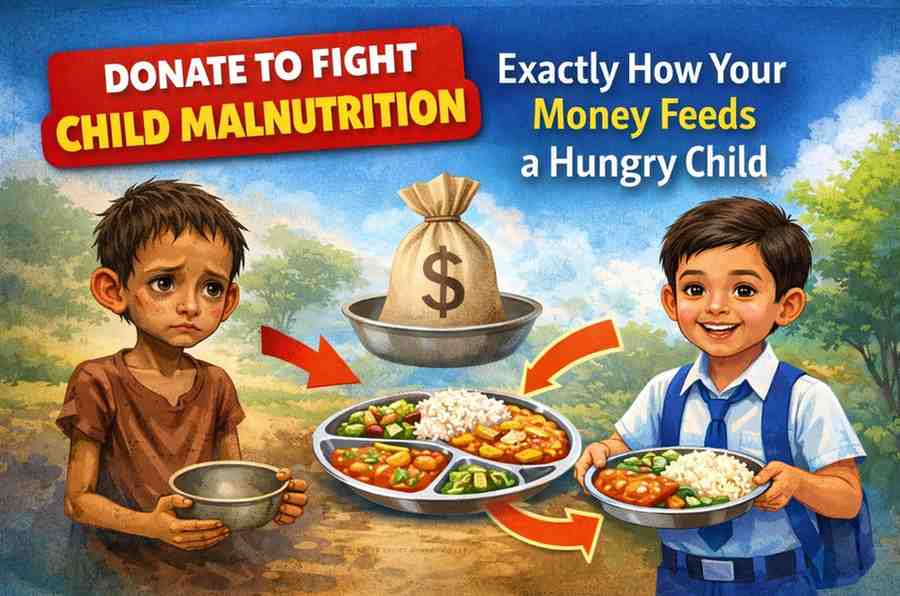
Child malnutrition is a health and nutrition issue, and a donation appeal should clearly identify the programme, receiving organisation and intended use of money. Do not assume an education campaign provides clinical nutrition treatment or that a fixed contribution guarantees a child’s recovery.
WHO’s malnutrition fact sheet distinguishes forms of malnutrition. This article is a donor-checking guide, not diagnostic or treatment advice. A child with a suspected health problem needs assessment through an appropriate healthcare professional.
For a related perspective on this topic, read Food Insecurity and Child Malnutrition: 6 Helpful Evidence Checks.
1. Confirm the actual programme and recipient
Ask for the organisation’s full name, official contact and current programme description. Is the appeal for food support, nutrition education, clinical care or another activity? These are different services. Confirm the location, period and provider before relying on a general statement that a donation “feeds a child”.
An organisation’s work in one field does not establish that it delivers every intervention discussed in its blog. Check whether an appeal is its own programme, a documented partnership or a referral to an independent provider.
2. Check qualified responsibility
Where an appeal involves screening, diagnosis, therapeutic food, supplements or treatment, ask who is clinically responsible and how assessment, referral and follow-up are arranged. A donor should not select a treatment or dosage from an internet article or direct unqualified volunteers to deliver clinical care.
Ask the provider about its process without requesting identifiable patient records. General programme evidence and a description of professional responsibility can be discussed while protecting children’s privacy.
3. Understand the budget and allocation
Request a dated explanation of costs, quantities, inclusions and the period covered. Food procurement, transport, staff, assessment and follow-up are not interchangeable items. A cost example should state assumptions and should not be described as a universal treatment price.
Check whether the contribution is restricted to the advertised programme or pooled with other activities. Confirm how unused funds or a changed programme will be handled. Do not infer an allocation guarantee from a round donation amount.
4. Separate delivery from health outcomes
Meals or supplies delivered are programme outputs. Clinical improvement and sustained recovery are different outcomes requiring suitable definitions, professional assessment and follow-up. A photo, receipt or emotional story cannot establish all of these results.
- What was delivered, where and during which period?
- How were participants and repeat visits counted?
- Which outcome was measured, by whom and with what follow-up?
- What limitations, missing records or unresolved needs affect the report?
5. Check stories and claimed returns
A genuine story should have a documented basis, appropriate permission and a clear distinction between the organisation’s role and other care. An anonymised account can protect privacy; an invented beneficiary must not be presented as a real patient.
Treat claims of precise economic returns or guaranteed recovery cautiously unless the exact study, population, intervention and limitations are given. A research estimate from another country or programme does not prove the same result for the appeal in front of you.
6. Support the campaign you actually intend
For child malnutrition support, use a verified provider whose current programme matches the need. Keep the appeal, payment acknowledgement and any material funding terms privately. Ask a specific question before donating if the programme scope is unclear.
Unessa’s education donation buttons on this page are for the education campaign described at the destination. They do not promise therapeutic food, clinical treatment or a fixed number of meals. Read the programme information and choose support on that basis.
Frequently asked questions
What should I ask before supporting a child-nutrition programme?
Identify the actual activity, intended participants, responsible team and reporting available. Ask how the programme distinguishes food support from professional assessment or treatment, and do not infer clinical capacity from a fundraising message.
Can a donation guarantee that a child’s malnutrition will be resolved?
A contribution can support the stated programme, but an individual clinical outcome should not be guaranteed. Check the campaign purpose and reporting, and leave assessment and care decisions to appropriately qualified professionals.
How do I donate to fight child malnutrition in India?
Identify an actual nutrition provider, programme, official contribution route and appropriate clinical responsibilities. Confirm purpose and reporting. Unessa’s education CTAs are not a clinical-nutrition purchase or confirmation that it provides the services in this guide.
How much does it cost to treat a malnourished child?
Actual costs depend on the condition, clinical setting, duration, provider, public support and included items. The restored ₹580–₹970,₹1,150–₹1,700,₹2,600–₹3,600 and ₹4,000–₹8,000 figures are hypothetical budget examples, not current quotes or treatment recommendations.
Which NGO is best for child malnutrition donations in India?
No independent best-provider ranking is established here. Compare the actual entity, clinical scope, reporting, methods, costs, safeguarding and relevant financial records. This blog does not certify that Unessa meets nutrition recovery, cost or evaluation benchmarks.
Is donating to child malnutrition charities tax deductible in India?
Only if the actual donation meets the applicable law, recipient category, approval, period, regime, payment and other conditions. Keep the relevant receipt and prescribed certificate where applicable. A charitable purpose or normal receipt alone does not establish deductibility.
Continue reading

Related guide

Related guide
Support children’s learning with Unessa Foundation.