
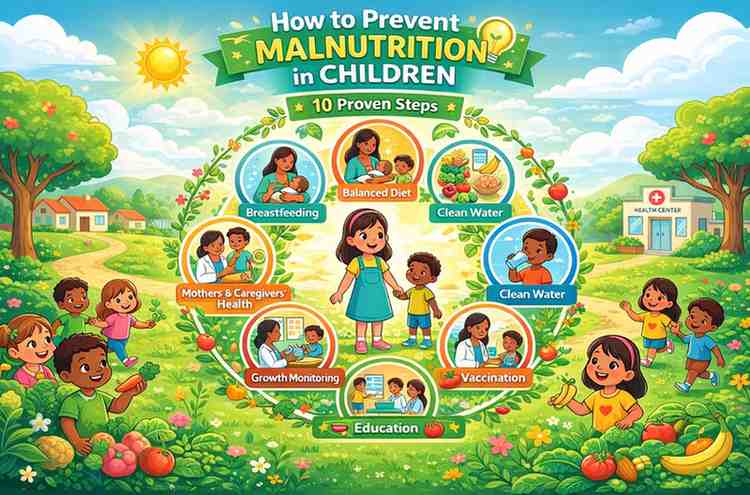

Understanding how to prevent malnutrition in children is the first step toward solving one of the most critical public health challenges, as it requires recognizing that while poverty creates the conditions for it, it is not the direct cause, and addressing it effectively demands a deeper analysis of the interconnected factors influencing children’s nutrition, health, and development—even in households that are not the poorest.
Poverty is the context in which child malnutrition thrives. But it is not the direct cause. Understanding why millions of children are malnourished — even in households that are not the poorest — requires a more rigorous analysis of the nine interconnected causes that drive undernourishment in underprivileged children.
This blog is for anyone who wants to understand, address, or fund solutions to child malnutrition with the precision those solutions require.
Quick Insight: India has 40% of the world’s stunted children despite being the world’s fifth-largest economy and a net food exporter. This statistical paradox is only possible when the causes of malnutrition extend far beyond food supply alone.
1. Why Poverty Alone Does Not Explain Child Malnutrition
If poverty caused malnutrition directly, then every poor family’s children would be malnourished and every non-poor family’s children would be well-nourished. Neither is true.
In India, malnutrition rates in states with higher per capita incomes — like Gujarat — are comparable to or worse than poorer states like Odisha. Conversely, Kerala — with literacy rates and gender equity indicators more typical of middle-income countries — has malnutrition rates far below its economic peers.
The difference is not income. It is the constellation of causes that determine whether a child actually receives adequate nutrition from the food available in their environment.
2. How to Prevent Malnutrition in Children: The 9 Root Causes You Must Understand
Cause 1:
Inadequate Dietary Intake
The most direct cause: insufficient food, insufficient variety, or insufficient quality of food reaching the child. In low-income households, diets are typically calorie-adequate but nutrient-poor — high in refined carbohydrates (rice, flour) and low in protein, vegetables, and dairy. A child can consume enough calories to avoid hunger and still be severely deficient in iron, zinc, vitamin A, and B12.
Cause 2:
Diarrhoea and Recurrent Illness
Diarrhoeal disease — still one of the leading killers of children under 5 — causes malnutrition through two mechanisms: it prevents nutrient absorption, and it increases nutritional demands as the body fights infection. A child who experiences 6+ episodes of diarrhoea per year can be in a state of near-permanent negative nutrient balance even if their diet is adequate. Diarrhoea and malnutrition are a self-reinforcing cycle.
Cause 3:
Poor Feeding Practices
Globally, fewer than 44% of infants are exclusively breastfed for the recommended first 6 months. In many low-income communities, early introduction of nutritionally poor complementary foods — dilute rice water, plain dal — displaces breast milk before the infant’s gut is ready to absorb alternatives. Poor complementary feeding between 6–24 months is the leading proximate cause of stunting.
Cause 4:
Lack of Access to Safe Water and Sanitation (WASH)
Open defecation contaminates water sources, food preparation surfaces, and children’s hands. Children in households or communities without sanitation facilities are exposed to a continuous cycle of gut infection — even when their diet is nutritionally adequate. Environmental enteropathy — a subclinical, chronic gut inflammation caused by repeated faecal-oral contamination — directly impairs nutrient absorption and is now recognised as a primary cause of stunting independent of dietary intake.
Cause 5:
Maternal Malnutrition
A malnourished mother produces a malnourished child. Maternal stunting, anaemia, and micronutrient deficiency during pregnancy and lactation directly determine birth weight, breast milk quality, and infant growth trajectories. Over 50% of Indian women of reproductive age are anaemic. Addressing child malnutrition without addressing maternal nutrition is treating a symptom, not a cause.
Cause 6:
Gender Discrimination
In many parts of India and South Asia, girls receive smaller food portions, are fed after male household members, and are withdrawn from nutrition programmes during periods of resource scarcity. In some communities, the protein-rich portions of family meals are reserved for adult men as a cultural norm. Girls’ malnutrition rates in these contexts exceed boys’ — not because of any biological difference, but because of deliberate, culturally normalised discrimination in food distribution.
Cause 7:
Inadequate Healthcare Access
Vaccinations, deworming, vitamin A supplementation, and iron-folic acid supplementation are all proven, low-cost interventions that protect against malnutrition and its co-conditions. Children in communities without functional primary health centres — a reality for hundreds of millions of rural and urban poor — do not receive these interventions. Each missed vaccination, each untreated worm load, each vitamin A deficiency compounds nutritional risk.
Cause 8:
Food Systems and Market Failure
Even when families have purchasing power, nutritious food may not be available or affordable locally. In remote rural areas and urban slums, markets are dominated by ultra-processed, nutritionally poor foods — biscuits, packaged noodles, sugary drinks — while fresh vegetables, dairy, and protein sources are either unavailable or priced beyond reach. Market failure at the local level causes malnutrition even in households with moderate income.
Cause 9:
Conflict, Climate, and Displacement
Natural disasters, displacement, and climate-related crop failures are increasingly significant drivers of child malnutrition. The 2022 floods in Pakistan made 14 million children acutely food insecure overnight. In India, climate-driven agricultural failure in rain-dependent farming communities creates seasonal spikes in malnutrition that official nutrition surveys — conducted at fixed annual intervals — systematically undercount.
Reflective Question: If you were designing a programme to address causes of malnutrition in children in a specific community, which of these 9 causes would you need to assess before deciding what to fund? Which causes are most prevalent in the communities you work with or care about?
3. How These Causes Interact — The UNICEF Malnutrition Framework
The UNICEF conceptual framework for malnutrition identifies three levels of causation:
Immediate Causes
- Inadequate dietary intake
- Disease and infection
Underlying Causes
- Household food insecurity
- Inadequate care and feeding practices
- Insufficient access to health services and safe water
Basic Causes
- Political, economic, and cultural systems that determine resource distribution
- Gender inequality
- Governance failures in service delivery
Programmes that address only immediate causes — providing therapeutic food — save lives in the short term but do not reduce malnutrition rates over time. Durable reduction requires addressing underlying and basic causes simultaneously.
4. Which Causes Are Most Prevalent in India
India’s malnutrition crisis is primarily driven by:
- Poor complementary feeding practices (Cause 3) — only 11% of Indian children 6–23 months receive a minimally adequate diet (NFHS-5)
- Open defecation and WASH gaps (Cause 4) — despite the Swachh Bharat Mission, open defecation continues in many rural areas
- Maternal anaemia (Cause 5) — at over 50%, India’s maternal anaemia rate is among the highest globally
- Gender discrimination in food distribution (Cause 6) — particularly in northern and central states
- Healthcare access gaps (Cause 7) — 40% of India’s population lives more than 5 km from a functional primary health centre
5. A Case Study: A Well-Fed Child Who Was Severely Malnourished
Background
Meena, 18 months, from a middle-income farming family in Uttar Pradesh, was not food insecure. Her family grew rice and vegetables and kept a buffalo. Her weight-for-age placed her as moderately malnourished — surprising to her parents, who believed she ate well.
Challenge
A nutritional assessment revealed that Meena’s diet was high in rice and low in protein and micronutrients. She had experienced 8 episodes of diarrhoea in the previous year. The family practised open defecation, and Meena’s play area was adjacent to the defecation field. Her haemoglobin was 8.2 g/dL — significantly anaemic.
Actions Taken
Intervention addressed all three levels: dietary counselling to introduce eggs, green leafy vegetables, and fortified foods; iron and zinc supplementation; construction of a household toilet under Swachh Bharat Yojana; and deworming for the entire household. The mother received iron-folic acid supplementation, having recently delivered Meena’s sibling.
Outcome
Six months later, Meena’s haemoglobin had risen to 10.4 g/dL. She had experienced zero diarrhoeal episodes since the household toilet was constructed. Her weight-for-age had moved from moderate to mild malnutrition range — on a recovery trajectory.
Lesson
Meena’s malnutrition had nothing to do with poverty or food shortage. It was caused by Causes 3, 4, 5, and 7 — feeding practice, WASH, maternal nutrition, and healthcare gaps. Addressing only food supply would have made no difference.
6. What Addressing Root Causes Looks Like in Practice
Organisations addressing the causes of malnutrition in children at root level design multi-pronged interventions:
- Nutrition education for mothers — not just what to feed, but how to prepare affordable, micronutrient-rich meals
- WASH programming alongside nutrition — toilet construction, handwashing promotion, water treatment
- Micronutrient supplementation and deworming through community health workers
- Maternal nutrition programmes beginning in the first trimester
- Gender-sensitisation programmes challenging discriminatory food distribution norms
- Coordination with healthcare facilities for vaccination and therapeutic referrals
Unessa Foundation integrates all of these components in its community nutrition programme — because addressing any single cause in isolation produces temporary improvement, not lasting change.
7. FAQ — People Also Ask
What are the main causes of malnutrition in children?
The nine main causes are inadequate dietary intake, diarrhoea and illness, poor feeding practices, lack of WASH, maternal malnutrition, gender discrimination, inadequate healthcare, food market failure, and conflict or climate disruption. Most malnourished children are affected by multiple causes simultaneously.
Why is India's child malnutrition rate so high despite economic growth?
Because economic growth has not uniformly improved feeding practices, maternal nutrition, WASH access, or gender equity in food distribution — the underlying causes of malnutrition that operate independently of household income.
Does poverty directly cause malnutrition?
Poverty is the context that increases vulnerability to malnutrition, but it is not a direct cause. Many poor families have well-nourished children, and many moderate-income families have malnourished children, depending on feeding practices, WASH, healthcare access, and gender norms.
How does breastfeeding affect malnutrition in children?
Exclusive breastfeeding for the first 6 months provides optimal nutrition, gut protection, and immune support. Early introduction of complementary foods, or formula, before 6 months increases malnutrition risk significantly.
8. Conclusion
The causes of malnutrition in children are nine interconnected factors operating across immediate, underlying, and basic levels. Poverty provides the context. Feeding practices, disease, WASH, maternal nutrition, gender norms, healthcare access, food markets, and climate determine the outcome.
Effective solutions require this level of diagnostic precision. Organisations — like Unessa Foundation — that understand this design programmes that address the real causes, not just the visible symptoms.
Understanding the causes is the first step. The second is funding and implementing solutions proportional to the complexity of the problem.