
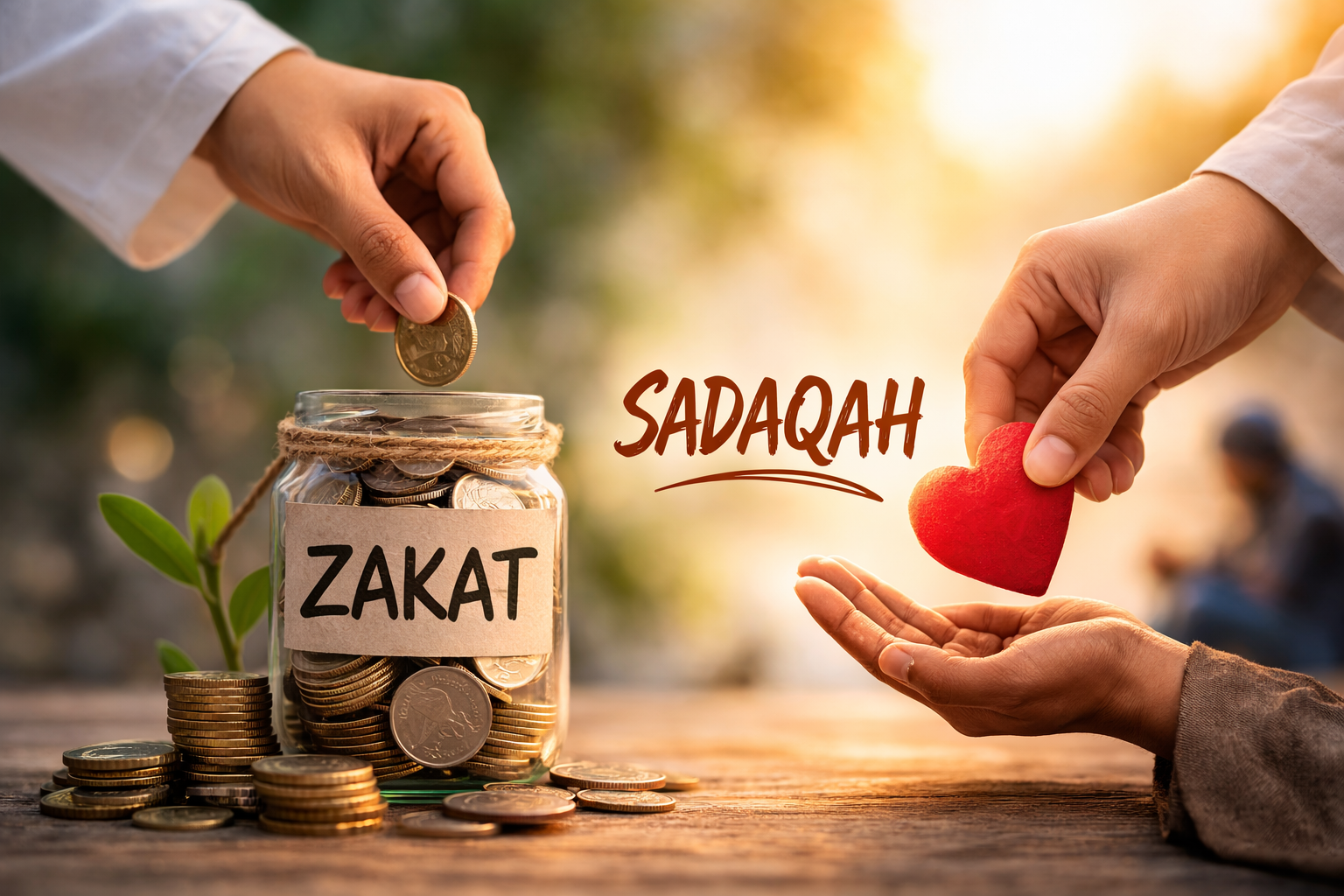

Introduction: Why Zakat vs. Sadaqah Often Confuses People
For many Muslims—especially new Muslims or those reconnecting with their faith—the terms Zakat and Sadaqah often sound interchangeable. Both involve giving. Both help people in need. Both are deeply rewarded in Islam.
Yet, Zakat and Sadaqah are not the same.
Understanding the difference between Zakat vs Sadaqah is essential—not just for religious accuracy, but for practicing generosity with clarity, confidence, and intention. One is an obligation tied directly to faith. The other is an open door to daily kindness. According to Islamic scholars and organizations like Islamic Relief, Zakat plays a key role in reducing poverty.
Understanding the Core Difference Between Zakat and Sadaqah
At its heart, the distinction is clear:
- Zakat is an obligation
- Sadaqah is a choice
Both are acts of worship. Both purify the heart. But they serve different roles within Islamic life and society.
Zakat establishes justice and responsibility.
Sadaqah nurtures mercy and generosity.
What Is Zakat in Islam?
Zakat is a mandatory act of worship for eligible Muslims. It is one of the Five Pillars of Islam, alongside:
- Shahada (faith)
- Salah (prayer)
- Sawm (fasting)
- Hajj (pilgrimage)
The word Zakat comes from an Arabic root meaning purification and growth. By giving Zakat, a Muslim purifies their wealth and allows it to grow in blessing.
Key Characteristics of Zakat
- Mandatory once wealth reaches the Nisab threshold
- Fixed rate (generally 2.5% of eligible wealth)
- Paid once every lunar year
- Distributed only to specific Quran-defined categories
Considered a right of the poor, not generosity
Zakat is not optional charity. It is a structured obligation connected to accountability, ethics, and social balance.
What Is Sadaqah?
Sadaqah is voluntary charity, given freely out of compassion, sincerity, and goodwill.
Unlike Zakat, Sadaqah has:
- No minimum amount
- No fixed time
- No restricted recipients
Sadaqah can be financial, physical, emotional, or even behavioral.
The Prophet Muhammad ﷺ taught that:
- A smile is Sadaqah
- A kind word is Sadaqah
- Removing harm from the road is Sadaqah
Key Characteristics of Sadaqah
- Voluntary, not obligatory
- Any amount, at any time
- Can be given to anyone (Muslim or non-Muslim)
- Includes non-material acts of goodness
- Encouraged daily
Sadaqah reflects generosity beyond rules—kindness without limits.
Zakat vs. Sadaqah: Side-by-Side Comparison
Aspect | Zakat | Sadaqah |
Status | Mandatory (if eligible) | Voluntary |
Amount | Fixed (usually 2.5%) | Any amount |
Timing | Once per lunar year | Anytime |
Recipients | Specific Quran-defined groups | Anyone in need |
Purpose | Purification & social justice | Kindness & compassion |
Pillar of Islam | Yes | No |
This table alone clarifies why Zakat vs Sadaqah is not about “which is better”—but about different responsibilities.
Who Must Pay Zakat and Who Is Exempt?
Zakat is required only if a Muslim:
- Owns wealth above the Nisab
- Has held that wealth for one full lunar year
If these conditions are not met:
- Zakat is not required
- The person may be eligible to receive Zakat
Sadaqah, on the other hand, is open to everyone, regardless of financial status.
When Should You Give Zakat?
Zakat becomes due when:
- Your wealth reaches the Nisab
- It remains above that threshold for one lunar year
Many Muslims prefer to give Zakat during Ramadan, but it can be paid at any time once it becomes due.
What matters most:
- Accurate calculation
- Honest intention
- Timely distribution
When Is Sadaqah Best Given?
Sadaqah has no schedule—and that is its strength.
It can be given:
- During moments of gratitude
- In times of hardship
- After receiving blessings
- In response to emergencies
- Quietly or publicly
Sadaqah fills emotional and social gaps that structured systems cannot.
Can Zakat and Sadaqah Be Given Together?
Yes—and often they should be.
A healthy approach looks like this:
- Zakat fulfills obligation and justice
Sadaqah nurtures compassion and empathy
Zakat ensures responsibility. Sadaqah expresses love.
Together, they shape a balanced believer.
Common Misunderstandings About Zakat vs. Sadaqah
“If I give a lot of Sadaqah, do I still need to pay Zakat?”
Yes. Sadaqah does not replace Zakat.
“Is Zakat only money?”
Mostly financial, but it applies to eligible forms of wealth—not personal necessities.
“Is Sadaqah only for the poor?”
No. Anyone—including family, neighbors, and even animals—can benefit from Sadaqah.
Why Islam Encourages Both Zakat and Sadaqah
Islam addresses both systemic justice and human compassion.
- Zakat prevents neglect
- Sadaqah cultivates mercy
- Zakat builds structure
- Sadaqah builds hearts
One ensures fairness.
The other ensures warmth.
A society needs both.
A Gentle Reflection
Zakat teaches responsibility.
Sadaqah teaches generosity.
Zakat reminds us wealth is a trust.
Sadaqah reminds us kindness costs nothing.
Both redefine wealth—not as ownership, but as stewardship.
If you are new to the concept, read our complete guide on What is Zakat in Islam.
Zakat vs. Sadaqah – Quick FAQs
Is Zakat compulsory for all Muslims?
No. Zakat is only compulsory if your wealth reaches the Nisab and is held for one lunar year.
Can Sadaqah replace Zakat?
No. Sadaqah is voluntary and does not replace the obligation of Zakat.
How much Zakat do I need to give?
Generally 2.5% of eligible savings and assets above the Nisab.
Can Zakat be given to family members?
Yes—except parents, grandparents, children, and spouse.
Can Sadaqah be given to non-Muslims?
Yes. Sadaqah can be given to anyone in need, regardless of faith.
Is Zakat only money?
No. Zakat applies to cash, savings, gold, investments, and business assets.
When is the best time to give Zakat?
Any time after it becomes due. Many give in Ramadan, but it’s not required.
Can I give both Zakat and Sadaqah together?
Yes—and it’s encouraged. Zakat fulfills duty, Sadaqah strengthens compassion.
Why does Islam encourage both?
Zakat builds justice and balance.
Sadaqah builds mercy and humanity.