
EDUCATION & COMMUNITY
Learning Poverty in India: 11 State Reading Comparisons
Understand the indicator, distinguish historical evidence from a current claim, and plan a suitable next reading activity without promising measured results.
Published by Unessa Foundation · Editorial update: 4 November 2026
On this page
- What Is Learning Poverty?
- Dated evidence:World Bank2022brief and ASER2024
- Causes of Learning Poverty in India: Beyond Bad Schools
- Rural vs. Urban: Learning Poverty Affects All Areas
- Two fictional learner situations
- Organizations Fighting Learning Poverty in India
- What I Did to Help (And What You Can Do Too)
- From a reading question to a useful next step
- Eleven-state comparison:ASER2024rural reading
- Beyond Education: The Broader Impact of Learning Poverty in India
- The Role of Parents and Communities in Reducing Learning Poverty
- Can Technology Help Combat Learning Poverty in India?
- Where India Stands Globally on Learning Poverty
- Learning poverty: what the indicator means
- 1. Read the actual India brief and its date
- 2. Keep different education indicators separate
- 3. Check population, task and comparison
- 4. Plan a classroom response without labelling the child
- 5. Review learning poverty claims with honest measures
- 6. Choose the next learning and support step
- Frequently asked questions
- Continue reading
Learning poverty in India concerns foundational reading. A dated national indicator and a child’s actual reading task answer different questions. This guide explains the measures, compares rural reading data across eleven states and discusses appropriate learning support without assigning a permanent label to a learner.
Fictional planning situation: Deepak, a fourth-grade learner in Bihar, is offered a GradeII-level story and is unsure how to begin. His name and situation illustrate an educator’s question; they are not a documented author visit or an Unessa case.
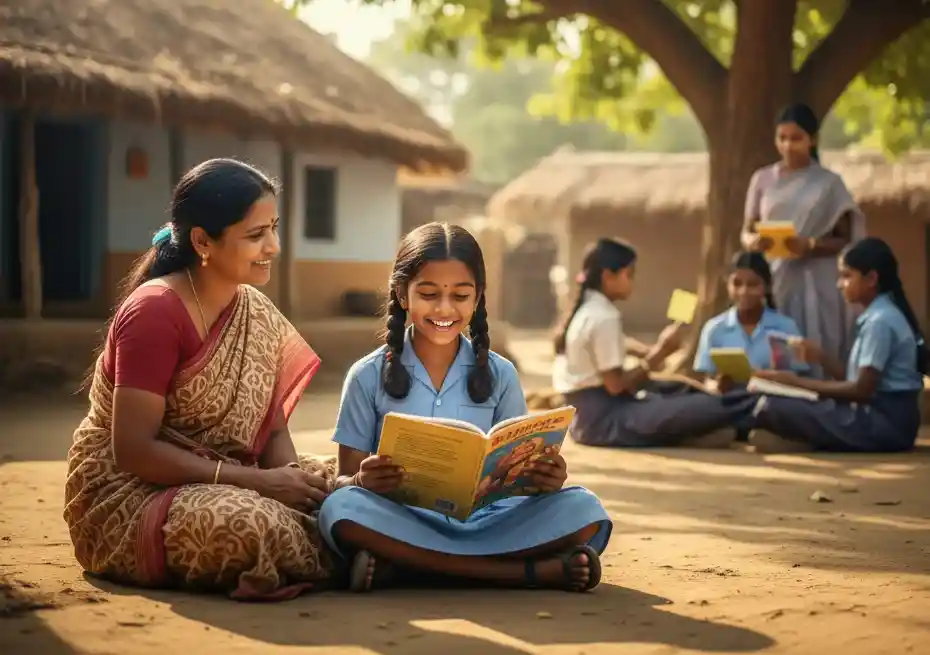
Fictional dialogue: “Didi, I don’t know how.” A supportive adult could ask what the learner finds difficult and choose an appropriate next step, rather than treating one response as a diagnosis.
A moment of uncertainty is a reason to listen, not to shame a learner or infer a fixed ability.
You do not need to be a parent or work in education to ask how school access and actual learning differ. A child can attend school and still need help with a particular reading task.
Begin by defining the indicator, then identify the evidence and practical response relevant to the actual learner or programme.
What Is Learning Poverty?
The World Bank’s methodology concerns inability to read and understand a simple text by age 10, combining reading proficiency with an out-of-school adjustment. It is different from household income poverty, a simple enrolment total or one classroom test.
Deepak’s fictional situation can illustrate a support question, but it does not calculate the World Bank indicator or establish a real person’s performance.
Difficulty reading should not be equated with laziness or intelligence. Language, teaching opportunities, access and individual support can matter. Assess the actual task and plan help with an appropriate educator.
Dated evidence:World Bank2022brief and ASER2024
Keep publication dates, underlying data and reading tasks separate. The World Bank’s India brief and ASER’s rural household assessment have different measures; they should not be merged into one updated national rate.
The World Bank India Learning Poverty Brief, June 2022 reports 56% under its indicator, using grade 5 learning data from 2017 and an out-of-school adjustment. This is historical evidence, not a measured 2025 or 2026 rate. ASER 2024 national findings report 48.8% of rural StdVchildren reading a StdII-level text for the stated school-type measure; its complement is 51.2% not demonstrating that task. That is not the World Bank indicator or proof of 100 million affected children.
For rural StdVchildren in government schools, ASER 2024 reports 44.8% reading a StdII-level text, compared with 38.5% in 2022. The combined government/private-school result and the government-school result have different denominators. A recovery in this reading measure does not establish every educational outcome improved.
Causes of Learning Poverty in India: Beyond Bad Schools
Investigate the actual learning barrier before choosing support. The following original teaching, access and continuity topics can guide that enquiry.
Questions may concern early vocabulary and decoding practice, teacher availability, comprehension rather than memorisation, disruption during school closures, digital access, tracking actual learning, and pressures affecting attendance. Do not assume every setting has a 1:60 teacher ratio,24% internet access or the same cause. Gender and household pressures require the actual learner and family’s context.
Illustrative educator reflection: ask whether the teaching approach and materials match what the learner can currently do. This is not a quotation from an identified Madhya Pradesh teacher.
Rural vs. Urban: Learning Poverty Affects All Areas
Foundational reading questions can arise in rural and urban settings. ASER 2024 covers rural households; its findings cannot be used as an urban-slum estimate.
ASER 2024’s rural StdVreading result concerns a specific text and school-type scope. The former 40–45% urban-slum estimate was not supported by a comparable source. A private-school label alone does not establish suitable teaching or a particular child’s reading ability.
To compare places, first check that year, age or grade, task, language and population match. A difference between sources is not automatically a narrowing rural–urban divide.
Two fictional learner situations
These scenarios preserve the learner-support questions while making their fictional status explicit. They are not measured programme results or published beneficiary histories.
Rani in Rajasthan: imagine an eleven-year-old who, after five years of schooling, finds a paragraph difficult. Her daily-wage-worker family and educator could discuss suitable reading practice and her ambition to teach. This is a fictional situation, not a verified Unessa phonics intervention or demonstrated improvement.
Sohail in West Bengal: a fictional learner faces disrupted schooling during the pandemic and work collecting scrap. A support enquiry could concern returning to learning and reading everyday signs. The wish,“I want to read signs so I don’t get lost,”is illustrative dialogue, not an authenticated beneficiary quotation or documented NGO reinstatement.
Listen to the learner and identify appropriate opportunities and support. A reading difficulty should not become a judgment about intelligence or future potential.

Unessa Foundation activity: children working with colourful paper during a Bengaluru group activity.
SUPPORT CHILDREN’S EDUCATION
Help learning become a regular part of a child’s life.
Support Unessa Foundation’s education programmes and volunteer-led learning activities.
Organizations Fighting Learning Poverty in India
Research the actual programme and methods of organisations such as Pratham,Room to Read in India and Unessa Foundation. Their roles differ; inclusion does not establish a partnership or identical services.
For an Unessa enquiry, begin with its published education and life-skills programme and ask which current activity fits the actual need.
Reading practice, volunteer preparation, family communication and materials such as books or flashcards can be topics to discuss with a programme. This article does not establish dedicated Unessa remedial phonics, home-visit or learning-kit schemes; confirm what is actually provided.
Use dated delivery and assessment records for any claim about reach or learning gains. No identified record establishes 5,000 Unessa learners in Bihar/Rajasthan in 2024 or a 15% local learning-poverty reduction. Use the actual programme information rather than inferring those results.
What I Did to Help (And What You Can Do Too)
You can ask about a suitable education donation, supervised volunteer role, requested materials or an approved awareness activity. Reading instruction and work with children require the actual qualifications, training and safeguarding arrangements.
Illustrative proposals:₹500 toward requested materials;one hour weekly offered for an appropriate supervised role;₹2,000 as a proposed library budget;or a remote mentoring enquiry. These are not confirmed prices,50-child reach guarantees or an Unessa language-matching service. Agree the real request, cost and availability before contributing. Share accurate resources rather than inventing a programme result.
Choose a role or contribution that fits your capacity and the actual request. Satisfaction is personal, not an outcome guaranteed by volunteering.
From a reading question to a useful next step
Menus, signs and messages illustrate everyday uses of reading. Deepak, Rani and Sohail are fictional situations for considering support, not evidence that all children experience a page with fear.
The 56% World Bank figure is the dated India indicator described above. It should not be relabelled today’s rate or applied to an individual child.
Broader questions include learning opportunities, access to work, participation and information. These need appropriate evidence rather than a single assumed economic effect.
Education and reading can relate to employment, inequality, public participation and economic development. The former 1.5% annual GDP-loss claim was not tied to identified evidence; no particular macroeconomic change follows automatically from one donation or reading activity.
Suitable materials, teaching opportunities and continuing support are distinct programme components. Discuss what is missing in the actual setting and who can responsibly help.
Eleven-state comparison:ASER2024rural reading
This table compares one consistent ASERmeasure:rural StdVchildren who can read a StdII-level text. Government, private and their weighted combined figures come from Table 6 on page 2 of each state’s ASER 2024 pages. A blank private-school estimate marked insufficient is not zero. These are reading percentages, not state World Bank learning-poverty rates; higher values mean more children demonstrated this task.
| State / official source | Government schools | Private schools | Government + private weighted |
|---|---|---|---|
| Bihar | 41.2% | 66.2% | 43.8% |
| Uttar Pradesh | 50.5% | 65.6% | 56.5% |
| Madhya Pradesh | 37.5% | 58.1% | 43.7% |
| Rajasthan | 37.7% | 63.5% | 47.5% |
| Jharkhand | 40.3% | 68.2% | 45.3% |
| Chhattisgarh | 52.3% | 65.8% | 54.3% |
| Odisha | 57.2% | 82.3% | 59.4% |
| West Bengal | 53.9% | Not published: insufficient sample | 54.6% |
| Maharashtra | 57.9% | 61.8% | 59.6% |
| Tamil Nadu | 37.0% | 32.3% | 35.6% |
| Kerala | 58.2% | 71.7% | 65.8% |
The state figures describe performance on this task within the stated rural sample and school-type measure. Differences do not by themselves prove one policy caused a result; review local teaching, access and programme evidence before drawing conclusions.
Beyond Education: The Broader Impact of Learning Poverty in India
A learner’s reading needs may affect access to curriculum and everyday information. The former 20% dropout-risk claim was not supported by an identified study, and an individual’s future should not be inferred from one reading result.
Economic questions require a defined model, population and period. This guide does not establish an annual 1.5% GDP effect from the learning-poverty indicator.
Agency and participation also matter:provide information in accessible ways rather than assuming that reading ability determines a person’s rights or judgment.
A person who does not read fluently can still make informed choices, hold rights and participate in community decisions. Legal access, civic information and language support should be considered in their actual setting rather than treating literacy as a prerequisite for dignity or citizenship.
Foundational learning is relevant to society while individual experiences and support needs differ.
The Role of Parents and Communities in Reducing Learning Poverty
Fictional family example: a mother in Bihar who does not read the story herself listens while her daughter reads and discusses it. This is an illustration of participation, not an observed author visit or an Unessa case.
Families and community members can discuss practical ways to make learning opportunities available.
Listening, asking about a story and showing interest are possible activities even when a caregiver has limited formal schooling. A reading circle can include grandparents and other agreed community members with suitable supervision. The former 60% parent-literacy claim and dedicated Unessa parent-training programme were unverified; no learning effect is assumed from the activity alone.
Include learners and caregivers in decisions about appropriate support without blaming a family’s schooling history for a child’s difficulties.
Can Technology Help Combat Learning Poverty in India?
Digital and offline resources have different requirements. During disruption or a routine session, consider device, language, connectivity, access and educator support rather than assuming an app fits every learner.
Books, flashcards and audio stories can be discussed alongside an appropriate digital tool. Google’s Read Along describes pronunciation support and a mobile app designed for low-bandwidth/offline use;check current device, language, account and privacy conditions. A proposed ₹5,000 tablet budget is illustrative, not an Unessa price or proof that one device reaches 30 children. The old 24% rural-home internet claim was not a dated measure for this proposal.
Technology is a tool to evaluate with the responsible educator. It does not replace understanding the learner’s task or establish a measured programme effect.
Where India Stands Globally on Learning Poverty
For a global comparison, obtain each country or region’s actual brief and underlying assessment year rather than mixing national figures and rural classroom tasks.
India, Nigeria, Vietnam and Sub-Saharan Africa can be compared only when the indicator, age, assessment, reference year and limitations are understood. The former 48/70/20 comparison mixed unsupported values and is not presented as a comparable ranking.
Teacher preparation, early reading and appropriate support are topics to investigate within each system. NEP 2020 sets an Indian policy context;it is not proof that one country’s results transfer automatically or that NGOs alone bridge every learning gap.
Learning poverty: what the indicator means
Learning poverty concerns the ability to read and understand a simple text by age 10. The World Bank’s definition and methodology combine a reading-proficiency measure with an adjustment for children out of school. It is not the same as household income poverty, enrolment alone or a diagnosis of an individual child.
Use the indicator to ask a precise question about foundational reading. A national estimate does not tell a teacher which task a particular learner can do today. This guide explains six evidence checks and a practical response; it does not claim a new Unessa study or a verified programme effect.
For the wider planning questions behind education support, read education support for underprivileged children.
1. Read the actual India brief and its date
The World Bank’s India Learning Poverty Brief, June 2022 reports 56% under its indicator. It refers to grade-5 learning data from 2017 and includes methodological limitations. This is a historical brief; the figure must not be relabelled a measured 2026 rate.
Before repeating a number, record both publication date and underlying measurement year. Check whether a newer comparable estimate exists through the original source. Do not update a headline’s year while leaving the evidence period unexplained.
2. Keep different education indicators separate
Learning poverty, school attendance, enrolment, completion and performance on a classroom activity answer different questions. A rise in one measure does not automatically establish improvement in every other measure. Describe the actual indicator rather than using “education crisis” as a substitute for a definition.
For administrative school information, consult UDISE+ and the relevant official report. Use its stated reference period and scope. A different source may be useful without being directly comparable to the World Bank indicator.
3. Check population, task and comparison
Ask which age or grade, geography, language and reading task the evidence covers. A rural survey, a national administrative system and a classroom observation may involve different populations and methods. Do not combine them into a single trend without checking comparability.
Record the denominator and any limitations. If a figure excludes some learners, explain the scope rather than implying it describes every child. Differences between data sources can be a reason to investigate, not a reason to choose whichever number sounds most dramatic.
4. Plan a classroom response without labelling the child
For a practical reading session, ask the responsible educator to choose a suitable text and a way to check understanding. Consider language, access, familiarity with the task and any support needed. A learner’s performance on one occasion should not become a permanent public label.
Suggested planning record: the intended reading task, assistance provided, an observation and the next teaching step. This is an adaptable educator tool, not the official learning-poverty calculation or a validated diagnostic test. Keep identifying details private.
5. Review learning poverty claims with honest measures
A programme can count sessions or materials delivered, but these are inputs and activities. A claim about reading improvement needs an appropriate starting point, later task, participant definition, period and method. Attendance or satisfaction should not silently replace a learning outcome.
If reporting an illustrative activity, label it hypothetical. Do not invent a beneficiary, percentage gain or university partnership. A small honest observation is more useful than a claim that one session solved a national indicator.
6. Choose the next learning and support step
Agree who will provide the next activity and how feedback will be shared with the learner and family. Keep the request manageable and accessible. Read the practical life-skills guide for complementary activity ideas; those suggestions are not proof of a reading intervention’s effect.
The education donation buttons support the campaign described at their destination. They do not guarantee a particular reading result or change in learning poverty. Check the current programme purpose and ask the official team for evidence relevant to any specific impact claim.
Frequently asked questions
Is learning poverty the same as being out of school?
No. Learning poverty concerns an indicator of reading proficiency at a defined age and includes particular measurement assumptions. Attendance and enrolment are different measures. Read the original brief, date and population before comparing figures.
Can a learning-poverty statistic describe an individual child’s ability?
A population indicator should not become a label or diagnosis for a learner. Identify the actual reading task, language and support needed, and review learning through an appropriate classroom process rather than inferring ability from a national percentage.
Continue reading

Related guide

Related guide
Support children’s learning with Unessa Foundation.