

EDUCATION & COMMUNITY
Best After-School Programs for Poor Students in: What Works and Why
An after-school programme should fit children's learning needs and the practical realities of attending. Compare activities, supervision, accessibility and continuity rather than relying on a programme label alone.
Published by Unessa Foundation · Editorial update: 4 November 2026
On this page
- Why After-School Hours Are the Most Critical for Underprivileged Students
- What Makes an After-School Program Effective for Poor Students
- How to Start, Fund, and Scale an After-School Program
- Innovative Models of After-School Programs
- Measuring Impact: How to Know If an After-School Program Works
- 5 practical checks for after-school programs for poor students
- Evidence and support: keep the scope clear
- Conclusion & Call to Action
- Sources and further reading
- Frequently asked questions
- Continue reading
Ask about the timetable, travel arrangements, teaching approach and responsible adults. Check how the programme communicates with families and schools, and whether a learner can participate without extra equipment or unaffordable charges.
For the wider planning questions behind education support, read education support for underprivileged children.
Why After-School Hours Are the Most Critical for Underprivileged Students
For children from affluent families, after-school hours often involve quiet study time, extracurricular activities, and parental support. For underprivileged children, the situation is vastly different. Household chores, sibling care, or even paid labor frequently replace study time, and many children lack a quiet space, access to electricity, or guidance on difficult subjects like mathematics and science.
After-school programs for poor students help bridge this gap by providing a safe and structured environment. These after-school programs for poor students offer homework assistance, remedial instruction, and enrichment activities that reinforce learning and build essential skills. By attending after-school programs for poor students, children gain consistent academic support and a chance to thrive despite challenging home environments.
The Three-Hour Window That Changes Academic Outcomes
The period between 4 PM and 7 PM is crucial. Children are still mentally alert, and lessons from the school day are fresh in their minds. A well-structured after-school program that utilizes this window can have disproportionate academic impact relative to its cost.
Case Study:
Fictional Bhopal planning example: a two-hour session, four days a week, serves an illustrative group of 60 learners aged 8–14. The baseline scenario sets 70% below a defined reading/mathematics benchmark, with proposed later values of 64% at benchmark in mathematics and 58% in reading. These are hypothetical planning values, not actual Unessa or NGO results; define the assessment and time point before comparing them.
Actions Taken: The after-school program for poor students used structured tutoring, peer learning, and activity-based reinforcement. Facilitators were trained community educators receiving a small stipend.
Lesson: Even a modest after-school program for poor students—two hours per session, four days a week—can produce significant gains when structured, well-facilitated, and tailored to student needs.
Pro Tips:
- Assess students by learning level, not grade, for more targeted support.
- Include brief recreational or creative activities in every session to keep children energized and motivated.
👉 Click here to know about The Community Strategies to Boost Underprivileged Education: 7 Approaches That Deliver Results
What Makes an After-School Program Effective for Poor Students
Five programme features to assess are consistent facilitators, an appropriate curriculum, homework/remedial support, safety and relevant nutrition, and family engagement. Their presence is a planning consideration, not proof that this is the universally most effective programme.
- Trained, Consistent Facilitators: Children need reliable adults who understand pedagogy and child psychology.
- Curriculum Alignment: The after-school programs for poor students should reinforce the school-day syllabus for maximum impact.
- Structured Homework Support & Remedial Instruction: Targeted assistance ensures learning gaps are addressed promptly.
- Safety & Nutrition Support: A simple snack and safe learning space can significantly boost engagement.
- Parental Engagement: Consistent communication keeps parents informed and children accountable.
Ineffective programs often suffer from high facilitator turnover, unclear objectives, and no outcome measurement. Children may attend but learn very little—a hidden cost that undermines the purpose of after school support for poor children.
The Role of Enrichment Activities in After-School Programs
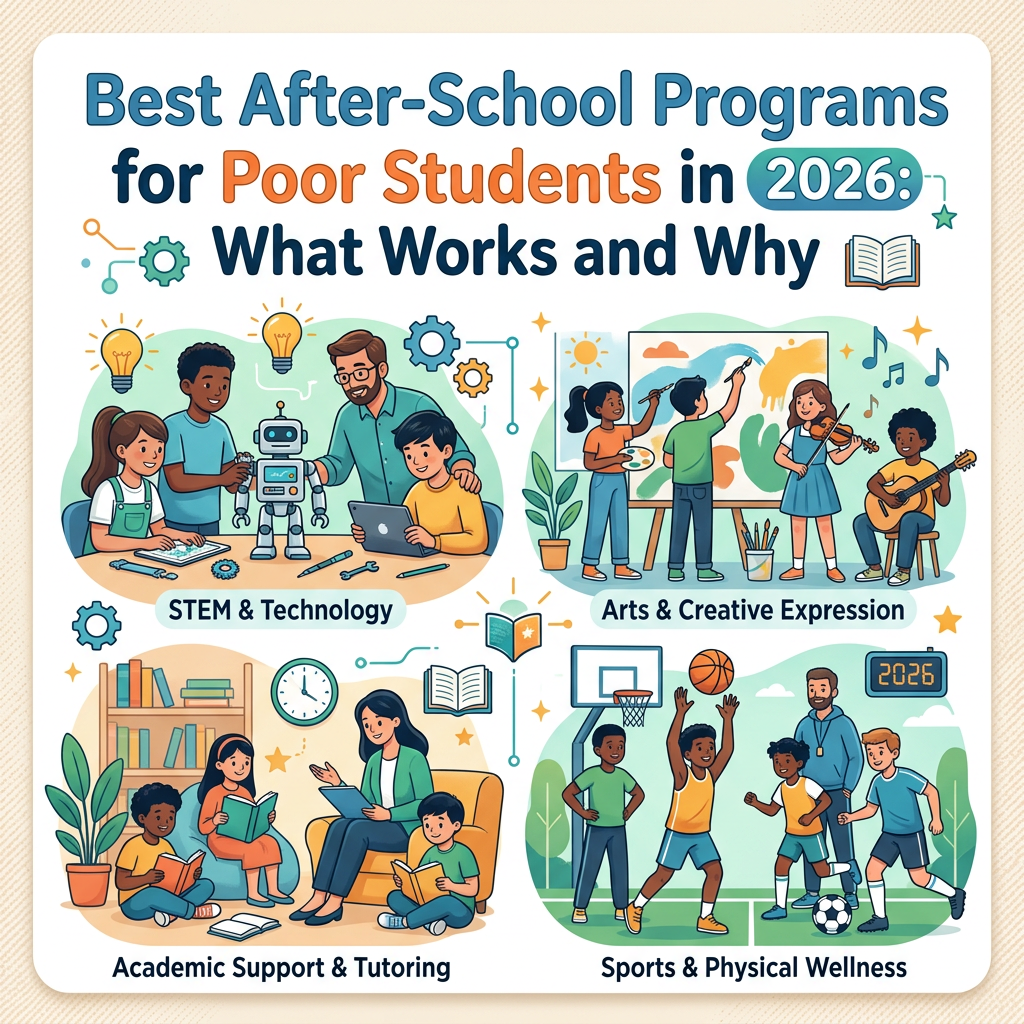
Enrichment activities—art, music, sports, coding, drama, and debate—are not optional in after-school programs for poor students. These after-school programs for poor students use enrichment to develop creativity, confidence, communication skills, and a sense of identity that academic instruction alone cannot build. By integrating such activities, after-school programs for poor students keep children engaged, motivated, and excited to learn, making academic support more effective.
Case Study:
- Background: An after-school program in Delhi added weekly theatre sessions to its standard tutoring schedule.
- Lesson: Enrichment activities act as a motivational engine, encouraging children to engage with academics.
Fictional Delhi enrichment example: tutoring-only attendance is set at 67%, with proposed theatre attendance of 91% and tutoring attendance of 84% during the same week. These figures illustrate a monitoring plan; they do not establish that theatre caused an increase.
Pro Tips:
- Survey children to design enrichment activities around their interests.
- Showcase student achievements through art exhibitions, plays, or coding demos to engage parents and the community.

Unessa Foundation activity: a volunteer and children working with paper learning materials in Vadodara.
SUPPORT CHILDREN’S EDUCATION
Help learning become a regular part of a child’s life.
Support Unessa Foundation’s education programmes and volunteer-led learning activities.
How to Start, Fund, and Scale an After-School Program
Starting an after-school program requires planning, resources, and community engagement:
Safe, Accessible Space
A critical component of after-school programs for poor students is a safe and accessible learning environment. This can include community halls, school classrooms after hours, or NGO offices. The space should be well-lit, ventilated, and free from hazards, allowing children to focus on learning without distractions or safety concerns. Accessibility is equally important—children should be able to reach the location easily, whether by walking, public transport, or safe community routes.
Trained Facilitator
The success of after-school programs for poor students relies heavily on qualified facilitators. College students, retired teachers, or trained community educators can provide consistent guidance and mentorship. Facilitators must understand child psychology, pedagogical methods, and strategies for engaging students who may have missed key concepts during the school day. A dedicated facilitator ensures that learning is structured, supportive, and enjoyable.
Materials
Effective after-school programs for poor students require basic but essential materials. Notebooks, pens, whiteboards, and markers enable hands-on learning, interactive sessions, and visual reinforcement of lessons. Having these resources readily available ensures that children can actively participate and complete homework or remedial exercises without interruption.
Curriculum Alignment
To maximize impact, after-school programs for poor students should align closely with the school syllabus. This ensures that the support provided complements classroom instruction rather than duplicating or conflicting with it. Facilitators can identify gaps in understanding, provide remedial teaching, and reinforce concepts learned during the school day, helping students stay on track academically.
Monitoring System
A robust monitoring system is essential for any after-school program for poor students. Tracking attendance, learning outcomes, and behavior allows program managers to identify struggling students, measure progress, and adjust teaching strategies as needed. Data-driven monitoring ensures that resources are used effectively, programs remain accountable, and children achieve measurable academic gains.
Illustrative budget only: the earlier ₹15,000–25,000 monthly range for 30 children is a starting scenario, not a current quote or established cost-effectiveness result. Price facilitators, sessions, premises, materials, supervision, access and snacks locally before setting a budget.
Funding Sources for After-School Programs for Poor Students
Sustainable funding is critical to running effective after-school programs for poor students. Several sources can be leveraged to ensure consistent operations and program quality:
- Local CSR Grants
Corporate Social Responsibility (CSR) initiatives often provide grants to educational programs that support underprivileged children. Partnering with local businesses allows after-school programs for poor students to access financial support, volunteers, and in-kind resources like books, computers, or sports equipment. - Individual Donors
Contributions from individual supporters can provide flexible funding for operational costs, scholarships, and enrichment activities. Regular donors also help create a community of supporters invested in the success of the after-school programs for poor students. - Government Schemes
Many government programs, such as Samagra Shiksha, offer funding or material support for after-school initiatives. Aligning your program with government guidelines and reporting requirements can unlock grants, teaching materials, and infrastructure support for after-school programs for poor students. - Community Contributions
Local communities often contribute through small donations, volunteer time, or shared resources. Engaging the community not only strengthens program sustainability but also fosters ownership and accountability among families whose children benefit from after-school programs for poor students.
Safety and Nutrition: The Non-Negotiables
Poor children often arrive hungry and tired. A simple snack—fruit, biscuits, or a hot beverage—improves concentration and learning outcomes. Safety is equally crucial: adult supervision, safe routes home, and child protection policies must be in place.
Case Study:
Fictional three-location comparison: A has no snack or play area; B adds a snack; C adds a snack and outdoor play space. Attendance/learning-change pairs of 58%/34%, 74%/52% and 89%/71% are invented scenario values, not an Unessa pilot. Define the second measure, baseline and comparable groups; the numbers do not prove that a snack or play area caused a gain.
- Lesson: Nutrition and safe recreational space are prerequisites for learning.
Pro Tips:
- Partner with local food providers to reduce costs.
- Conduct a safety audit before opening your program.
👉 Click here to know about Scholarships: 10 Helpful Checks for Families Applying in India
Innovative Models of After-School Programs
Community-Led Learning Hubs
Some of the most effective programs are run by the local community. Parents, youth volunteers, and retired teachers collaborate to create an environment that reflects local needs and culture. Community-led hubs ensure sustainability, reduce facilitator turnover, and strengthen family engagement.
Case Study:
Fictional Mumbai learning-hub example: 10 community volunteers consider an evening centre, using 55% and 88% as illustrative attendance values and doubled parental participation as a target. These are not actual measured results; define participation and compare equivalent periods before interpreting a change.
Pro Tip: Leverage local talent and volunteers; they understand community dynamics and can build trust faster than external facilitators.
Technology-Enabled Tutoring
Digital tools and low-cost devices are bridging gaps where trained facilitators are scarce. Tablets, smartphones, and online platforms provide interactive lessons, quizzes, and video tutorials.
Pro Tip: Use offline solutions where internet access is unreliable—preloaded educational content can be as effective as live sessions.
Measuring Impact: How to Know If an After-School Program Works
Tracking outcomes is critical to ensure that programs truly help students:
Key Metrics:
- Attendance rates and consistency
- Learning gains (reading levels, math scores)
- Student engagement in enrichment activities
- Parent feedback and satisfaction
Fictional Hyderabad review example: quarterly assessments are proposed over six months, with 48% learning-change and 36% engagement-change targets. These are hypothetical and need explicit measures and baselines; they do not prove that quarterly testing itself caused progress.
5 practical checks for after-school programs for poor students
- Identify the child’s learning and participation needs.
- Check timetable and travel arrangements.
- Ask about supervision and teaching approach.
- Confirm charges and equipment requirements.
- Review suitable progress information with the family.
Evidence and support: keep the scope clear
Attendance and satisfaction help describe the experience but do not establish learning gains. Look for a clear activity plan and appropriate progress information, and avoid assuming a result from one programme applies to every after-school setting.
The education donation buttons lead to Unessa’s education campaign. They do not fund every third-party provider, item or service mentioned here. Read the programme information and confirm any allocation or service condition important to you before giving.
Conclusion & Call to Action
The hours after school are when the education gap widens fastest—but also when it can be most effectively closed. After-school programs are not optional; they are critical components of a complete education system for underprivileged children.
Sources and further reading
Frequently asked questions
How should I compare after-school programmes?
Check the purpose, age group, timetable, accessibility, supervision and actual activities. Ask how the programme complements the learner’s needs rather than assuming the most intensive or widely advertised option is the best fit.
What should an after-school programme report about learning?
Identify the intended task and review process, while separating attendance and completed activities from measured learning. A programme description or success story does not establish the same result for every participant.
What are the most effective after-school programs for poor students?
An after-school plan may combine academic support, trained facilitators, enrichment, family communication and nutrition where needed. Choose the components around the learners and setting, and assess results rather than assuming one combination always works best.
How much does it cost to run an after-school program?
Build a local budget for facilitators, materials, snacks if offered, space, safeguarding, administration and overhead. For a group of 30 learners, confirm session frequency and obtain current quotes before setting a monthly total. Costs vary between locations and service arrangements.
Can I volunteer at an after-school program for underprivileged children?
Ask a relevant provider about current tutoring, mentoring or enrichment roles, the required commitment, screening and supervision. An enquiry is a starting point rather than a confirmed placement.
Continue reading

Related guide

Related guide
Support children’s learning with Unessa Foundation.