

Can Zakat Be Given to Family Members? Complete Islamic Guidelines Explained
One of the most frequently asked questions during Zakat season is: Can Zakat be given to family members?
It’s a practical and deeply personal concern. Many people have relatives struggling financially. You may have a brother facing debt, a widowed aunt struggling with expenses, or a married daughter going through hardship.
Naturally, you wonder:
Is it permissible? Is it valid? Is it even better?
The short answer is yes — Zakat can be given to family members, but only under specific conditions. Understanding those conditions ensures your Zakat is both valid and rewarded.
Let’s break it down clearly.
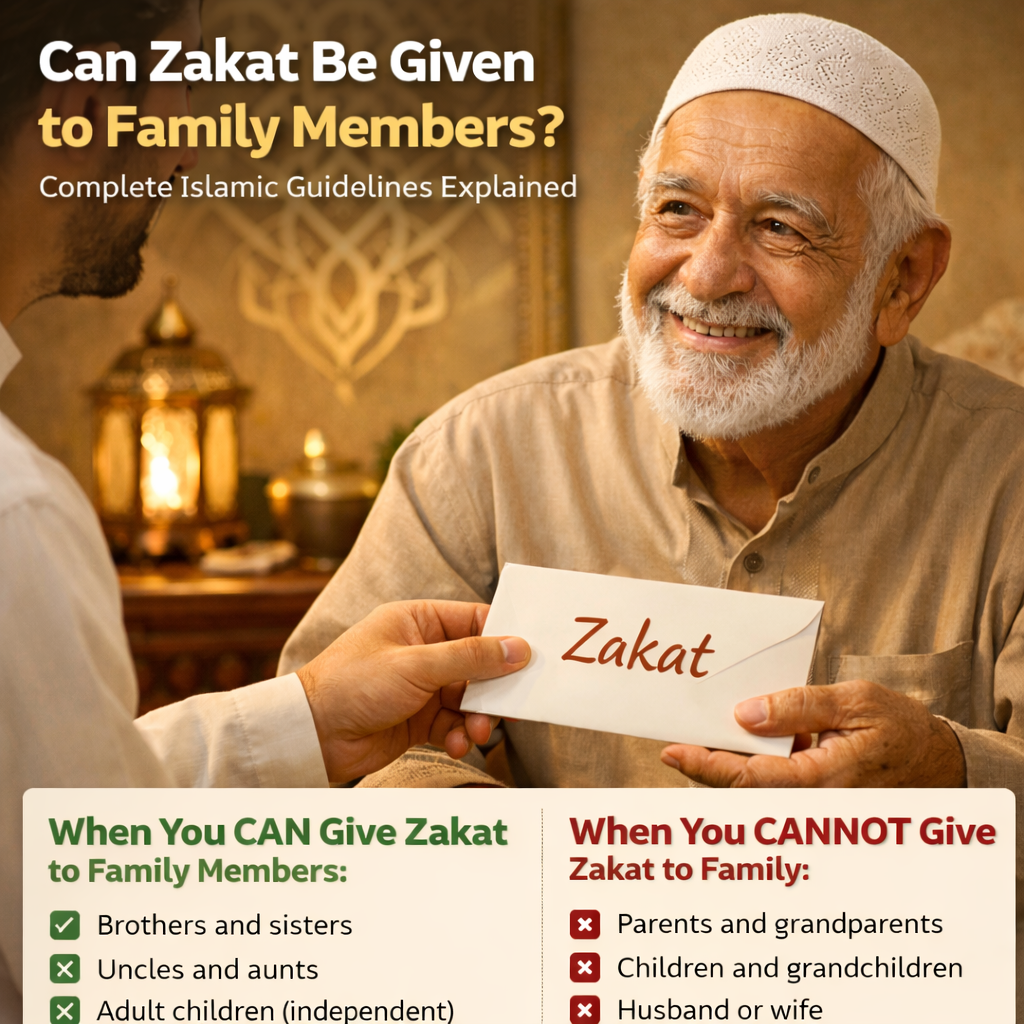
Understanding the Foundation of Zakat Distribution
Before answering “Can Zakat be given to family members?”, we must revisit the core purpose of Zakat.
Zakat is:
- A mandatory pillar of Islam
- A wealth purification system
- A mechanism for social justice
- A redistribution tool for economic balance
The Qur’an identifies eight categories of Zakat recipients (Surah At-Tawbah 9:60), including:
- The poor (Al-Fuqara)
- The needy (Al-Masakin)
- Those in debt
- Wayfarers
- And others specified categories
Eligibility is based on financial need, not family relation alone.
Can Zakat Be Given to Family Members? The General Rule
Yes — Zakat can be given to family members if they:
- Fall under one of the eight eligible categories
- Possess wealth below the Nisab threshold
- Are genuinely in financial hardship
- Are not already financially dependent on you
In fact, scholars state that giving Zakat to eligible relatives carries double reward:
- Reward for Zakat
- Reward for maintaining family ties (Silat ar-Rahm)
This makes supporting needy relatives especially virtuous.
Family Members Who Can Receive Zakat
Here’s where clarity matters most.
You can give Zakat to:
- Brothers and sisters
- Cousins
- Uncles and aunts
- Nephews and nieces
- Married daughters (if financially independent and struggling)
- Married sisters in hardship
- Relatives facing debt
For example:
If your brother loses his job and falls below Nisab, giving him Zakat is valid — and highly rewarding.
If your widowed aunt struggles to pay rent, she may qualify.
In these cases, the answer to “Can Zakat be given to family members?” is clearly yes.
Family Members Who Cannot Receive Zakat
There are important exceptions.
You cannot give Zakat to:
- Your parents or grandparents
- Your children or grandchildren
- Your spouse
Why?
Because you are already financially responsible for their support.
Zakat cannot be used to fulfill your own mandatory obligations.
For example:
If your elderly father needs support, you must provide for him regardless of Zakat. Giving him Zakat would not be valid.
Why This Distinction Exists
Islam separates:
- Financial responsibility (Nafaqah)
- Charitable obligation (Zakat)
You cannot transfer your responsibility onto Zakat.
This ensures:
- Fair distribution
- Proper accountability
- Protection of Zakat’s integrity
Understanding this principle resolves most confusion about whether Zakat can be given to family members.
Real-Life Scenario Examples
Let’s make it practical.
Scenario 1: A Struggling Brother
Your brother earns irregular income and cannot meet basic expenses. He owns no savings above Nisab.
You can give him Zakat.
In fact, scholars encourage it before giving to strangers.
Scenario 2: A Married Daughter
Your married daughter lives independently. Her husband is unemployed and facing debt.
If she falls below Nisab and is financially distressed, many scholars allow giving her Zakat because she is no longer your direct financial obligation.
Scenario 3: Elderly Mother
Your mother has no savings and depends on you.
You cannot give her Zakat because you are obligated to support her financially.
Scenario 4: Cousin in Debt
Your cousin accumulated debt due to medical expenses.
If he qualifies under the “debtor” category, giving him Zakat is valid.
Research & Social Impact Perspective
Studies in Islamic social finance show that:
- Poverty often exists within extended families
- Internal family support reduces community-level dependency
- Direct assistance to relatives reduces social fragmentation
When Muslims ask, “Can Zakat be given to family members?”, the answer is often not just legal — it’s socially beneficial.
Supporting relatives:
- Strengthens trustzz
- Reduces jealousy
- Encourages mutual support
- Promotes economic circulation within families
Conditions to Ensure Validity
If you plan on giving Zakat to relatives
ensure:
- They are below the Nisab threshold
- They are not financially dependent on you
- The Zakat is given with proper intention (Niyyah)
The transfer is complete (ownership fully transferred)
Avoid:
- Labeling regular support as Zakat without clear intention
- Mixing gifts and Zakat carelessly
Publicizing assistance in a way that harms dignity
Common Misunderstandings
Many assume:
“If they are family, they automatically qualify.”
This is incorrect.
Eligibility is determined by financial need — not blood relation.
Similarly, some believe:
“Zakat should not stay within family.”
This is also incorrect. Islam encourages helping relatives first if they qualify.
Therefore, when asking “Can Zakat be given to family members?”, always focus on eligibility.
Spiritual Dimension: Strengthening Family Bonds
Zakat isn’t just financial.
It heals relationships.
Imagine:
A struggling sibling feels supported without humiliation.
A widowed aunt regains stability.
A cousin avoids falling deeper into debt.
The Prophet ﷺ emphasized maintaining family ties. Giving Zakat to eligible relatives fulfills both charity and kinship.
That dual reward makes the question “Can Zakat be given to family members?” spiritually significant.
Industry Trends in Zakat Distribution
Modern Islamic charities report:
- Many donors prefer giving locally
- Family-first Zakat distribution reduces administrative costs
- Transparent giving strengthens trust
However, scholars caution that favoritism should not override fairness.
Balance is essential.
Practical Checklist Before Giving Zakat to Family
Ask yourself:
- Does this relative own wealth above Nisab ?
- Am I financially obligated to support them already?
- Is this genuine Zakat or routine maintenance support?
- Have I made clear Zakat intention?
If all conditions are met, proceed confidently.
Related Zakat Guides
Conclusion
So, can Zakat be given to family members?
Yes — if they are eligible and not your direct dependents.
You cannot give Zakat to parents, children, or spouse because you are responsible for their financial care.
However, giving Zakat to needy siblings, cousins, uncles, or married daughters in hardship is valid and often highly rewarding.
When done correctly, Zakat strengthens both faith and family.
It purifies wealth — and sometimes, it heals relationships.
FAQs
Can Zakat be given to family members?
Yes, if they are eligible under Zakat categories and not your direct dependents.
Can I give Zakat to my parents?
No, because you are financially responsible for supporting them.
Can I give Zakat to my married daughter?
If she is financially independent and struggling below Nisab, many scholars allow it.
Can Zakat be given to siblings?
Yes, if they are in financial hardship and meet eligibility conditions.
Is giving Zakat to relatives better?
Yes, it carries double reward: charity and maintaining family ties.