
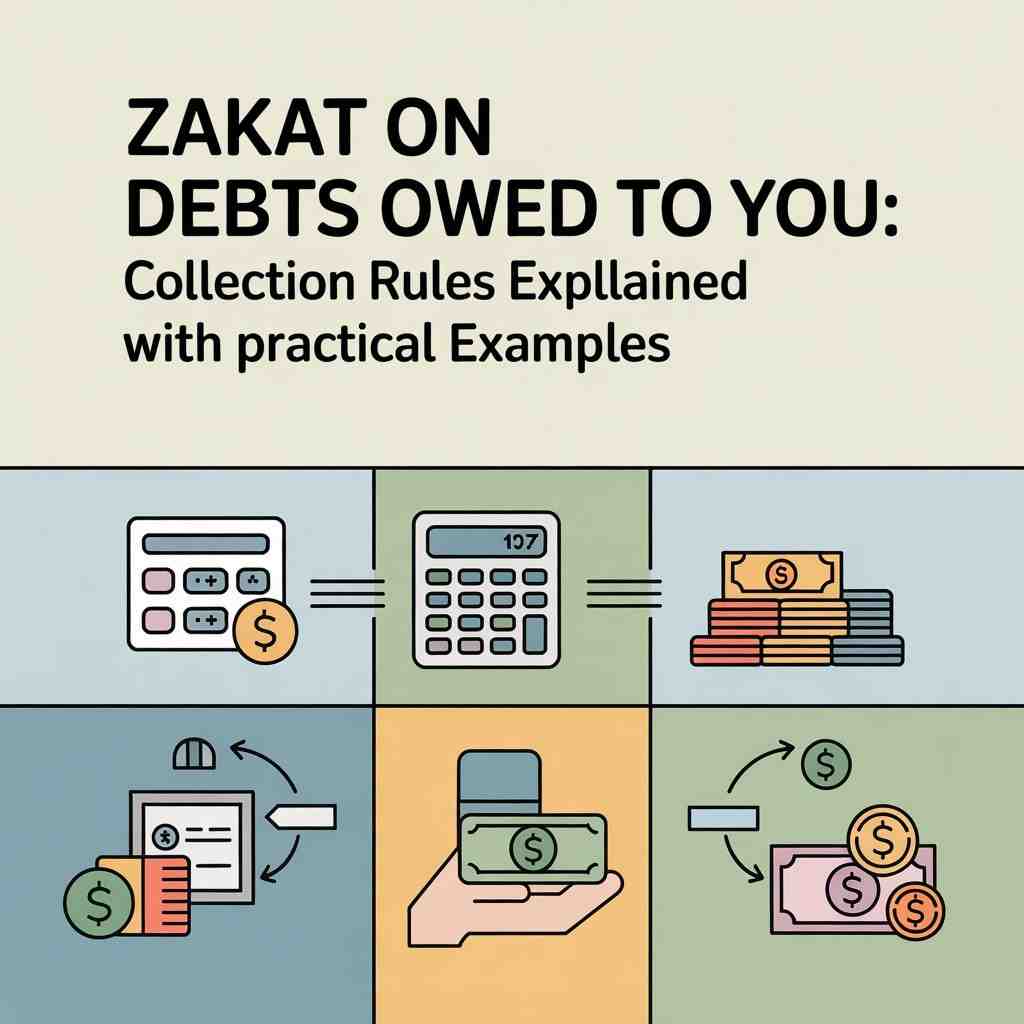

Zakat on Debts Owed to You: Collection Rules
Zakat is more than charity. It is a structured financial obligation that ensures wealth circulation and social justice. Yet one question repeatedly creates confusion:
Do you pay Zakat on money that someone owes you?
Understanding Zakat on Debts Owed to You: Collection Rules is essential for accurate Zakat calculation. Whether you have lent money to a friend, extended business credit, or are waiting for a delayed repayment, Islamic rulings differentiate between types of debts and their recovery likelihood.
This guide breaks it down clearly, with scholarly insights, real-life examples, and practical steps you can follow.
Why Understanding Zakat on Debts Matters
Globally, Zakat contributions are estimated in hundreds of billions of dollars annually. According to Islamic finance research institutions, effective Zakat systems could significantly reduce poverty in many Muslim-majority countries.
However, incorrect calculations weaken its impact.
Debts owed to you can form a significant part of your wealth. Ignoring them entirely — or miscalculating them — may lead to underpayment or overpayment.
That’s why mastering Zakat on Debts Owed to You: Collection Rules ensures:
Compliance with Islamic principles
Fair financial assessment
Peace of mind
Accurate annual Zakat calculation
Types of Debts in Zakat Calculation
Islamic scholars classify debts owed to you into categories based on repayment certainty. The ruling differs accordingly.
These are debts where:
- The borrower acknowledges the debt
- The borrower is financially capable
Repayment is expected
1. Strong Debts (Al-Dayn Al-Qawi)
These are debts where:
- The borrower acknowledges the debt
- The borrower is financially capable
Repayment is expected
Example
You lend ₹200,000 to a financially stable relative. They confirm they will repay in six months.
This qualifies as a strong debt.
Zakat Ruling on Strong Debts
According to the majority of scholars:
- You must include the amount in your Zakatable assets each lunar year.
- Zakat is due annually at 2.5%.
However, some scholars allow delaying payment until the debt is actually received. Once received, you pay accumulated Zakat for previous years.
Practical Calculation Example
If ₹200,000 remains unpaid for 2 years:
- Zakat per year = ₹5,000
- Total for 2 years = ₹10,000
You either:
- Pay yearly during those 2 years, OR
Pay ₹10,000 once repayment is received (depending on scholarly opinion you follow).
2. Weak Debts (Al-Dayn Al-Da’if)
These include debts where:
- The debtor is financially struggling
- The debtor denies the debt
- Legal disputes exist
Repayment is uncertain
Example
You lent ₹100,000 to a friend who lost their job and cannot repay.
Zakat Ruling on Weak Debts
For weak debts:
- No annual Zakat is required while repayment is uncertain.
- Once recovered, Zakat is paid for one year only (according to many scholars).
This ruling prevents financial hardship on the creditor.
Scholarly Opinions on Zakat on Debts Owed to You: Collection Rules
Islamic jurisprudence schools have slightly different views.
Hanafi Opinion
- Strong debts: Zakat is obligatory annually.
- Weak debts: Pay only after receiving.
Shafi’i & Hanbali Opinions
Similar classification but emphasize likelihood of recovery.
Click here to know more on scholarly opinions on zakat
Maliki Opinion
Zakat is due once debt is recovered. Despite differences,
the central principle remains:
Business Debts vs Personal Loans
Many people today operate businesses or offer goods on credit.
Trade Receivables
If you sell products on credit and expect payment, these are considered strong debts. Include them in your Zakatable assets.
Long-Term Installments
If repayment stretches across years, evaluate:
- Is payment regular?
- Is default likely?
- Is legal enforcement possible?
If repayment is structured and reliable, include annually.
How to Calculate Zakat on Debts Step-by-Step
Follow this structured approach:
Step 1: List All Outstanding Debts
Separate:
- Personal loans given
- Business receivable
Informal lending
Step 2: Categorize Them
Label each as:
- Strong
- Weak
- Doubtful
Step 3: Add Strong Debts to Assets
Include in:
- Cash
- Gold & silver
- Investments
- Inventory
Step 4: Apply 2.5%
Calculate total Zakatable wealth and apply 2.5%.
Step 5: Review Annually
Conditions change. A weak debt may become strong — or vice versa.
Common Mistakes in Zakat on Debts Owed to You
Many Muslims unknowingly make these errors:
Repayment certainty determines Zakat obligation.
Zakat is due once debt is recovered.
Despite differences,
the central principle remains:
Ignoring all debts entirely
Paying Zakat on debts unlikely to be recovered
Double counting business inventory and receivables
Forgetting multi-year accumulated Zakat
A structured yearly review solves most of these issues.
Modern Financial Context
Today, debts often include:
- Digital transfers
- Bank loans
- Corporate receivables
- Installment payments
Informal family lending
With digital banking and financial apps, tracking debts is easier than ever. Use spreadsheets or financial apps to:
- Record repayment dates
- Track repayment status
- Maintain Zakat calculation accuracy
Economic Wisdom Behind These Rules
Islamic finance emphasizes fairness.
Requiring Zakat on uncertain wealth would:
- Create hardship
- Discourage lending
- Complicate business transactions
At the same time, excluding strong debts entirely would:
- Understate actual wealth
- Reduce Zakat collection
Limit community support
Zakat on Debts Owed to You: Collection Rules strike a balance between justice and practicality.
Actionable Tips for Accurate Zakat Management
- Maintain written loan agreements
- Set reminders for lunar year review
- Consult scholars for complex business structures
- Keep digital records
- Separate personal and business accounts
If unsure, always lean toward clarity and documentation.
Final Thoughts
Money owed to you represents potential wealth — but Islamic law wisely differentiates between what you control and what remains uncertain.
By understanding Zakat on Debts Owed to You: Collection Rules, you ensure:
- Accurate Zakat calculation
- Fair wealth assessment
- Compliance with Islamic obligations
- Financial clarity year after year
When in doubt, review your records, assess repayment certainty, and consult a knowledgeable scholar. Zakat is not meant to burden you — it is meant to purify wealth while strengthening the community.
Short FAQs
1. Do I pay Zakat on money someone owes me?
Yes, if it is likely to be repaid (strong debt). Otherwise, wait until recovery.
2. What if the debt is unpaid for several years?
For strong debts, pay accumulated Zakat. For weak debts, pay one year upon recovery (according to many scholars).
3. Is Zakat required on informal family loans?
Yes, if repayment is expected and acknowledged.
4. Do I include business credit sales in Zakat?
Yes, if payment is reasonably certain.
5. What if I never recover the debt?
If completely unrecoverable, no Zakat is due.