
HEALTH & COMMUNITY
Cancer Screening and Early Detection: 6 Helpful Questions
Cancer Screening and Early Detection: six practical questions on reliable sources, personal context, professional assessment and follow-up, without guaranteed health outcomes.
Published by Unessa Foundation · Editorial update: 1 November 2026
On this page
- Cancer Screening and Early Detection: start with the right question
- 1. Ask whether screening applies to you
- 2. Understand the trade-offs
- 3. Plan for an abnormal result
- 4. Use a question record for cancer screening and early detection
- 5. Check the source and the claimed result
- 6. Confirm support and follow-up
- Supporting education with a clear purpose
- Continue reading
Cancer Screening and Early Detection: start with the right question
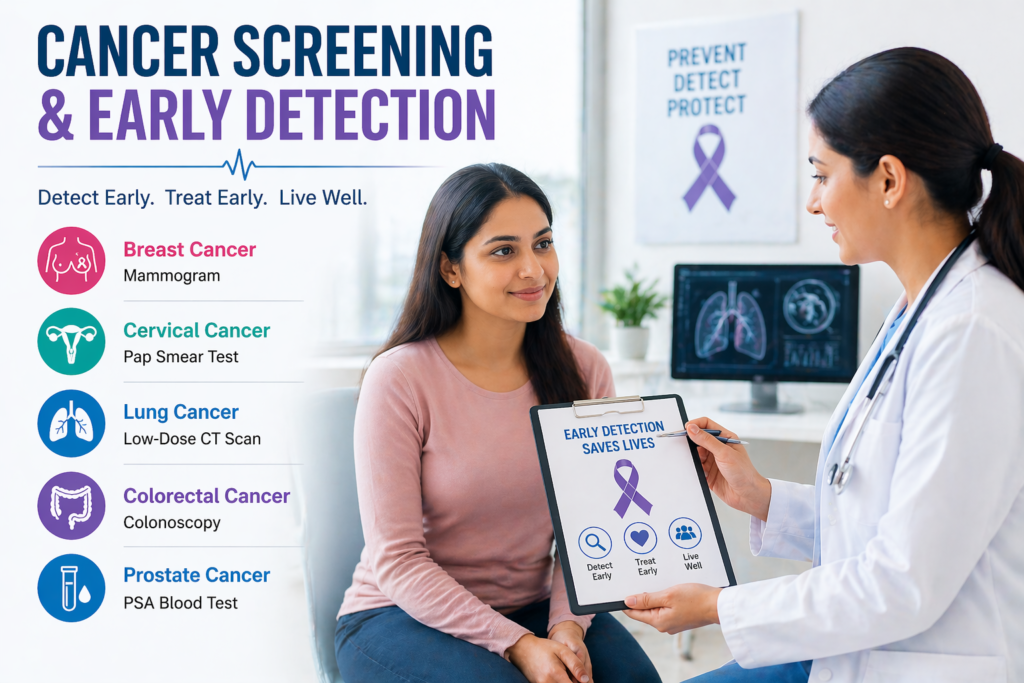
Screening looks for cancer before symptoms. It can have benefits and harms, including false results, overdiagnosis and overtreatment. It differs from assessment of an existing symptom. NCI: Cancer Screening Overview.
This is general information and a discussion aid. It does not diagnose a condition, prescribe care or claim a named clinician has reviewed this article. The source links were checked for this editorial update; personal advice should come from an appropriately qualified professional who understands the circumstances.
For choosing reliable general information before a clinical discussion, see reliable cancer-awareness information.
1. Ask whether screening applies to you
Discuss the cancer type, age, family and personal history and the guidance applicable in your setting. Do not treat a screening recommendation from another country as a universal Indian schedule.
2. Understand the trade-offs
Ask about the possible benefit, false-positive and false-negative results, follow-up procedures and the chance of finding a cancer that would not have caused problems. More testing is not automatically a better decision.

Unessa Foundation activity: a volunteer and children working with paper learning materials in Vadodara.
SUPPORT CHILDREN’S EDUCATION
Help learning become a regular part of a child’s life.
Support Unessa Foundation’s education programmes and volunteer-led learning activities.
3. Plan for an abnormal result
Ask who will explain the result and arrange assessment if needed. A screening result alone is not always a diagnosis. New symptoms still need appropriate medical attention rather than waiting for the next routine screening appointment.
4. Use a question record for cancer screening and early detection
Before a discussion, write the issue in plain language and list what you already know, what remains uncertain and the decision you need help with. Keep existing reports together and note the dates. If another person is helping, agree what may be shared and who should receive the explanation.
- What does this information establish, and what does it leave uncertain?
- Which guidance applies to this person and setting?
- What are the reasonable options, limitations and next steps?
- Who will explain the result or arrange the next contact?
A suggested question record is an organisational tool, not a validated diagnostic instrument. Adapt it to the situation and the professional’s instructions. Do not delay appropriate care while trying to complete every field or waiting for a response from an NGO blog.
5. Check the source and the claimed result
For cancer screening and early detection, use the source linked beside the overview as a starting point, then check its scope and date. A general reference does not support every treatment, percentage or claim made elsewhere. If a statistic matters, look for the exact population, period, definition and original study.
A case story describes one account, not a guaranteed outcome. This guide does not present an invented child, patient, recovery rate or programme result as fact. When discussing a real person, keep health details private and obtain appropriate permission before sharing any story or image.
6. Confirm support and follow-up
If seeking a service, confirm the actual provider, location, eligibility, appointment process and any charge. A charity directory, awareness activity and clinical service are different things. Ask about the specific support required rather than assuming it is available because an organisation publishes health information.
Keep a private record of the agreed next step and the person responsible. If a plan or result is unclear, ask the relevant professional to explain it. The practical aim is an informed conversation and an appropriate support route, not a promise of prevention, diagnosis or recovery from a webpage.
Supporting education with a clear purpose
Unessa publishes this resource. The donation buttons on this article support the education campaign described at their destination; they do not purchase a test, treatment, nutrition product or counselling session. Check Unessa’s published programme information for its stated remit and ask the official team about any current service question.
Frequently asked questions
How is cancer screening different from investigating symptoms?
Screening looks for cancer or relevant abnormal changes in people without symptoms. A concern about an existing symptom needs an appropriate clinical assessment; it should not be treated as the same question as choosing a screening programme.
Should everyone choose the same cancer screening tests?
Discuss the relevant screening options, personal circumstances and possible benefits and harms with an appropriately qualified clinician. A general list of tests is not an individual recommendation or a guarantee that screening will detect every cancer.
Continue reading

Related guide

Related guide
Support children’s learning with Unessa Foundation.