

Introduction: Why Agricultural Zakat Matters
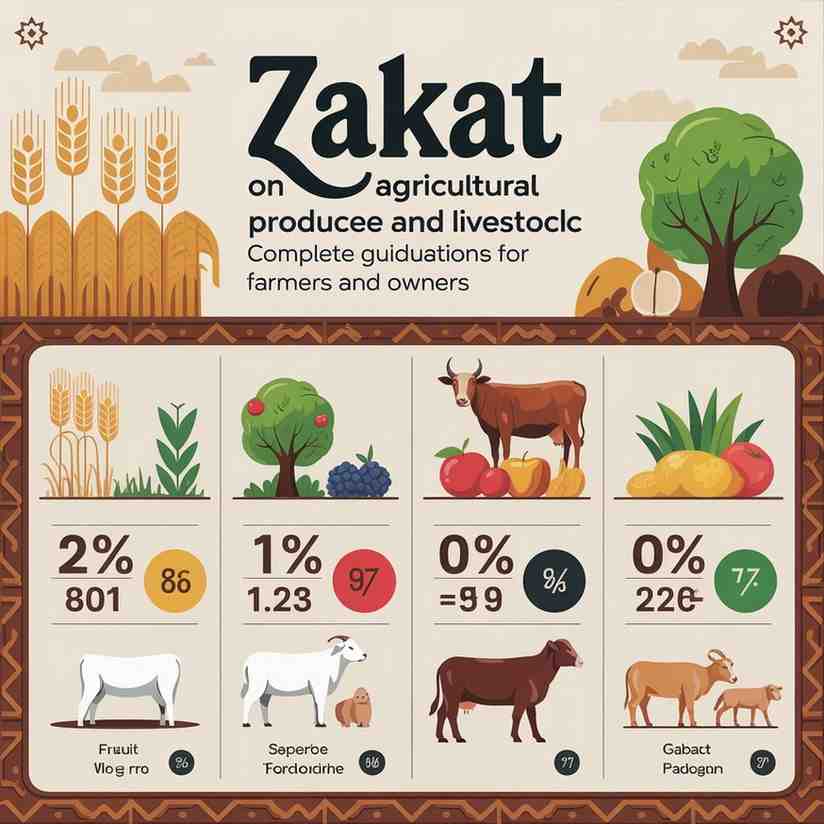
Zakat on agricultural produce and livestock plays a vital role in ensuring food security, supporting rural livelihoods, and strengthening social welfare systems in Islam. Unlike Zakat on cash or savings, agricultural Zakat follows distinct rules tied to production, yield, and care, reflecting fairness toward farmers and landowners.
For centuries, Islamic economic principles have recognized agriculture and livestock as core sources of wealth. Even today, with modern farming techniques and commercial dairy operations, these rulings remain deeply relevant. Understanding them correctly ensures compliance with Islamic teachings while contributing meaningfully to community well-being.
Understanding Zakat on Agricultural Produce and Livestock
Zakat on agricultural produce and livestock differs from other forms of Zakat in three key ways:
- It is often due at harvest time, not after a lunar year
- Rates vary based on effort and irrigation methods
- Nisab thresholds differ for crops and animals
This system reflects Islam’s emphasis on justice, effort, and sustainability.
Zakat on Agricultural Produce: Core Principles
When Is Zakat on Crops Obligatory?
Zakat on crops becomes obligatory when:
- The produce reaches the minimum nisab
- The crops are harvested
- The produce is measurable and storable
Unlike savings or gold, haul (one lunar year) is not required. Zakat is paid at the time of harvest, making it immediately impactful for those in need.
Nisab for Agricultural Produce
The nisab for agricultural produce is approximately:
- 5 wasaq, equal to about 612–653 kg (varies slightly by scholarly opinion)
If the total harvest reaches or exceeds this amount, Zakat becomes obligatory.
Zakat Rates Based on Irrigation Method
Islamic rulings account for farming effort by adjusting Zakat rates:
- 10% (Ushr)
- Crops grown using natural rainfall, rivers, or groundwater
- Crops grown using natural rainfall, rivers, or groundwater
- 5% (Half Ushr)
- Crops irrigated using paid systems like pumps, canals, or tankers
This distinction ensures fairness by recognizing the costs borne by farmers.
Which Crops Are Zakatable?
Zakat applies to crops that are:
Staple foods
Storable and measurable
Cultivated for consumption or sale
Common Zakatable produce includes:
Wheat, rice, barley
Dates, raisins
Corn, millet
Lentils and pulses
Generally exempt:
Perishable vegetables
Fruits meant for immediate consumption
Decorative or non-food crops
Zakat on Livestock: Key Rules Explained
Livestock Zakat applies to animals that are:
- Grazing freely for most of the year
- Raised for trade, milk, or breeding
- Meeting the prescribed nisab
Animals kept purely for labor, transport, or personal use are not Zakatable.
Types of Livestock Subject to Zakat
Zakat applies to:
- Camels
- Cattle (cows, buffalo)
- Sheep
- Goats
Each category has specific nisab thresholds and Zakat obligations.
Nisab Thresholds for Livestock
Here are simplified minimum thresholds:
- Sheep/Goats: 40 animals
- Cattle: 30 animals
- Camels: 5 animals
Once the nisab is met and conditions fulfilled, Zakat becomes obligatory according to established Islamic rulings.
Livestock Zakat Rates (Simplified)
Zakat on livestock is often paid in animals, not cash, depending on quantity.
Examples:
- 40–120 sheep → 1 sheep
- 30 cattle → 1 one-year-old calf
- 5 camels → 1 sheep
Modern scholars allow cash equivalents where distribution of animals is impractical, especially in urban or institutional settings.
Modern Farming and Livestock Operations: How Zakat Applies Today
With commercial farming, dairy businesses, and corporate agriculture, Zakat on agricultural produce and livestock has evolved in application—but not in principle.
Commercial Farms
- Zakat applies to total eligible produce
- Costs of irrigation affect the applicable rate
- Storage and sales do not delay obligation
Dairy and Poultry Farms
- Grazing animals may be Zakatable
- Animals raised exclusively on purchased feed may be treated as business assets
- In such cases, Zakat may apply to net business value
Scholarly consultation is recommended for complex operations.
Common Mistakes in Agricultural and Livestock Zakat
Many errors arise from misunderstanding eligibility:
- Paying Zakat on personal farming tools
- Ignoring irrigation method differences
- Paying after one year instead of at harvest
- Including animals used for ploughing or transport
- Confusing business Zakat with livestock Zakat
Clear records and informed calculation prevent these issues.
Practical Tips for Accurate Zakat Calculation
Track harvest quantities carefully
Note irrigation methods for each crop
Maintain livestock counts throughout the year
Separate personal-use animals from grazing herds
Use trusted Zakat calculators where applicable
Seek scholarly guidance for modern farming models
Social Impact of Zakat on Agriculture
Reduced rural poverty
Supported food distribution systems
Stabilized farming communities
Encouraged ethical land ownership
In today’s context, it continues to bridge wealth gaps and support sustainable livelihoods.
Conclusion
Zakat on agricultural produce and livestock reflects Islam’s deep understanding of economic justice and labor. By aligning Zakat obligations with harvest cycles, effort, and sustainability, Islamic law ensures fairness for farmers while protecting the rights of the poor.
Correct application not only fulfills a religious duty but also strengthens food systems, rural economies, and social harmony. With clarity, intention, and proper guidance, agricultural Zakat becomes a powerful force for collective well-being.
FAQs: Zakat on Agricultural Produce and Livestock
Is Zakat due on crops every year?
Zakat is due at each harvest if the produce reaches nisab.
Do vegetables have Zakat?
Generally, perishable vegetables are exempt unless treated as trade goods.
Is Zakat paid on total harvest or profit?
Zakat is paid on total produce, not net profit.
Does irrigation affect Zakat rate?
Yes. Natural irrigation is 10%, paid irrigation is 5%.
Is Zakat due on animals used for farming work?
No. Animals used for labor or transport are exempt.
Can livestock Zakat be paid in cash?
Yes, where distribution of animals is impractical.