
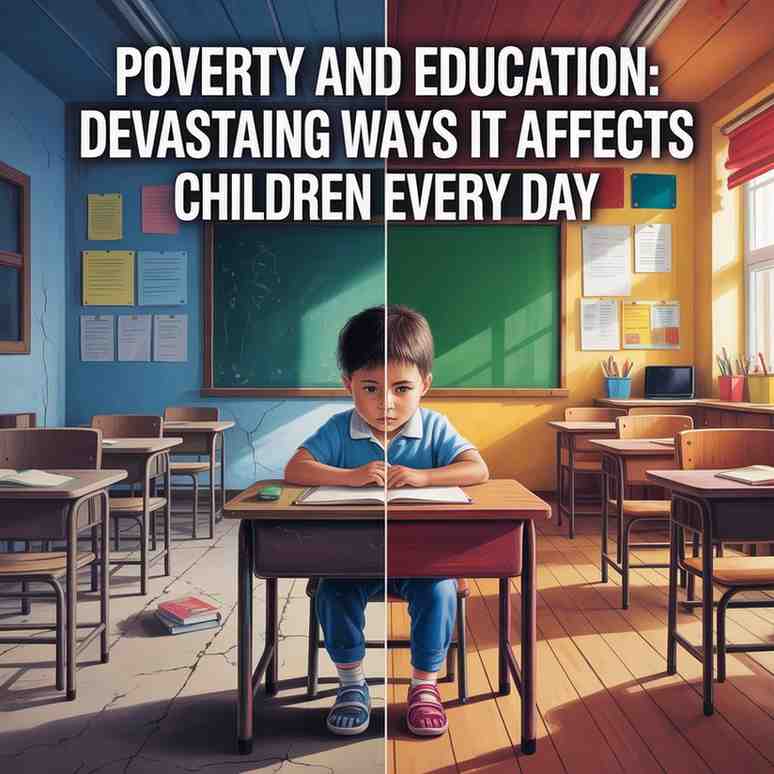

In 2025, a child born into poverty is still five times less likely to complete secondary education than a child from a middle-income family. That number alone tells you something is deeply wrong — but it doesn’t tell the whole story.
Because the relationship between Poverty and Education is not just about access to school. It’s about what happens long before a child enters a classroom, and what follows them long after they leave.
We often talk about education as the solution to poverty. And that’s true — but only partially. What we don’t talk about enough is how poverty actively prevents education from working in the first place.
This creates a cycle that is incredibly difficult to break.
A child born into poverty doesn’t just start behind — they stay behind, unless something deliberately interrupts that pattern.
And that’s exactly what we’re going to explore here.
Quick Insight: Improving educational attainment for the bottom 40% of income earners could add 2-3% to a country’s annual GDP growth rate (UNESCO, 2024).
Table of Contents
1. The Poverty-Education Trap: Understanding the Core Mechanism
To understand how deeply poverty affects education, it is important to recognize that the relationship is not linear but cyclical, meaning that poverty creates conditions that hinder learning, and poor learning outcomes then reinforce poverty by limiting future opportunities, which in turn affects the next generation in the same way.
A child growing up in poverty is more likely to experience instability, stress, and lack of resources, all of which directly influence cognitive development and emotional well-being, and these factors begin affecting a child’s ability to learn from a very early age, often before formal schooling even begins, which means that by the time such a child enters a classroom, they are already at a disadvantage compared to children who have grown up in more stable and resource-rich environments.
What makes this cycle particularly difficult to break is that it is not caused by a single factor but by a combination of economic, social, and psychological pressures that interact with each other, creating a situation where even well-intentioned educational interventions may fail if they do not address the broader context of poverty within which learning takes place.
The poverty-education trap is not a metaphor. It is a neurological, social, and economic reality that manifests in measurable learning deficits from as early as age 3.
2. 7 Ways Poverty Affects Children's Education Every Day
Understanding the barriers is essential before designing solutions.
2.1 Malnutrition and Cognitive Development
Chronic malnutrition — affecting over 190 million children globally — directly impairs brain development. Iron deficiency, common among poor children, reduces IQ scores by an estimated 5-7 points. Children in food-insecure households attend school less frequently, concentrate for shorter periods, and retain information less effectively.
2.2 Unstable Home Environments
Poverty is rarely just a lack of money. It typically means housing insecurity, parental stress, relationship conflict, and frequent relocation. Each of these factors disrupts the stable, predictable environment children need to build literacy and numeracy foundations. Studies show that children who experience 3 or more home relocations before age 10 are significantly more likely to fall below grade level.
2.3 Lack of Learning Materials
In middle-income homes, children grow up surrounded by books, educational toys, and digital devices. In low-income homes, these materials are absent. This ‘word gap’ — where children from high-income families hear 30 million more words by age 3 than their low-income peers — has measurable consequences for reading readiness at school entry.
2.4 Parental Education Levels
Children of uneducated parents face a compounding disadvantage. Without literate parents, homework goes unassisted, the value of education goes uncommunicated, and school-family communication breaks down. First-generation learners carry an invisible additional burden that no curriculum acknowledges.
2.5 Child Labour
An estimated 160 million children worldwide are in child labour. For most, this is not a preference — it is economic compulsion. A 10-year-old who spends 6 hours in a field or at a loom cannot simultaneously be a full-time student. Poverty and education compete directly for a child’s time and energy.
2.6 School Infrastructure Disparities
Schools in low-income communities consistently receive less funding, have higher teacher-to-student ratios, and offer fewer extracurricular or enrichment programmes. The child born poor attends a worse school. And attends it less reliably. This is educational inequality baked into the system.
2.7 Psychological and Emotional Burden
The chronic stress of poverty — known as ‘toxic stress’ in developmental psychology — reshapes children’s stress-response systems in ways that impair learning, social development, and emotional regulation. Children from extreme poverty backgrounds show measurably higher cortisol levels, reduced executive function, and lower academic resilience.
Reflective Question: When we design education programmes for low-income children, are we accounting for the physiological and psychological burden they carry into every classroom?
3. The Long-Term Consequences of Educational Poverty
The consequences of the poverty-education trap do not end at school leaving age. They compound across a lifetime.
- Adults without secondary education earn 50-60% less over a lifetime than those with full schooling
- Children of uneducated mothers are 2x more likely to be malnourished, regardless of household income
- Communities with lower educational attainment have higher rates of preventable disease, shorter life expectancy, and higher crime rates
- Nations with persistent educational inequality show slower economic growth, weaker democratic institutions, and higher internal conflict rates
The cost of failing to address poverty and education is not borne only by the children who fall through the cracks. It is borne by entire societies.
4. What the Evidence Says Actually Works
Decades of research — from randomised controlled trials to longitudinal cohort studies — have identified interventions that consistently break the poverty-education cycle.
Conditional Cash Transfers (CCTs)
Programmes that pay low-income families to keep children in school — like Brazil’s Bolsa Familia or India’s Balika Samridhi Yojana — show consistent improvements in enrollment, attendance, and completion rates. The financial incentive addresses the economic tradeoff directly.
Early Childhood Education
Every dollar invested in high-quality early childhood education for low-income children returns 7-13 dollars in long-term economic benefit (Heckman, 2013). The first five years are the highest-leverage period in any child’s educational trajectory.
School Feeding Programmes
Providing nutritious meals at school increases attendance by up to 25% and measurably improves cognitive performance. Addressing hunger is not a welfare programme — it is an educational intervention.
Community Learning Centres
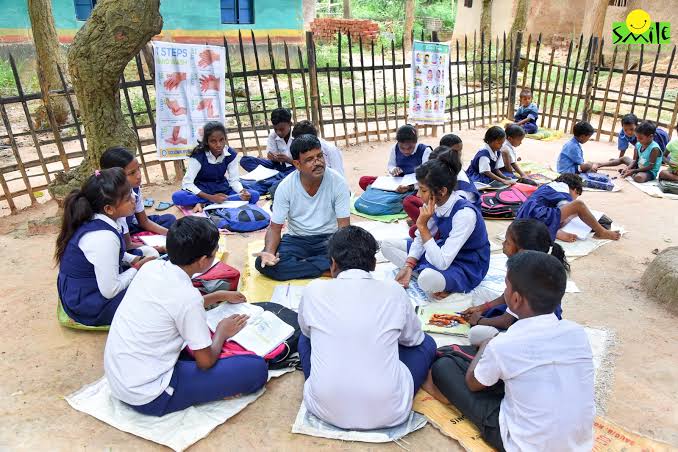
Bringing education into communities — rather than requiring communities to travel to schools — dramatically reduces the geographic and social barriers that keep poor children out of classrooms.
5. A Case Study: Breaking the Cycle in Urban Slums
Background
In a dense urban slum settlement in Maharashtra, over 40% of children between 6-12 were out of school. Most were engaged in informal work — rag picking, domestic labour, or small-scale vending — alongside their parents.
Challenge
The conventional solution — building a school nearby — had already been tried. Attendance was low because children worked in the mornings and were too exhausted in the afternoons. Schools were built for a schedule that did not match how these children’s lives worked.
Actions Taken
An education programme redesigned around the children’s actual daily rhythms — offering two-hour intensive learning sessions in the early evening, combined with a hot meal, family coordination sessions, and a stipend tied to 80% monthly attendance.
Outcome
Within two years, 67% of the target children had transitioned into mainstream government schools at grade-appropriate levels. Three children from the original cohort went on to pass Class 10 board exams — a milestone their parents had never reached.
Lesson
Addressing poverty and education together requires redesigning education around the constraints of poverty — not expecting poor children to conform to systems designed for non-poor children.
6. The Role of NGOs Like Unessa Foundation
Governments set policy. NGOs fill the gap between policy and reality. Organisations focused on education for underprivileged children — like Unessa Foundation — operate in precisely the spaces where state systems have failed: remote communities, marginalised populations, and chronically under-resourced schools.
Their value is not replication — it is innovation, agility, and proximity to communities that formal systems cannot replicate.
Pro Tip: NGOs that address poverty and education simultaneously — through stipends, nutrition support, family engagement, and quality learning — consistently outperform those that address only one dimension
7. FAQ — People Also Ask
How does poverty affect a child's education?
Poverty limits education through malnutrition, unstable home environments, lack of learning materials, parental illiteracy, child labour, inferior school infrastructure, and the psychological burden of chronic stress.
What is the relationship between poverty and academic performance?
Through quarterly learning assessments, annual third-party evaluations, dropout tracking, and transparent public reporting of both successes and shortfalls.
What education solutions work for children living in poverty?
Conditional cash transfers, early childhood education, school feeding programmes, community learning centres, and family engagement initiatives all show strong evidence of effectiveness.
Why do poor children underperform in school?
Because they arrive at school carrying burdens — hunger, fatigue, stress, trauma — that affluent children do not. School performance is inseparable from the conditions of a child’s life outside school.
Can education break the cycle of poverty?
Yes — but only when education programmes are designed to address the specific constraints of poverty, not simply provided to poor children in the same format designed for non-poor children.
8. Conclusion
The relationship between poverty and education is one of the clearest causal chains in social science. Poverty limits education. Limited education deepens poverty. And the cycle continues — unless deliberately interrupted.
We have the evidence. We have the models. We have the organisations — like Unessa Foundation — doing this work at ground level. What remains is the collective decision to prioritise this over less urgent, more glamorous interventions.
A child’s intelligence is not determined by their income. Their access to education should not be either.