
Every 11 seconds, a child dies from hunger-related causes. Most of these deaths are preventable — if the signs of malnutrition in children are identified early enough to intervene.
Malnutrition does not always look like the extreme images seen in emergency relief campaigns. In millions of homes across India and the world, it presents quietly — in a child who seems smaller than expected, tires easily, or catches every infection going around. The warning signs are visible. They simply go unrecognised.
This guide is for parents, teachers, community health workers, and anyone who spends time with children in low-income settings. By the end, you will be able to identify 12 key physical and behavioural signs of malnutrition in children — and know exactly what to do when you spot them.
Quick Insight: The World Health Organization estimates that malnutrition contributes to 45% of all deaths in children under 5. Early identification and intervention can reverse most forms of malnutrition if caught before severe damage occurs.
1. What Is Malnutrition — And Why Early Detection Matters
Malnutrition refers to deficiencies, excesses, or imbalances in a person’s intake of energy and nutrients. In children from underprivileged backgrounds, it almost always means undernutrition — insufficient intake of calories, protein, vitamins, and minerals to support healthy growth and development.
The reason early detection matters so acutely is neurological. The first 1,000 days of a child’s life — from conception to the second birthday — represent a window of brain development that, once passed, cannot be fully recovered. Malnutrition during this period causes permanent cognitive damage. After this window, damage is still serious, but recovery with proper nutrition and care is more complete.
Early detection means the difference between temporary setback and permanent impairment.
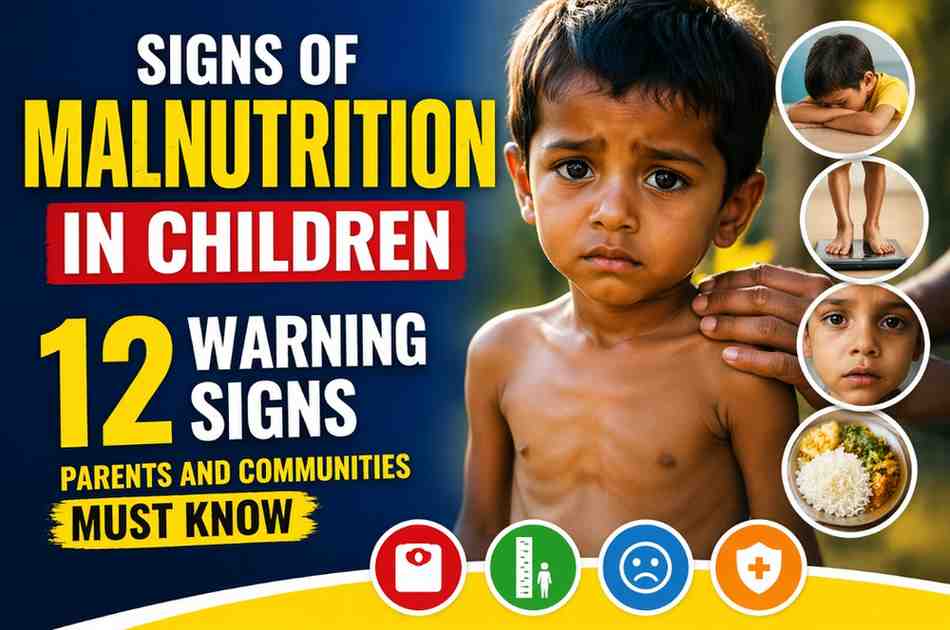
Signs of malnutrition in children include both physical indicators (low weight, stunted height, skin and hair changes) and behavioural indicators (fatigue, irritability, loss of interest in play). Both must be assessed together for accurate identification.
2. The 4 Main Types of Malnutrition in Children
2.1 Wasting (Acute Malnutrition)
Wasting occurs when a child is significantly underweight for their height — a sign of rapid, recent weight loss. It is the most immediately life-threatening form of malnutrition. Children with severe acute malnutrition (SAM) have a 9x higher risk of dying than well-nourished children of the same age.
2.2 Stunting (Chronic Malnutrition)
Stunting occurs when a child is significantly short for their age — the result of prolonged inadequate nutrition and repeated illness over months or years. Over 148 million children under 5 are stunted globally (UNICEF, 2023). Stunting is largely irreversible once the growth window closes.
2.3 Underweight
A child who is underweight for their age may be experiencing wasting, stunting, or both. In India, approximately 32% of children under 5 are underweight — one of the highest rates in the world (NFHS-5, 2021).
2.4 Micronutrient Deficiency
Also called 'hidden hunger,' micronutrient deficiency occurs when a child consumes enough calories but lacks essential vitamins and minerals — iron, zinc, vitamin A, iodine. It is possible to be overweight and micronutrient deficient simultaneously, making it one of the most widely misidentified forms of malnutrition.
3. 12 Physical and Behavioural Signs of Malnutrition in Children
Physical Signs
01
Visible Thinness or Visible Ribs and Bones
When a child’s ribs, shoulder blades, or hip bones are visibly prominent, this indicates severe wasting. The muscles are being consumed for energy. This is a medical emergency requiring immediate referral.
02
Swollen Abdomen, Face, or Limbs (Oedema)
Paradoxically, severe protein deficiency (kwashiorkor) causes fluid retention, resulting in a swollen belly and puffy face while the limbs remain thin. This is a dangerous and frequently misunderstood sign — families sometimes interpret the swelling as the child being ‘well-fed.’
03
Growth Faltering — Small for Age
A child who is consistently below the 3rd percentile on growth charts for both weight and height is showing signs of chronic malnutrition. This requires plotting against standardised WHO growth charts, which Anganwadi workers and community health nurses carry.
04
Changes in Hair
In protein-deficient children, hair loses its colour (may turn reddish or brownish), becomes thin and brittle, and falls out easily. This is a classical sign of kwashiorkor. A simple ‘hair pull test’ — if multiple hairs detach with minimal force — can indicate severe protein deficiency.
05
Skin Changes
Dry, flaky, peeling skin — particularly on the legs — is a sign of micronutrient deficiency. In severe malnutrition, the skin may develop a ‘flaky paint’ appearance or develop sores that do not heal. Pale skin in the inner eyelids and palms indicates anaemia, a common co-presentation with malnutrition.
06
Sunken Eyes and Dry Mouth
Malnutrition is often accompanied by dehydration. Sunken eyes, dry cracked lips, and reduced skin elasticity (skin tent test) indicate combined dehydration and nutritional deficit requiring urgent medical attention.
07
Muscle Wasting
Visible loss of muscle mass — particularly in the buttocks, thighs, and upper arms — indicates the body is catabolising muscle protein for energy. In children, the buttocks may appear ‘baggy’ or flat. This is a reliable sign of acute malnutrition.
Behavioural Signs
08
Persistent Lethargy and Fatigue
A malnourished child has insufficient energy to sustain normal activity levels. Persistent tiredness, reluctance to play, and low engagement with surroundings — in a child who was previously active — is a significant warning sign that must not be attributed simply to ‘laziness’ or ‘quiet temperament.’
02
Irritability, Crying, and Apathy
Iron deficiency — the most common micronutrient deficiency globally — directly impairs mood regulation. Severely malnourished children often alternate between extreme irritability and complete apathy. A child who has stopped responding to stimulation, smiling, or engaging with caregivers requires urgent assessment.
03
Loss of Interest in Food — or Unusual Food Cravings
Severe malnutrition paradoxically reduces appetite. A child who refuses food consistently may be in a late stage of malnutrition where the digestive system is compromised. Conversely, pica — craving non-food substances like soil, chalk, or clay — indicates severe micronutrient deficiency, particularly iron and zinc.
04
Frequent Illness
Malnutrition severely compromises immune function. A child who contracts respiratory infections, diarrhoea, or skin infections repeatedly — more than 3-4 significant episodes per year — may be malnourished even if their weight appears borderline. Each illness worsens nutritional status, creating a downward spiral.
05
Developmental Delays
Milestones that are significantly delayed — walking later than expected, speech development lagging, poor fine motor skills, limited social responsiveness — can all indicate chronic malnutrition affecting brain development. These signs are frequently missed because they are assessed in isolation from nutritional status.
Reflective Question: Have you seen any of these signs in children in your community? Early identification does not require medical training — it requires knowing what to look for. Sharing this list with community health workers and teachers multiplies its reach significantly.
4. Signs by Age Group: What to Watch at Each Stage
0–6 Months
- Poor weight gain — less than 150g/week
- Difficulty latching or feeding — may indicate insufficient breast milk production in a malnourished mother
- Persistent jaundice beyond 2 weeks
6–24 Months (Critical Window)
- Weight-for-height below -2 SD on WHO growth chart
- Failure to achieve sitting, standing, or walking milestones
- Recurrent diarrhoea lasting more than 3 days
2–5 Years
- Height below -2 SD for age (stunting threshold)
- Hair and skin changes as described above
- Swollen belly with visible ribs — a combination that demands immediate referral
5–12 Years
- Learning difficulties and poor school performance
- Short stature combined with low energy
- Pale conjunctiva and pallor indicating anaemia
5. When to Seek Immediate Medical Help
The following signs indicate Severe Acute Malnutrition (SAM) — a medical emergency requiring immediate referral to a health facility:
- MUAC (mid-upper arm circumference) below 11.5 cm
- Weight-for-height below -3 SD on WHO chart
- Bilateral pitting oedema (swelling that retains an indent when pressed)
- Sunken eyes combined with inability to drink
- Visible severe wasting — ribs and bones clearly prominent
- Unresponsiveness or unconsciousness
In India, children with SAM should be referred to the nearest Nutritional Rehabilitation Centre (NRC) — available in district hospitals across most states under the Integrated Child Development Services (ICDS) scheme. Do not wait for a scheduled check-up if any of the above signs are present.
6. A Case Study: How Early Detection Changed One Child's Future
Background
Aarav, 3, from a migrant labourer family in Madhya Pradesh, had been small since birth. His parents attributed his slow growth to ‘family build’ and delayed speech to ‘being a quiet child.’ At his Anganwadi check-up, his weight-for-height placed him in the SAM category and his MUAC measured 10.8 cm.
Challenge
The family had no awareness of malnutrition as a medical condition. They had not connected Aarav’s frequent coughs, persistent loose stools, and low energy to a nutritional cause. The household’s diet consisted primarily of rice and dal — calorically adequate but severely deficient in zinc, iron, and vitamin A.
Actions Taken
Aarav was referred to the district NRC for a 14-day inpatient therapeutic feeding programme. He received Ready-to-Use Therapeutic Food (RUTF), treatment for concurrent respiratory infection, and vitamin supplementation. His mother received nutrition counselling on dietary diversification using available local foods.
Outcome
After 14 days of therapeutic care, Aarav’s weight increased by 18% and his oedema resolved. At a 3-month follow-up, his energy levels, engagement, and speech showed measurable improvement. His mother identified and brought his younger sister — showing early signs — to the Anganwadi before she reached SAM status. Early detection in the second child prevented hospitalisation entirely.
Lesson
The signs of malnutrition in children were present for months before Aarav’s identification — visible to anyone who knew what to look for. A single community awareness session at the Anganwadi changed the trajectory of two children in the same family.
7. What Communities and NGOs Can Do
Identification without action is incomplete. Once signs of malnutrition are recognised, communities and NGOs play a critical role in the response:
- Train frontline workers — ASHAs, Anganwadi workers, teachers — in the 12 signs using practical visual guides
- Conduct monthly growth monitoring sessions with standardised equipment (weighing scales, height boards, MUAC tapes)
- Establish referral pathways from community identification to NRC or health facility
- Create community-level nutrition support groups for mothers of young children
- Map severely malnourished children in each catchment area — Unessa Foundation’s field teams use community nutrition maps to ensure no child is missed
👉Click here to know more about: Food Security and Hunger NGOs
Pro Tip: The MUAC tape — a colour-coded measuring tape for mid-upper arm circumference — is the single most practical screening tool for malnutrition in field settings. It costs less than Rs 10, requires no special training, and identifies SAM with 90%+ sensitivity. Every community health worker, teacher, and parent of a young child should have one.
8. FAQ — People Also Ask
What are the early signs of malnutrition in children?
Early signs include poor weight gain, persistent fatigue, frequent infections, loss of interest in food, and slight delays in developmental milestones. Hair thinning and skin dryness may also appear before more severe signs develop.
How do you identify malnutrition in a child at home?
Use the MUAC tape to measure mid-upper arm circumference — below 11.5 cm indicates severe acute malnutrition. Also watch for visible thinning, swollen abdomen, hair colour changes, persistent tiredness, and frequent illness. Any concerning sign warrants a visit to an Anganwadi or health worker.
What does a malnourished child look like?
A malnourished child may appear visibly thin with prominent bones, or paradoxically may have a swollen abdomen with thin limbs. Hair may be discoloured and thin. Skin may be dry or peeling. Behavioural signs — extreme fatigue, irritability, and apathy — are equally important as physical appearance.
What is the difference between stunting and wasting?
Stunting is low height-for-age, reflecting chronic, long-term malnutrition over months or years. Wasting is low weight-for-height, reflecting acute, recent nutritional deprivation. A child can be both stunted and wasted simultaneously — this combination indicates the most severe risk.
What should I do if I suspect a child is malnourished?
Contact the nearest Anganwadi worker or ASHA immediately. Do not wait for a scheduled visit. If the child shows signs of SAM — bilateral oedema, MUAC below 11.5 cm, visible severe wasting, or unresponsiveness — take them to the nearest government hospital or Nutritional Rehabilitation Centre without delay.
8. Conclusion
The signs of malnutrition in children are not hidden. They are present — in the hair, the skin, the eyes, the weight, and the behaviour of millions of children who are invisible to systems that do not look for them.
Early detection is not a medical skill. It is a community skill. It requires awareness, attention, and the knowledge of what to look for — all of which can be transmitted through a single training session, a shared guide, or a conversation between a parent and a health worker.
Organisations like Unessa Foundation train community workers in exactly these signs — and build the referral systems that ensure identification leads to treatment, not just documentation.
Know the signs. Share this guide. And act without delay when you see them.