
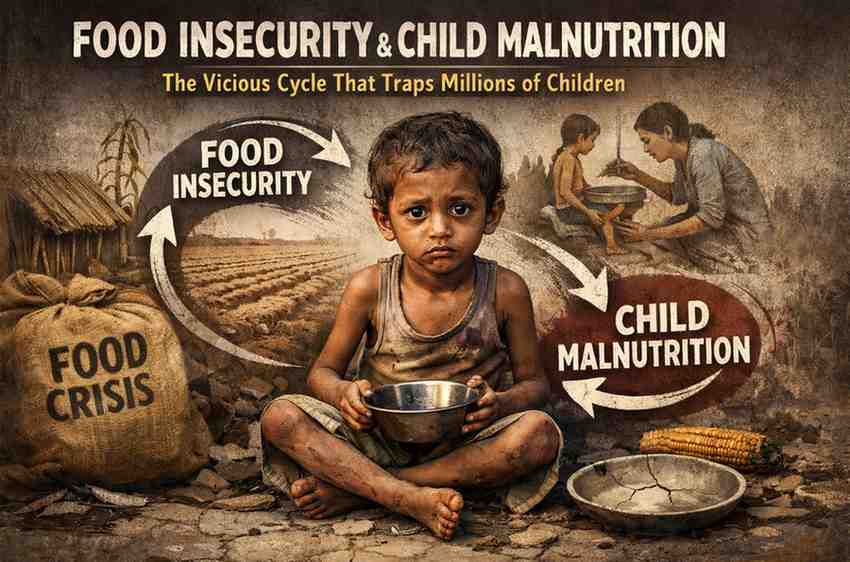

Food insecurity and child malnutrition are not simply correlated. They are mechanically connected — each one creating the conditions for the other to worsen, in a self-reinforcing cycle that, once established, is genuinely difficult to escape.
Understanding this cycle is essential for anyone designing, funding, or advocating for solutions to child malnutrition. Breaking the cycle requires intervening at specific points — and knowing which interventions work at which points makes the difference between temporary relief and lasting change.
Quick Insight: The Global Hunger Index 2023 ranks India 111th out of 125 countries. Over 74 million Indians experience severe food insecurity — defined as going without food entirely for an entire day. Among the children in these households, malnutrition rates are 3–4x the national average.
1. Defining Food Insecurity — What It Actually Means
Food insecurity exists on a spectrum. The USAID Food Security framework defines four levels:
- Food secure: consistent access to adequate, safe, and nutritious food
- Mildly food insecure: occasional uncertainty about food access; coping through dietary quality reduction
- Moderately food insecure: regular reduction in food quantity; skipping meals; feeding children before adults go without
- Severely food insecure: going entire days without food; acute hunger; emergency conditions
Child malnutrition is most directly caused by moderate and severe food insecurity — but mild food insecurity, through chronic dietary quality reduction, produces micronutrient deficiencies that are just as damaging as caloric restriction, particularly during the first 1,000 days.
Critically: food insecurity is not only about absolute food shortage. It is also about access — the inability to afford, reach, or prepare nutritious food even when it exists — and about quality: a household may have enough calories but entirely inadequate micronutrient diversity.
2. How Food Insecurity and Child Malnutrition Are Connected
Reduced Dietary Diversity
When household food budgets are constrained, the first dietary change is the elimination of expensive, micronutrient-rich foods: eggs, meat, fish, dairy, and fresh vegetables. What remains is a calorie-adequate but nutrient-poor diet dominated by staples. Children in food-insecure households are more likely to experience ‘hidden hunger’ — micronutrient deficiency without obvious caloric insufficiency.
Interrupted Feeding Routines
Food insecurity disrupts the consistent, scheduled feeding routines that young children require. Missed meals, irregular feeding times, and unpredictable food availability impair the development of healthy appetite regulation and stress children’s metabolic systems. Infants in severely food-insecure households show measurably higher cortisol levels — the stress hormone — than food-secure peers.
Poor Complementary Feeding
When food budgets are minimal, the introduction of nutritious complementary foods at 6 months — the single most critical nutritional transition — is compromised. Rice water, dilute dal, and plain roti replace the protein, micronutrient-rich foods that brain development requires during this window. This is a direct pathway from household food insecurity to infant stunting.
Psychological Stress in Caregivers
Food insecurity is not only a material condition — it is a chronic psychological stressor. Mothers experiencing food insecurity show higher rates of depression, anxiety, and post-traumatic stress, all of which impair responsive feeding practices, breastfeeding duration, and caregiver-infant interaction quality. A stressed, depressed mother in a food-insecure household has reduced capacity to provide the attentive, nutritionally appropriate feeding her infant requires.
3. How Malnutrition Makes Food Insecurity Worselnutrition
The cycle is bidirectional. Malnutrition does not only result from food insecurity — it actively deepens it.
Reduced Adult Productivity
Malnutrition in childhood produces adults with reduced physical capacity, cognitive capacity, and health status. Adults who were malnourished as children earn less, work less productively, and are more frequently ill — reducing household income and thereby deepening food insecurity for the next generation.
Higher Healthcare Expenditure
Malnourished children are sick more often and more severely. Healthcare expenditure for malnourished children’s recurrent illness consumes household income that would otherwise be available for food. In India, a single hospitalisation for a child with severe acute malnutrition can consume 30–60 days of a daily wage household’s income.
Reduced Agricultural Productivity
In rural farming households, malnutrition among working-age adults reduces agricultural output — directly limiting the household’s food production capacity. A food-insecure farming family that is chronically malnourished cannot farm as effectively as a well-nourished family — reducing yields and deepening their food insecurity in the next season.
Reflective Question: The food insecurity-malnutrition cycle can persist for generations in the same community. What would it take to identify which households in your area are trapped in this cycle — and what is the first intervention point that would be most accessible to reach?
4. The Scale of the Problem in India and Globally
- India: 194 million people food insecure (FAO, 2022); 35.5% of children under 5 stunted (NFHS-5)
- Globally: 783 million people face chronic hunger; 148 million children under 5 stunted
- Among the 10 countries with the highest child malnutrition rates, 8 are simultaneously experiencing acute food insecurity
- In India’s most food-insecure districts — concentrated in Jharkhand, Bihar, Madhya Pradesh, and Uttar Pradesh — stunting rates exceed 50% of children under 5
- The COVID-19 pandemic pushed an additional 100 million people into food insecurity globally, with India experiencing one of the sharpest increases in food insecurity measurement since 2000
5. Who Is Most Affected — The Intersection of Vulnerabilities
Food insecurity and malnutrition are not randomly distributed. They concentrate in specific populations:
Scheduled Caste and Scheduled Tribe Communities
NFHS-5 data shows stunting rates of 43% among ST children and 40% among SC children — compared to 30% among ‘other’ categories. Land dispossession, seasonal agricultural labour, and social exclusion from food distribution programmes all contribute to higher food insecurity in these communities.
Children of Female-Headed Households
Paradoxically, female-headed households in India show better child nutrition outcomes than male-headed households at the same income level — because women direct a higher proportion of household income to food and child welfare. However, female-headed households also have lower income on average, creating compounding vulnerability.
Urban Slum Communities
Urban food insecurity is frequently overlooked in national nutrition discussions focused on rural poverty. Urban slum residents spend 50–70% of income on food but consistently access lower dietary diversity than rural households at the same income level — due to higher food prices, less access to cultivation, and greater reliance on ultra-processed convenience foods.
Migrant and Seasonal Labour Households
Seasonal migration disrupts household food routines, access to government food programmes (PDS ration cards are typically non-portable), and antenatal and child nutrition services. Children in migrant households have higher malnutrition rates than non-migrant poor households with similar income — because the instability of migration compounds nutritional risk.
6. What Interventions Break the Cycle
Social Protection — PDS and Cash Transfers
India’s Public Distribution System (PDS) provides subsidised grains to below-poverty-line households — representing the country’s most significant food security intervention. Its effectiveness is highly variable by state: Chhattisgarh and Tamil Nadu show near-universal coverage and low leakage; several northern states show high exclusion error and significant diversion.
Conditional cash transfers — linking cash payments to health and nutrition behaviour — consistently break the cycle more effectively than in-kind food transfers because they allow families to purchase the specific foods their children need.
Nutrition-Sensitive Agriculture
Programmes that support poor households in cultivating kitchen gardens — producing vegetables, legumes, and small livestock — address food insecurity and malnutrition simultaneously. A kitchen garden costing Rs 500 to establish can produce micronutrient-rich food year-round, directly improving dietary diversity without increasing food expenditure.
Community-Based Management of Acute Malnutrition (CMAM)
CMAM programmes provide ready-to-use therapeutic food (RUTF) and community-based treatment for moderate and severe acute malnutrition — reaching children before they require hospitalisation. Community-level CMAM consistently produces recovery rates above 75% and is one of the most cost-effective nutrition interventions available.
7. A Case Study: Breaking the Cycle in an Urban Slum in Mumbai
Background
In a resettlement colony in Mumbai, a survey of 340 households found that 61% experienced moderate to severe food insecurity. Stunting rates among children under 3 were 48%. Families were spending Rs 80–120/day on food — theoretically sufficient — but diets were dominated by cheap grains and oil, with negligible protein or micronutrient diversity.
Challenge
The food environment around the colony offered primarily processed snacks, refined carbohydrates, and subsidised grains. Fresh vegetables were available at a market 1.5 km away — too far for mothers with young children and demanding work schedules. The PDS ration provided rice and wheat but no protein sources.
Actions Taken
An integrated intervention: established a community-managed nutrition kiosk offering vegetables, eggs, and affordable protein sources within the colony; provided nutrition counselling to 120 mothers using a 6-session dietary diversification curriculum; coordinated with the municipal Anganwadi to improve RUTF availability for SAM children; and linked the colony’s migrant households to portable ration card services.
Outcome
At 18-month follow-up: new stunting cases among children born during the programme period were 27% lower than the pre-programme cohort. Dietary diversity scores rose from 2.9 to 4.1 food groups. RUTF uptake for SAM children increased by 45% as awareness of the programme improved. The nutrition kiosk was sustained independently by the community after programme funding ended — indicating genuine community ownership.
Lesson
Breaking the food insecurity-malnutrition cycle in urban settings requires addressing the food environment — not just household knowledge or income. Proximity, affordability, and convenience of nutritious food are as important as awareness.
8. FAQ — People Also Ask
How does food insecurity cause malnutrition in children?
Food insecurity causes malnutrition by reducing dietary diversity (eliminating nutrient-rich foods), disrupting feeding routines, compromising complementary feeding quality, and creating caregiver stress that impairs responsive feeding practices.
What is the relationship between food insecurity and child development?
Food insecurity impairs physical growth, cognitive development, immune function, and emotional regulation in children. The effects are most severe when food insecurity occurs during the first 1,000 days of life.
How many children experience food insecurity in India?
India has over 194 million food-insecure people, with children disproportionately affected. NFHS-5 data shows 35.5% of children under 5 are stunted — a key indicator of chronic food insecurity affecting child nutrition.
What programmes address food insecurity and malnutrition together?
India’s PDS, ICDS supplementary nutrition, mid-day meal scheme, and CMAM programmes all address the food insecurity-malnutrition link. Community-based kitchen garden programmes and conditional cash transfers show strong evidence for addressing both simultaneously.
9. Conclusion
Food insecurity and child malnutrition are not two separate problems that happen to coexist. They are two manifestations of the same systemic failure — in food systems, social protection, healthcare access, and gender equity — that requires integrated, multi-sector solutions.
Understanding the cycle is not academic. It determines which interventions are funded, which communities are prioritised, and whether solutions address root causes or manage symptoms.
Organisations like Unessa Foundation design their nutrition programmes with this systemic understanding — integrating food support, nutrition education, WASH, and healthcare linkages because no single component addresses the cycle alone.