
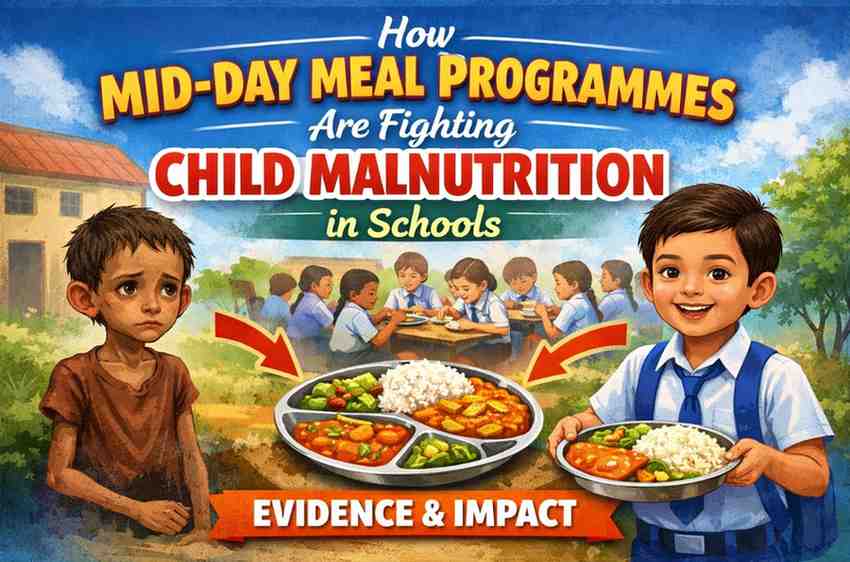

Every school day in India, over 120 million children receive a cooked meal at school. It is the largest school feeding programme in the world — and one of the most cost-effective nutrition interventions in history. Yet its implementation is deeply uneven, its quality highly variable, and its potential far from fully realised.
This post examines the evidence on mid-day meal programmes and child malnutrition: what the data shows they achieve, where they fall short, and what it would take to realise their full potential as a weapon against childhood undernutrition.
Quick Insight: A 2022 meta-analysis of school feeding programmes across 37 countries found consistent evidence of 15–29% reductions in stunting among programme beneficiaries compared to controls — making school feeding one of the few nutrition interventions with documented effects at the population level.
1. What Is Malnutrition — And Why Early Detection Matters
India’s school mid-day meal programmes — now called PM POSHAN (Pradhan Mantri Poshan Shakti Nirman), previously the Mid-Day Meal programme Scheme — provides free cooked meals to all children enrolled in government and government-aided schools from Classes 1–8. It covers approximately 120 million children across 1.1 million schools.
Programme Standards
- Primary school children (Classes 1–5): 450 calories, 12g protein per meal
- Upper primary children (Classes 6–8): 700 calories, 20g protein per meal
- Menu designed to include vegetables, legumes, and occasionally eggs or other protein sources
- Funded jointly by central and state governments
Programme Reach
PM POSHAN is the single largest food security programme targeting school-age children in India. Its annual budget exceeds Rs 12,000 crore. In terms of daily reach, it is surpassed globally only by the US National School Lunch Program.
2. The Evidence: What School Feeding Programmes Do for Child Nutrition
Increased School Enrollment and Attendance
The most consistent and robust finding across all evaluations of India’s school mid-day meal programme is its effect on attendance. A 2003 study comparing matched schools before and after meal introduction found attendance increased by 15–29% in the first year. Crucially, the effect was largest for girls from the most food-insecure households — the population most likely to be absent.
Reduced Short-Term Hunger and Improved Concentration
Teacher surveys consistently document improved classroom concentration, reduced absenteeism due to illness, and higher afternoon retention rates in schools with functioning meal programmes compared to matched schools without. A hungry child cannot concentrate — this is not a hypothesis, it is a neurological fact documented in classroom observation studies.
Improved Nutritional Status
Longitudinal evaluations in Tamil Nadu, Karnataka, and Andhra Pradesh show weight-for-age improvements of 0.2–0.4 SD among consistent mid-day meal recipients compared to matched non-recipients. For children from the most food-insecure households, the improvement is larger — as the school meal represents a more significant proportion of their daily nutritional intake.
Female Teacher Employment
An underappreciated effect of the mid-day meal programme is its contribution to female employment in rural areas. The programme employs approximately 2.5 million cooks and helpers, the majority of whom are women from the local community — providing income, skill development, and social status that indirectly benefits child nutrition through improved household food security.
Gender Equity in Enrollment
Research from Rajasthan and Madhya Pradesh shows that introducing school meals significantly increased girls’ enrollment — reducing the gender gap in primary school attendance in some districts by up to 50%. The meal effectively changed the cost-benefit calculation for families considering whether to send daughters to school.
3. The Gaps: Where Mid-Day Meal Programmes Fall Short
Quality and Nutritional Adequacy
The most frequently documented failure in India’s school feeding programme is the gap between nutritional standards and actual meal content. In many schools, meals consist primarily of rice or roti with dal — meeting caloric standards but falling significantly short on protein, micronutrients, and dietary diversity. Only 10 states currently provide eggs as part of the meal — despite the egg being the single most affordable, high-quality protein available at scale.
Hygiene and Food Safety
Recurring reports of contaminated mid-day meals causing illness — some fatalities — reflect inadequate food safety infrastructure in many schools: no piped water, no handwashing facilities, no refrigeration, and insufficient kitchen space. A meal that causes diarrhoea actively worsens the nutritional status it is designed to improve.
Exclusion of the Most Vulnerable
Children who are out of school — the very children most vulnerable to malnutrition — receive no benefit from a school-based nutrition programme. The mid-day meal scheme’s reach is entirely limited to enrolled children, excluding the estimated 6+ million school-age children not attending school — the population with the highest malnutrition burden.
State-Level Implementation Variability
PM POSHAN’s effectiveness varies enormously by state. Tamil Nadu — which introduced school feeding in 1956, decades before the national programme — has well-functioning infrastructure, consistent quality, and documented nutritional outcomes. Bihar and Uttar Pradesh — with higher malnutrition burdens — show significantly poorer implementation, higher leakage, and more frequent meal discontinuation.
Reflective Question: India’s mid-day meal programme reaches 120 million children daily — but reaches none of the 6 million children who are out of school and most food-insecure. What would a complementary programme for out-of-school children look like, and who should fund it?
4. What High-Quality School Feeding Looks Like
Evidence from the best-performing school feeding programmes — Tamil Nadu’s Amma Unavagam, Brazil’s National School Feeding Programme (PNAE), and South Africa’s National School Nutrition Programme — identifies the following as defining features of high-quality implementation:
- Menu diversity: at least 5 food groups represented weekly, including protein (eggs, legumes, or meat)
- Local food procurement: sourcing from local farmers improves freshness, economic linkages, and community support
- Hygiene infrastructure: piped water, soap, covered cooking areas, and refrigeration at all sites
- Regular food safety audits: third-party monitoring of meal quality, preparation standards, and portioning
- Nutrition education integration: classroom nutrition education reinforcing healthy eating alongside the meal
- Community oversight: parent and community involvement in menu planning and quality monitoring
5. A Case Study: Transforming Attendance and Nutrition in Rural Rajasthan
Background
A government primary school in rural Rajasthan with 180 enrolled students had average attendance of 52% — well below the state average. Teacher surveys identified hunger and lack of incentive as primary reasons for absenteeism, particularly among girls from agricultural households.
Challenge
The school had been theoretically eligible for mid-day meals for three years, but delayed food procurement contracts and irregular grain delivery had made the programme inconsistent. In practice, meals were served only 60% of school days.
Actions Taken
An NGO supporting government school systems — aligned with Unessa Foundation’s model of complementing government provision — intervened with: reliable procurement from a local self-help group of women; kitchen infrastructure upgrades including water storage and clean cooking surfaces; introduction of eggs three times per week through a local poultry cooperative; and community oversight committee activation including parent representatives.
Outcome
Over one academic year: attendance rose from 52% to 74% — the largest single-year increase in the school’s recorded history. Girls’ attendance improved more than boys’ (from 47% to 71%). Weight-for-age z-scores among SAM-range children in the school improved by an average of 0.3 SD. The school’s mid-year dropout rate dropped to zero.
Lesson
The mid-day meal’s potential as a malnutrition intervention is not limited by the concept — it is limited by implementation quality. Consistent delivery, dietary diversity, and community ownership produce outcomes that inconsistent, low-diversity programmes do not.
8. FAQ — People Also Ask
Does the mid-day meal scheme reduce malnutrition in India?
Yes — where consistently implemented with adequate quality and diversity. Evidence shows 15–29% reductions in stunting among consistent beneficiaries, improved attendance particularly for girls, and measurable weight-for-age improvements in food-insecure children.
What is PM POSHAN and how does it work?
PM POSHAN (formerly the Mid-Day Meal Scheme) provides free cooked meals to over 120 million children in government schools Classes 1–8. Meals are cooked on-site by employed local women and must meet central government calorie and protein standards.
What are the problems with India's mid-day meal scheme?
Key challenges include nutritional quality gaps (low dietary diversity, insufficient protein), food safety issues in poorly equipped kitchens, exclusion of out-of-school children, and significant state-level implementation variability.
How can school feeding programmes be improved to fight malnutrition better?
By ensuring dietary diversity (including eggs and vegetables), investing in kitchen hygiene infrastructure, creating community oversight mechanisms, sourcing locally for freshness and economic benefit, and integrating nutrition education alongside meal provision.
8. Conclusion
India’s mid-day meal programme is simultaneously one of the country’s greatest social policy achievements and one of its greatest unrealised opportunities. At its best — well-funded, consistently delivered, nutritionally diverse, and community-monitored — it is a powerful weapon against child malnutrition that reaches children at exactly the age when sustained nutritional support can change learning and development trajectories.
At its worst — inconsistent, nutritionally inadequate, and hygienically unsafe — it is a missed opportunity that consumes significant public investment without delivering proportionate nutritional returns.
The difference between these two outcomes is not resources — it is political commitment, community ownership, and the kind of NGO-government partnership that organisations like Unessa Foundation exemplify.