

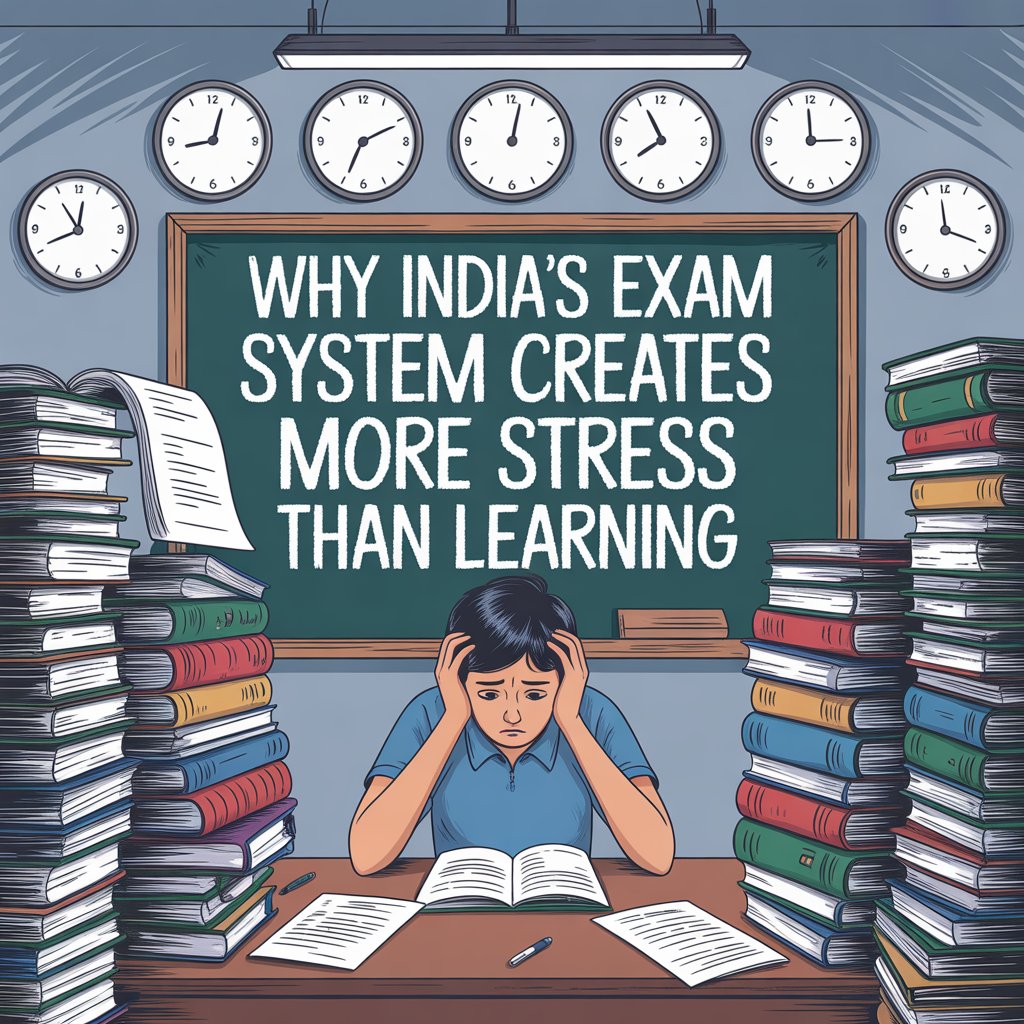


What if exams were never designed to measure learning—but only to measure memory under pressure?
In India, millions of students prepare for exams that decide their academic future. However, instead of encouraging deep understanding, the system often rewards memorization, repetition, and speed-based recall. This is one of the key reasons why India’s exam system creates more stress than actual learning.
This creates a situation where India exam system stress vs learning becomes a real educational paradox—students spend months studying, but much of that effort goes into short-term memorization rather than long-term understanding. As a result, India’s exam system creates more stress by prioritizing performance over knowledge.
The result is clear:
- High stress levels before exams
- Weak conceptual clarity
- Rapid forgetting after exams
- Low confidence in real-world application
This blog breaks down why this happens, what it means, and how it impacts both students and professionals.
The Structure of the Indian Exam System
The Indian education system is heavily centered around summative examinations, where final written tests define success.
Most schools and colleges follow a pattern where:
- Final exams carry the highest weightage
- Answers must match predefined textbook formats
- Time-bound writing is critical
- Theory is prioritized over application
Key Issue:
The system prioritizes output (marks) instead of input (understanding).
Real Impact:
Students often:
- Study to reproduce answers
- Avoid conceptual learning
- Depend on last-minute memorization
Insight:
This structure naturally pushes students toward performance-based learning instead of understanding-based learning.
Case Study:
A student preparing for board exams may study chapters multiple times, but their focus remains on reproducing textbook language instead of interpreting meaning.
Pro Tip:
Shift focus from “what is the answer?” to “why does this concept exist?”
Why Memorization Overpowers Learning
The keyword rote learning pressure in schools India explains a deep-rooted issue.
Explanation:
Students are trained to:
- Memorize definitions
- Repeat textbook language
- Follow predefined answers
Challenge:
This leads to:
- Weak problem-solving skills
- Poor long-term retention
- Anxiety before exams
Case Study:
A group of engineering students scored 85%+ in exams but failed basic real-world application tests.
Outcome:
They could write perfect answers—but could not apply concepts.
Lesson:
Memorization does not equal mastery.
Pro Tip:
Use active recall + practice tests instead of rereading notes.
Psychological Impact of Exam Pressure
The keyword why students are stressed during exams India highlights mental strain.
Key Effects:
- Anxiety before exams
- Sleep disruption
- Fear of failure
- Reduced confidence
Explanation:
The fear of losing marks creates a high-pressure survival mindset, not a learning mindset.
Case Study:
A school student preparing for board exams reported panic attacks due to expectation pressure from family and teachers.
Outcome:
Performance dropped despite high preparation.
Lesson:
Stress reduces recall ability and decision-making speed.
Pro Tip:
Practice timed mock tests to normalize pressure.
👉 Click here to know about Rote Learning in India: Why It Fails Modern Students
India's exam system creates more stress
At the core of the system is an intense focus on performance:
- Marks and rankings become the primary indicators of success
- A single exam can outweigh months or years of effort
- Students are constantly compared with peers
Because of this structure, India’s exam system creates more stress by placing excessive importance on outcomes rather than the learning process itself.
Students often feel that:
- Every mistake has serious consequences
- There is little room for experimentation or failure
- Success depends on perfect performance under pressure
Learning vs Memorization System Gap
In the discussion around India exam system stress vs learning, one of the most important distinctions is between learning and memorization. While both are part of the education process, they lead to very different outcomes in terms of understanding, retention, and real-world application.
Learning is an active process where a student understands concepts, connects ideas, and applies knowledge in different situations. It builds a strong foundation that stays useful beyond exams.
Memorization, on the other hand, is a passive process focused on remembering information for a short period—usually just long enough to reproduce it in an exam.
Learning System
Exam System
Understanding concepts
Memorizing answers
Problem solving
Repetition
Application-based
Theory-based
Example for Better Clarity
Consider a student studying a science concept:
- A student using memorization may remember the definition perfectly but struggle to explain how it applies in real life.
- A student who has learned the concept can explain it in their own words, give examples, and solve related problems—even if the question is unfamiliar.
Key Insight
The core problem in the current system is not that memorization exists—it’s that it is often rewarded more than learning. This pushes students toward short-term strategies instead of building meaningful knowledge.
Pro Tip:
Instead of repeatedly reading notes, try:
- Explaining concepts aloud in your own words
- Solving application-based questions
- Testing yourself without looking at answers
Effects Beyond School Education
The impact of this system extends into adulthood and professional life.
Students transitioning into higher education or jobs often face:
- Difficulty solving real-world problems
- Dependency on instructions
- Weak analytical thinking
- Low adaptability in unfamiliar situations
Insight:
Education becomes exam-focused instead of life-focused.
Case Study:
Graduates often struggle in interviews not due to lack of knowledge, but due to lack of applied thinking skills.
Case Study: Performance vs Understanding Gap
Background:
Students preparing for competitive exams often achieve high marks but struggle in interviews or real-world tasks.
Challenge:
- High academic score
- Low practical application
Actions Taken:
A study group shifted from passive reading to:
- Mock tests
- Problem-solving drills
- Group discussions
Outcome:
Performance improved by 35% in application-based exams.
Lesson:
Practice-based learning improves retention significantly.
How Exam Stress Impacts Certification Learners
Professionals preparing for certifications (PMP, IT, business exams) often face similar patterns, even though they are no longer part of traditional academic systems.
Key Issues:
- Over-studying theory:
Many professionals spend excessive time reading study material, focusing on definitions, frameworks, and concepts without actively applying them. This creates an illusion of preparation but does not translate into exam readiness. - Lack of practice tests:
Without regular self-assessment, learners are unable to identify weak areas or understand how questions are framed. As a result, they struggle with application-based or scenario-driven questions. - Time pressure anxiety:
Certification exams are often time-bound and require quick decision-making. Professionals who are not used to practicing under timed conditions may feel overwhelmed, even if they understand the content.
Solution Approach:
A more effective learning system can be built by focusing on structured and practice-oriented preparation methods, such as:
- Mock Simulations:
Regular practice under real exam-like conditions helps students become familiar with time pressure, question patterns, and performance expectations. This reduces anxiety and improves confidence during actual exams. - Practice-Based Learning:
Instead of passively reading or memorizing content, students benefit more from solving problems, applying concepts, and engaging in active recall. This strengthens long-term understanding and improves retention. - Exam-Ready Question Practice:
Exposure to well-structured question sets that reflect actual exam patterns helps students identify weak areas early and improve accuracy. This also supports better time management during exams.
Solutions to Reduce Exam Stress
✔ Shift to Concept-Based Learning
Focus on understanding logic, not memorization.
✔ Practice Under Time Pressure
Simulate real exam conditions.
✔ Use Active Recall Techniques
Test yourself instead of rereading.
✔ Break Study Sessions
Avoid long continuous study hours.
Role of Structured Practice Platforms
Modern learning methods increasingly emphasize structured preparation techniques that go beyond traditional reading and memorization.
Key Learning Approach
Effective preparation systems today focus on:
- Simulating Real Exam Environments:
Practicing under timed, exam-like conditions helps learners adapt to pressure, manage time efficiently, and reduce anxiety during actual assessments. - Structured Practice Tests:
Well-designed practice assessments allow learners to systematically cover the syllabus, reinforce concepts, and track progress over time. - Identifying Weak Areas:
Regular evaluation through practice helps learners pinpoint knowledge gaps, enabling targeted improvement instead of random revision.
Conclusion
The issue of India exam system stress vs learning clearly shows a gap between how students are evaluated and how they actually learn. While exams measure performance, they often prioritize memorization over real understanding, leading to unnecessary pressure and limited conceptual growth.
As a result, students tend to focus more on scoring marks than on building long-term knowledge and problem-solving ability. This increases stress and reduces true learning outcomes.
A more balanced approach that emphasizes conceptual clarity, application-based learning, and regular practice can significantly reduce exam pressure and improve real understanding.
Ultimately, education should not only be about passing exams—it should be about developing the ability to think, apply, and grow beyond them.
Frequently Asked Questions
Why does the Indian exam system create so much stress?
The Indian exam system creates stress because it is heavily focused on time-bound written tests, high-stakes scoring, and memorization-based evaluation. Students often feel that their future depends on a single exam, which increases pressure and anxiety.
Is the Indian education system based on memorization or understanding?
In most cases, the system still leans toward memorization rather than deep understanding. Students are often expected to reproduce textbook answers instead of applying concepts in real-life situations.
How does exam stress affect student performance?
Exam stress negatively impacts concentration, memory recall, and decision-making ability. High stress levels can lead to anxiety, reduced confidence, and lower performance despite good preparation.
What is the difference between learning and memorization in education?
Learning focuses on understanding concepts and applying knowledge in different situations, while memorization focuses on remembering information temporarily for exams. Learning leads to long-term retention, whereas memorization is short-term.