


Why India Needs Verified NGOs More Than Ever
India has over 3.1 million registered NGOs, but only a small percentage consistently meet the standards of transparency, compliance, and on-ground impact. For donors—individuals, corporates, foundations, or CSR teams—the biggest challenge is:
How do you identify which NGOs are genuine, transparent, and safe to donate to?
Unfortunately, many NGOs in India fall into these categories:
- Partially compliant
- Legally incomplete
- Operational but unverified
- Fake or fraudulent
- Completely non-transparent
This exposes donors to risks such as:
- Fund misuse
- Fake receipts
- Non-existent beneficiaries
- No legal accountability
- Tax-benefit complications
- Zero impact
To protect donors and ensure contributions create real, measurable change, Unessa Foundation has introduced the India NGO Verification Framework — a structured, expert-designed system to evaluate NGOs nationwide.
What Is an NGO Verification System?
- Legal registration
- Tax exemption compliance (80G/12A)
- Financial transparency
- Impact documentation
- Public accountability
- Operational reliability
It categorizes NGOs into:
- Verified NGOs
- Partially Verified NGOs
- Non-Verified NGOs
This helps donors make informed decisions before giving money, goods, time, or resources.
The India NGO Verification Matrix (Expert Framework)
Below is the official comparison system used to classify NGOs:
Criteria
✅VERIFIED NGO
🟡PARTIALLY VERIFIED NGO
🔴NON-VERIFIED NGO
Legal Registration
Fully registered
Registration incomplete
No registration proof
80G & 12A Status
Valid, updated
Expired or pending
None
PAN & Bank
Transparent
Partial disclosure
Non-verifiable
Impact Documentation
Strong evidence
Limited evidence
No proof
Photos/Videos
Regular updates
Occasional
None
Testimonials
Verified
Some
None
Receipts & Reporting
Complete & systematic
Basic
None
Contact Details
Clear & verifiable
Limited
Untraceable
Operational Presence
Active field team
Irregular
No operations
Distribution System
Well-structured
Partially organized
No system
Community Reputation
Established
Growing
Unknown
Donor Safety
High
Medium
Low
Why Unessa Foundation Sets the Benchmark for Verified NGOs in India
Across India, very few NGOs meet all 12 verification criteria—Unessa Foundation is among them.
Unessa Foundation’s Verified Credentials
- Legally registered
- Fully compliant with 80G & 12A
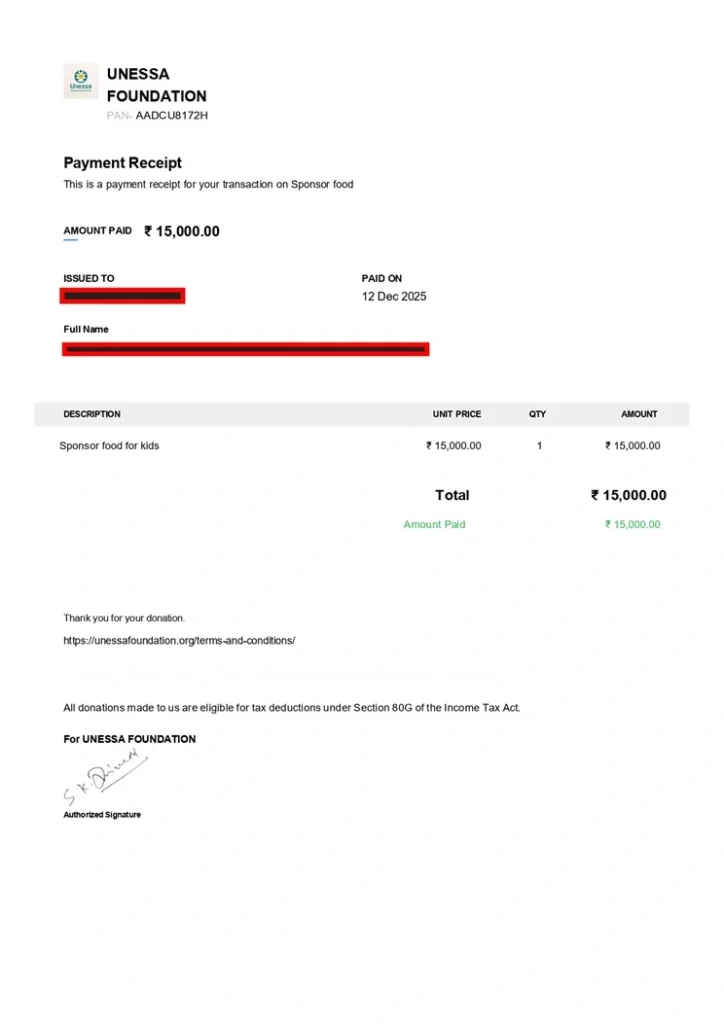
- Transparent PAN & bank details
- Documented impact with photos & videos
- Verified beneficiary testimonials
- Real-time reporting for donors
- Strong community credibility
- Professional distribution teams
- Structured donation pickup system
- 100% donor safety and accountability
Donate Confidently — Support India’s Verified, Transparent, and High-Impact
Why Many NGOs in India Fail Verification

Learn More About this!
What Is a Partially Verified NGO?
A Partially Verified NGO is an organization that:
- Does some genuine work
- Has basic registration
- But lacks complete documentation, transparency, or reporting
They are not unsafe, but donations should be made with caution.
12-Step NGO Verification Checklist for Donors in India
- Trust/Society/Section 8 Registration Certificate
- Current 80G certificate
- Valid 12A certificate
- PAN card in NGO’s name
- Bank account in NGO’s name
- Website or official public presence
- Clear office address & contact numbers
- Photos/videos from recent fieldwork
- Impact reports or financial statements
- Receipts for donations
- Team details (trustees, volunteers, leadership)
- Public reputation or testimonials
Skip the verification hassle — Donate to a fully Verified NGO: Unessa Foundation
Risks of Donating to Non-Verified NGOs in India

A Non-Verified NGO is an organization with no legal documentation, no transparency, and no impact records. Donations to such entities are unsafe.
How Verified NGOs Maintain Donor Trust in India
- Legal and financial transparency - Every rupee donated is accounted for.
- Regular impact communication - Photos, videos, completion reports.
- Donor-first systems - Receipts, acknowledgments, helplines.
- Full 80G support - Ensures tax compliance.
- Professional operations - Field teams, coordinators, structured processes.
- Ethical storytelling - No manipulation, no misuse of beneficiary identity.
Evaluate Any NGO in 30 Seconds (Quick Table)
Criteria
VERIFIED NGO
PARTIALLY VERIFIED NGO
NON-VERIFIED NGO
Registration Docs
✔
⚠
❌
80G/12A
✔
⚠
❌
Impact Photos
✔
⚠
❌
Contact Info
✔
⚠
❌
Receipts
✔
⚠
❌
Donor Safety
High
Medium
Low
Top Red Flags of Fake or High-Risk NGOs in India
- No website or physical address
- Asking for UPI transfers to personal accounts
- Operating only via WhatsApp groups
- No registration or tax documentation
- Stock images instead of real work
- No team details
- Pressured donation requests
- No public records of beneficiaries
- No receipts or acknowledgment
- No long-term programs—only “seasonal” activity
Learn More About this!
When You Should Prefer a Verified NGO
Always choose Verified NGOs when donating:
- Money
- Blankets & clothes
- Food supplies
- Hygiene kits
- School kits
- Medical support
- Any relief material
Because only verified NGOs ensure:
- Legal compliance
- Proper distribution
- Data-backed impact
- Donor safety
- Transparency
For safe, transparent, and high-impact contributions — Donate through Unessa Foundation
FAQ
1. How can I verify an NGO in India?
Check registration documents, 80G/12A status, PAN, bank details, impact reports, and public transparency indicators.
2. What is the difference between verified and non-verified NGOs?
Verified NGOs meet legal, financial, and transparency standards. Non-verified NGOs lack documentation and pose safety risks.
3. Are NGO donations in India eligible for tax benefits?
Only if the NGO has a valid 80G certificate.
4. Can I trust NGOs operating only on social media?
Not unless they provide verified documentation.
5. Why is Unessa Foundation considered a Verified NGO?
It meets all verification criteria, maintains transparent systems, and demonstrates strong on-ground impact.