

Why Scholarships Are the Bridge Between Talent and Opportunity
India produces some of the world’s most talented students from the most resource-constrained environments. Yet talent alone does not guarantee access to higher education when a family earns Rs. 8,000 a month. Scholarships for underprivileged children are not handouts — they are investments in proven potential. According to the National Sample Survey, over 60% of students who drop out of higher education cite financial reasons as the primary cause.
A scholarship for underprivileged children does more than pay fees. It signals to a child and their family that their effort has been recognized, that someone believes in them, and that their future is worth investing in. That psychological impact is as powerful as the financial one.
The Scholarship Awareness Gap
Despite hundreds of scholarship programs being available, lack of awareness is the biggest barrier to uptake. Students live in remote towns and villages where information rarely reaches — and when it does, application procedures overwhelm families unfamiliar with digital systems or document requirements.
Studies show that over 40% of eligible students never apply simply because they don’t know about the opportunity or fear the process is too difficult.
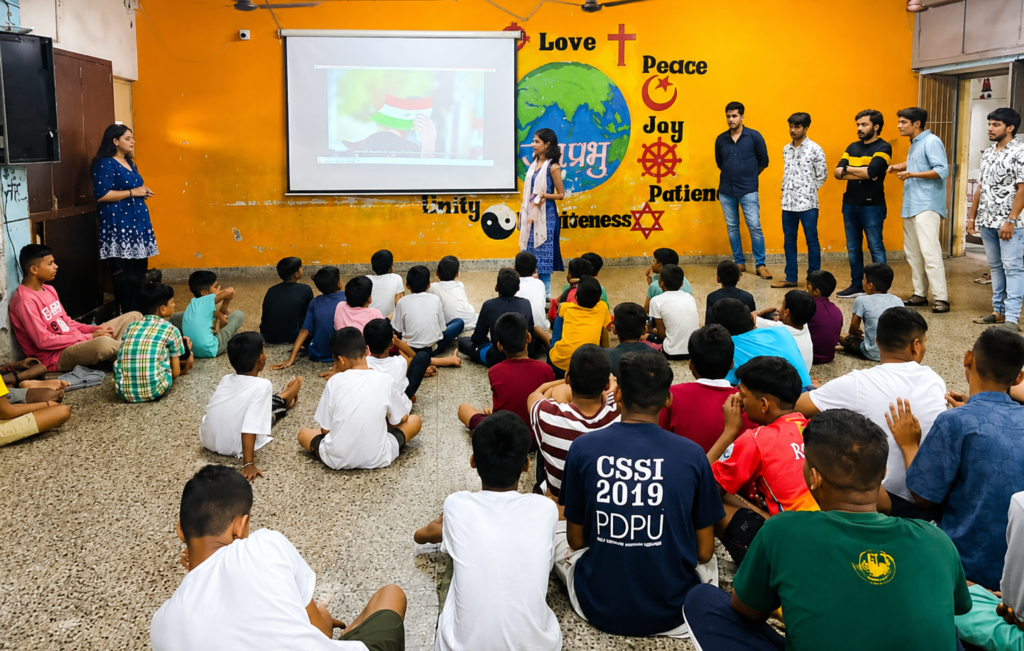
Unessa Foundation’s Insight: Empowering community teachers and volunteers to spread scholarship information has increased application rates by 38% in districts where active awareness campaigns were run.
How Financial Need & Academic Merit Intersect
Scholarship programs generally evaluate:
- Financial Need: Income certificates, family status, rural background
- Academic Merit: Grades, board exam scores, discipline‑specific performance
- Potential & Leadership: Community activities, extracurricular achievements
High family need alone may qualify a student for need‑based grants, while top academic performers are eligible for merit‑based awards. Programs such as the Merit Cum Means Scholarship blend both — rewarding students who need financial help but also excel academically.
👉 Click here to know about Long-Term Benefits of Sponsor Education Programs: Why Investing Now Changes Everything
Case Study
Background: A 16-year-old girl in Madhya Pradesh ranked in the top 5% of her state board exams but was told by her parents she would not continue to college. Challenge: The family saw no pathway to fund her education. Actions Taken: A local NGO counselor informed them about the Prime Minister’s Scholarship Scheme and helped the family complete the application. Outcome: The girl received a full scholarship covering tuition, hostel, and stipend for three years. She is now completing a B.Sc. in Nursing. Lesson: Information and application support can change a life entirely.
Pro Tips
- Create a scholarship calendar for your region — different scholarships have different deadlines and eligibility windows.
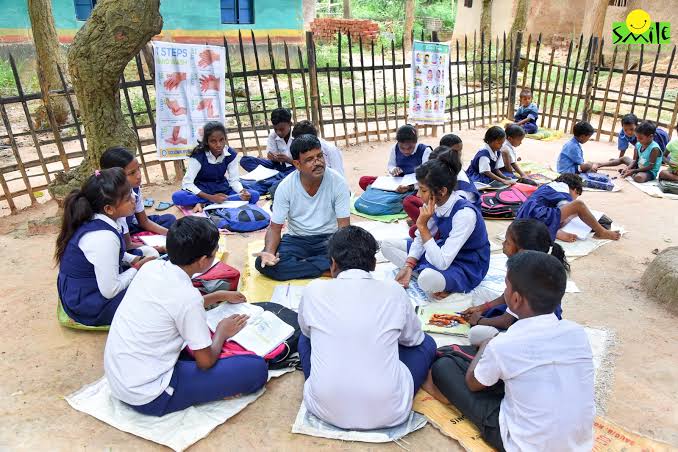
- Train community educators to identify eligible students and guide applications actively.
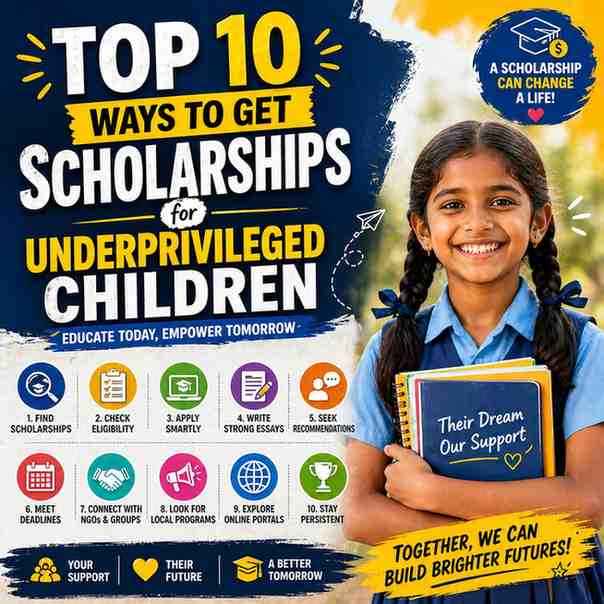
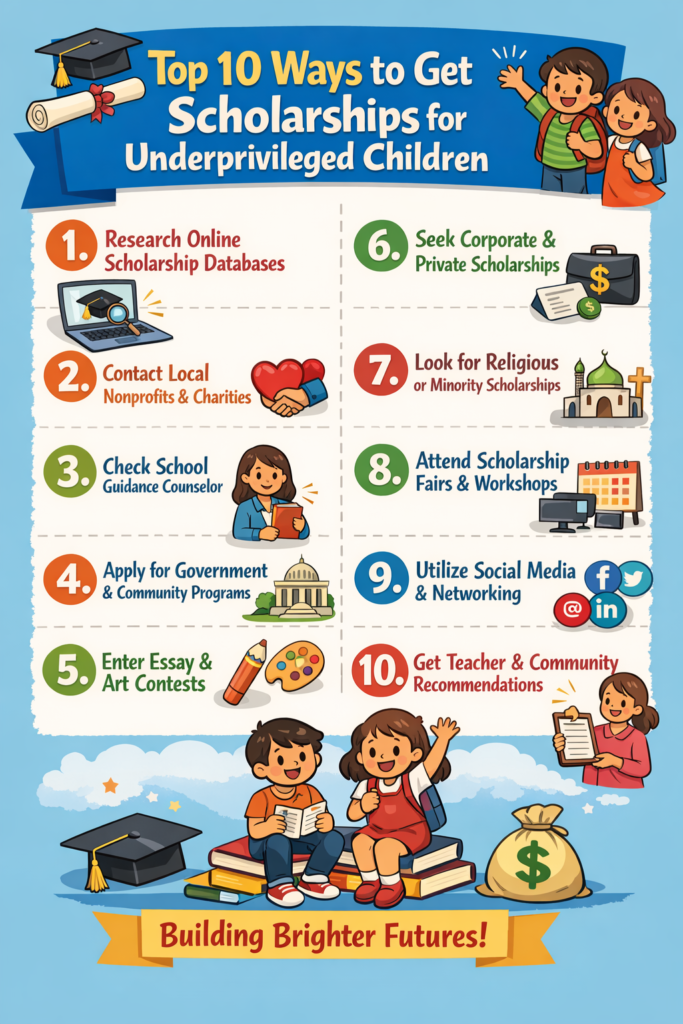
Top 10 Ways to Secure Scholarships for Underprivileged Children
1. Government National Scholarship Portal (NSP)
The National Scholarship Portal (scholarships.gov.in) is India’s official central platform for most government scholarships:
- Students can apply for multiple schemes through a single registration.
- Includes pre‑matric, post‑matric, technical education, and maintenance scholarships.
- State and central schemes are consolidated here for ease of access.
2. Prime Minister’s Scholarship Scheme
This central scheme focuses on:
- Children of defense personnel, ex‑servicemen, and families in lower income brackets.
- Benefits include tuition support and stipends for UG/PG programs.
Because eligibility involves parental employment records, NGO or school counsellor help is crucial for compiling correct documentation.
3. Pre‑Matric & Post‑Matric Trans‑State Scholarships
These are among the largest scholarship buckets for SC/ST/OBC and other reserved categories:
- Pre‑matric: Students studying in Class 9 and 10.
- Post‑matric: For Class 11, 12, UG, and PG courses.
- Covers tuition fees, maintenance, and sometimes hostel allowances.
Each state often has its own portal or linkage with NSP, so students must check both local and national lists.
4. Minority Scholarships (Maulana Azad Foundation & Others)
Scholarships for students from minority communities (Muslim, Christian, Sikh, Buddhist, Jain, Parsi) include:
- Full‑fee scholarships for higher education.
- Merit‑based awards with monthly stipends.
- Special programs for girl students and science/medical aspirants.
NGOs and community centres usually assist with applications and awareness drives.
5. Merit Cum Means Scholarships
This is a central government scholarship combining:
- Academic merit (boards or qualifying exam marks).
- Family income thresholds.
It targets students entering professional or technical courses — engineering, medicine, law, and similar fields.
6. Corporate CSR Scholarships
Many public and private companies run scholarship schemes under Corporate Social Responsibility (CSR) mandates:
- Often multi‑year support covering fee + book stipend.
- Some link with internships or employment opportunities.
- Examples include scholarships from major banks, tech firms, and industrial groups.
Apply directly via CSR portals or through partnering NGOs that channel applications.
7. NGO‑Administered Scholarships
NGOs play a central role in reaching students who otherwise remain invisible to formal programs. Some key advantages:
- Local outreach and trust networks.
- Personal mentoring and document support.
- Often includes coaching, transportation support, and peer groups.
Examples of NGO scholarship efforts:
- Academic mentorship + scholarship sponsorship.
- Community‑driven small donor funds for individual children.
- Residential preparatory programs for college entrance tests.
8. International Scholarships & Foundations
For exceptional students:
- Foundations such as Aga Khan, Commonwealth, and Rotary offer scholarships with international study options.
- These are highly competitive but transformational for students with global goals.
Students must prepare portfolios, essays, and recommendation letters far in advance.
9. State Government Merit Scholarships
Every Indian state runs targeted scholarship schemes alongside national ones:
- For academically outstanding students from economically weaker sections.
- Some focus on rural talents and first‑generation college students.
- Important to register with state education boards and check annual notifications.
10. Crowdfunded & Community Scholarships
Platforms like Milaap, Ketto, and local community funds allow:
- Communities to sponsor individual children.
- Personalized scholarship support tailored to student needs.
- Often combined with mentorship and outcome tracking.
These scholarships are especially helpful when mainstream schemes fail to cover full costs.
How to Build a Strong Scholarship Application
A strong application includes academic transcripts, a compelling personal statement, income and caste certificates (where applicable), teacher recommendations, and proof of extracurricular achievement. Encourage students to write honestly about their circumstances — reviewers respond to authenticity, not performance.
Essential Elements of a Winning Application
Component
Purpose
Academic Transcripts
Proof of performance
Personal Statement/Essay
Tell your story and goals
Income Certificate
Verify financial need
Teacher/Leader Recommendations
Validate character & potential
Extra‑Curricular Achievements
Show rounded capability
Resume/Portfolio
Organize achievements professionally
How NGOs Are Bridging the Scholarship Gap
NGOs play a critical role in the scholarship ecosystem — not just as funders, but as navigators, coaches, and advocates. They identify high-potential students who would otherwise be invisible to formal scholarship programs, provide mentoring through the application process, and offer wraparound support including tutoring, counseling, and career guidance.
Unessa Foundation’s scholarship program goes beyond financial support. Each sponsored student receives a mentor, access to study materials, and quarterly academic reviews to ensure they remain on track throughout their scholarship period.
Tracking Scholarship Impact: Metrics That Matter
Scholarship programs should track not just award numbers but retention rates, graduation rates, first-generation college graduate percentages, and post-graduation employment. A scholarship that a student cannot sustain because of non-academic barriers — like lack of accommodation or mental health support — is an incomplete intervention.
Case Study
Background: A scholarship program awarded 50 college scholarships but saw a 35% dropout rate among recipients in Year 2. Challenge: Students were struggling with urban adjustment, loneliness, and academic pressure without support systems. Actions Taken: The program added a buddy system, monthly check-ins with a counselor, and emergency financial support for unexpected needs. Outcome: Year 3 retention improved to 91%. Lesson: Financial support alone is not enough; holistic support determines scholarship success.
Pro Tips
- Build alumni networks so scholarship recipients can mentor future applicants from their communities.
- Create emergency funds within scholarship programs to address unexpected financial shocks that derail students.
Regional & State Scholarship Portals You Should Know
Every state in India now runs or links scholarship support to its education department portal. For example:
- Gujarat Scholarship Portal — state merit & need scholarships
- Maharashtra Scholarship Portal — pre‑matric, post‑matric schemes
- Karnataka Education Scholarship Programs
Students should keep a regional scholarship calendar to track deadlines.
Conclusion
Talent is equally distributed; opportunity is not. Scholarships are the most direct mechanism to correct that imbalance. The 10 pathways outlined in this blog give students, families, NGOs, and donors a clear roadmap to access and provide financial support for underprivileged children’s education. Do not let another exceptional child drop out because the paperwork was too complex or the deadline too obscure. Support Unessa Foundation and help every deserving student find their pathway to higher education.
Frequently Asked Questions
What is the National Scholarship Portal?
The National Scholarship Portal (scholarships.gov.in) is a centralized platform for students in India to apply for central and state government scholarship schemes.
Can underprivileged students apply for multiple scholarships?
Yes, students can apply for multiple scholarships simultaneously. However, some scholarships prohibit concurrent receipt of other government awards, so read eligibility conditions carefully.
How do NGOs help with scholarships for underprivileged children?
NGOs identify eligible students, assist with application preparation, provide mentoring, and often administer their own scholarship funds from CSR and donor contributions.