
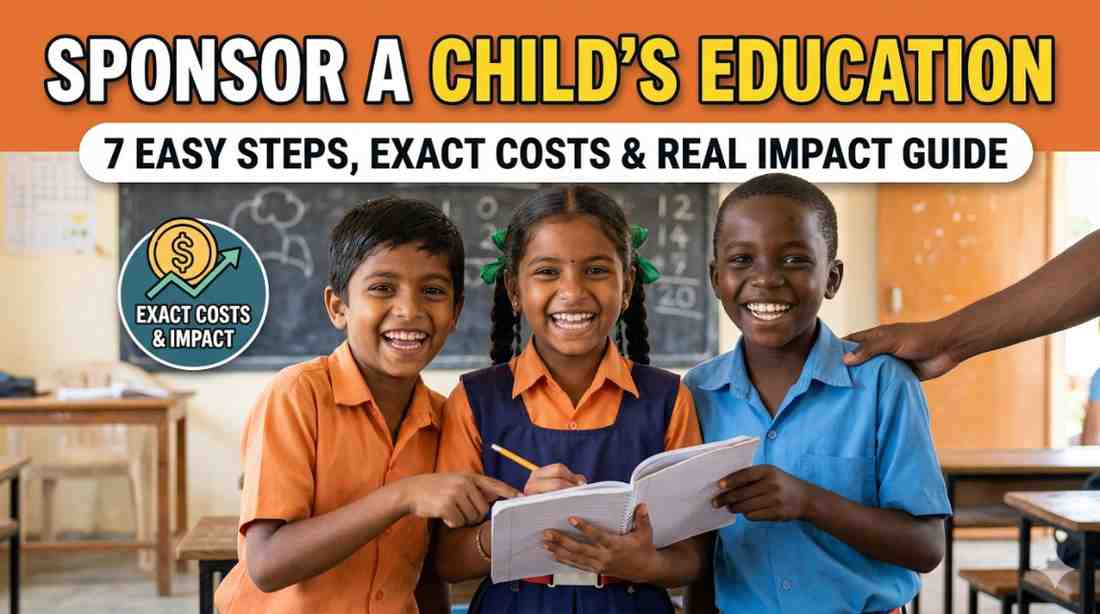

Child education sponsorship is one of the most direct, accountable, and personally meaningful ways to support a child’s future. But it is also one of the most misunderstood — with questions about cost, accountability, transparency, and actual impact clouding what should be a clear decision.
This guide answers every significant question about how to sponsor a child’s education — honestly, specifically, and with the evidence you need to give confidently.
Quick Insight: Child sponsorship programmes that include quarterly learning outcome reports — not just progress letters — produce 23% better educational outcomes than those without structured accountability mechanisms.
1. What Child Education Sponsorship Actually Means
Child sponsorship is a direct funding relationship between an individual donor and a specific child’s education programme. Unlike general charitable donations — which fund an organisation’s overall operations — sponsorship is allocated to a named child’s educational support.
This creates three things that general donations do not:
- Accountability — the NGO must report on that specific child’s progress
- Personalisation — the donor develops a relationship with a real individual
- Motivation — donors with named sponsorships give more consistently and for longer periods
Importantly, credible sponsorship programmes do not involve direct child-donor contact that could create inappropriate dependency or safety risks. Communication is managed through the NGO with appropriate safeguarding protocols.
2. What Does It Cost to Sponsor a Child's Education?
Costs vary significantly based on the country, the programme model, and the NGO’s administrative efficiency. Here are representative figures for India-based sponsorship programmes:
Annual Costs (India, 2024-25)
- Basic primary school support (materials, uniform, nutrition): Rs 8,000-12,000 per year
- Full community learning centre programme (all costs): Rs 10,000-18,000 per year
- Girls’ education programme with stipend component: Rs 15,000-22,000 per year
- Secondary school sponsorship (Class 9-10): Rs 20,000-30,000 per year
Monthly Contribution Equivalents
- Rs 700-1,000/month: Covers basic primary school support
- Rs 1,200-1,500/month: Covers full community learning centre programme
- Rs 2,000-2,500/month: Covers secondary school sponsorship
For reference: these amounts represent 1-3% of a median urban Indian professional’s monthly salary. The cost-to-impact ratio is among the highest available in the philanthropic space.
Quick Insight: Ask the NGO for their cost-per-outcome data — not just cost-per-child. Cost per child who graduates or achieves grade-level learning is the metric that matters for evaluating value for money.
3. What Your Sponsorship Funds
A well-designed sponsorship programme allocates funds across the following categories:
- Learning materials: 20-25% (textbooks, stationery, educational games, library access)
- Educator costs: 35-40% (teacher salary contribution, training, supervision)
- Nutrition support: 15-20% (mid-day meal, micronutrient supplementation)
- Programme overhead: 10-15% (administration, monitoring, evaluation, safeguarding)
- Family support: 5-10% (family engagement sessions, crisis support fund)
Any NGO unwilling to provide this breakdown should be treated with caution. Administrative transparency is a basic accountability standard.
4. How to Measure the Real Impact of Sponsorship
The gold standard for evaluating sponsorship impact is learning outcome data — measurable improvements in reading, writing, and numeracy at regular intervals. Supplementary indicators include:
- Attendance rate: should be above 80% for sponsored children
- Grade-level progression: is the child advancing through expected class levels?
- Family stability indicators: reduction in child labour hours, improved family health
- Community indicators: spillover effects on siblings, peer groups
Reject any programme that can only report on enrollment or activity levels. These are inputs, not outcomes.
5. A Case Study: Three Years of Sponsorship in Odisha
Background
A sponsored child — Raju, 8, from a fishing community in coastal Odisha — had never attended formal school. His family’s seasonal migration pattern made consistent attendance at a fixed-location government school impossible.
Challenge
Standard sponsorship programmes required fixed-location enrollment. Raju’s family moved twice yearly between fishing seasons, making any fixed-location programme incompatible with his family’s reality.
Actions Taken
A flexible sponsorship model: enrolled Raju in a residential learning programme during non-migration periods, provided a digital tablet for learning during migration periods, coordinated with receiving communities to identify local educators for continued support, and maintained quarterly assessments regardless of location.
Outcome
Over three years: Raju progressed from zero literacy to reading at Class 3 level. His attendance-equivalent rate — calculated across fixed and migration-period learning — was 78%. His younger sister was subsequently enrolled, funded by the same sponsor who extended their commitment voluntarily after seeing Raju’s progress.
Lesson
Sponsoring a child’s education produces results when programmes are flexible enough to address the real constraints of poverty — not designed for the idealised circumstances of non-poor children.
6. How to Choose a Credible Sponsorship Programme
- Quarterly progress reports with actual learning assessment data — not just photos and letters
- Child safeguarding policy that governs all donor-child communication
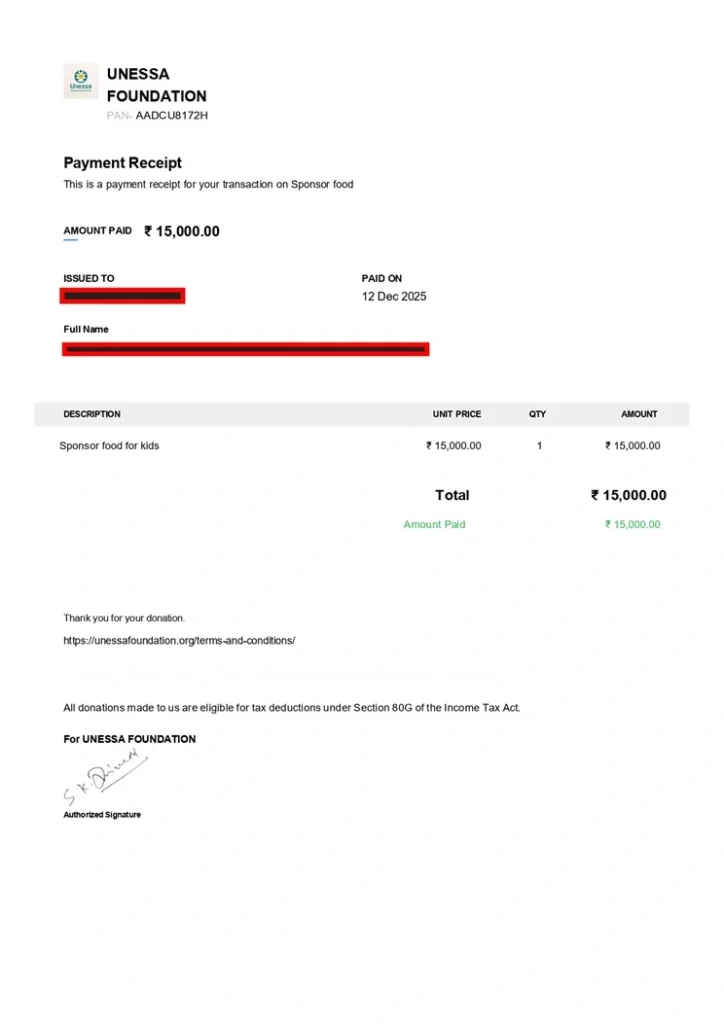
- 80G certification for tax deductibility
- Third-party annual programme evaluation
- Clear fund allocation breakdown showing educator, material, nutrition, and overhead splits
- Published organisational financial accounts
Red flags: programmes that allow unsupervised direct contact between donors and children, programmes that cannot provide learning outcome data, and organisations with overhead ratios above 25%.
7. How to Start Sponsoring in 3 Steps
Step 1: Choose Your Programme Level
Decide whether you want to fund primary, secondary, or full-programme support, and identify your monthly or annual contribution capacity. Be realistic — a commitment you maintain for 3+ years is worth more than a larger commitment you abandon after 6 months.
Step 2: Select and Verify Your NGO
Use the criteria above to evaluate 2-3 organisations. Check their 80G status, request their latest impact report, and confirm their child safeguarding policy. Unessa Foundation’s sponsorship programme includes all of the above.
Step 3: Set Up Recurring Payment and Schedule Your First Review
Configure a recurring monthly payment — not a standing instruction you forget. Calendar a review at 6 months to assess whether you are receiving adequate impact reporting and whether you want to continue, expand, or redirect your support.
👉Click here to know more about : Help Underprivileged children education
8. FAQ — People Also Ask
How much does it cost to sponsor a child's education in India?
Between Rs 8,000 and Rs 30,000 per year, depending on the programme level (primary vs. secondary) and the NGO’s programme model. Monthly equivalents range from approximately Rs 700 to Rs 2,500.
What does child education sponsorship actually include?
Learning materials, educator salary contribution, nutrition support, family engagement, and programme monitoring and evaluation. Credible programmes publish their cost allocation breakdown.
How do I know if a child sponsorship programme is legitimate?
Look for learning outcome data (not just enrollment), 80G certification, third-party annual evaluation, published financial accounts, and a clear child safeguarding policy.
Is sponsoring a child's education better than a general donation?
Sponsorship creates direct accountability and personal motivation to give consistently. General donations provide more operational flexibility for the NGO. Both are valuable — sponsorship is particularly suited to donors who want a personal connection and outcome accountability.
8. Conclusion
Sponsoring a child’s education is not a symbolic act. It is a direct, measurable investment in a specific child’s future — with transparent costs, verifiable outcomes, and significant personal and social returns.
The decision to sponsor requires only three things: a clear understanding of what you are funding, a credible organisation to fund it through, and the commitment to maintain the relationship long enough for it to make a real difference.
Start today. Commit to 3 years. Review the outcomes annually. And watch one child’s trajectory change — because of your specific, deliberate choice.