
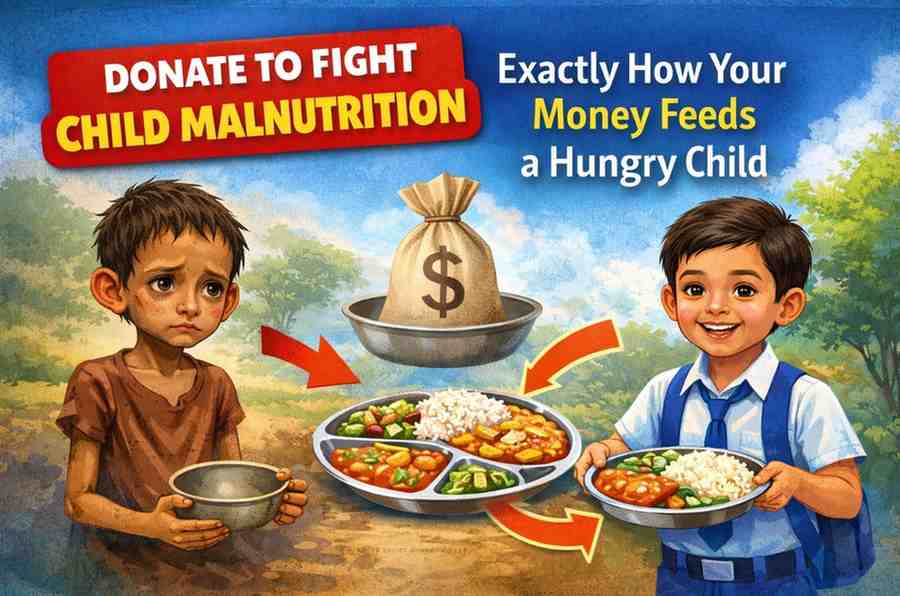

There is no shortage of causes asking for your money. The question is not whether child malnutrition deserves support — it clearly does. The question is whether your donation will actually make a difference, or whether it will be absorbed by administration, diverted from its stated purpose, or deployed in programmes that don’t work.
This post gives you exactly what you need to donate with confidence: what your money actually funds, how to evaluate the organisations asking for it, what the real cost of reaching a malnourished child is, and why acting today rather than later is not emotional manipulation — it is arithmetic.
Quick Insight: The Copenhagen Consensus — a project that ranks development interventions by cost-effectiveness — consistently places nutrition interventions in the top 5 highest-return investments globally. Every dollar invested in preventing or treating malnutrition returns an estimated 16–18 dollars in long-term economic benefit.
1. What Happens When You Donate to Fight Child Malnutrition
Donations to well-run malnutrition programmes fund a specific, traceable chain of interventions:
- Community nutrition workers are trained and deployed to identify, screen, and monitor children under 5
- Ready-to-use therapeutic food (RUTF) is procured and delivered to children with severe acute malnutrition
- Micronutrient supplements — iron, zinc, vitamin A — are provided through community outreach
- Mothers receive nutrition education sessions on affordable dietary diversification
- WASH interventions — household toilet construction, handwashing materials — reduce the infection cycle that worsens malnutrition
- Growth monitoring equipment and protocols are maintained for monthly screening
Each of these activities has a measurable cost and a documented outcome. Well-run programmes publish this data. Before donating to any organisation, request their cost-per-outcome report.
2. The Real Cost of Feeding a Malnourished Child
Community Prevention Programme (per child, per year)
- Community nutrition worker time: Rs 300–500
- Micronutrient supplements (iron, zinc, vitamin A): Rs 150–250
- Nutrition education session materials: Rs 50–100
- Growth monitoring equipment share: Rs 80–120
- Total prevention cost: Rs 580–970 per child per year
Moderate Acute Malnutrition (MAM) Treatment
- Supplementary food (fortified blended flour, 3 months): Rs 800–1,200
- Micronutrient supplementation: Rs 150–200
- Community worker monitoring visits: Rs 200–300
- Total MAM treatment cost: Rs 1,150–1,700 per child
Severe Acute Malnutrition (SAM) — Community-Based
- RUTF (ready-to-use therapeutic food, 8-week course): Rs 1,800–2,400
- Medical consultation and medicines: Rs 500–800
- Community worker visits: Rs 300–400
- Total SAM treatment (community-based): Rs 2,600–3,600 per child
SAM — Inpatient (NRC)
- 14-day NRC admission (food, monitoring, staff): Rs 4,000–8,000 per admission
The arithmetic is unambiguous: preventing malnutrition costs Rs 600–1,000 per child. Treating SAM costs Rs 4,000–8,000. Prevention is 5–8x more cost-effective — which is why programmes that invest in community prevention produce better outcomes per rupee than those focused primarily on emergency treatment.
Pro Tip: When evaluating a malnutrition organisation, ask what percentage of their programme expenditure goes toward prevention vs. treatment. Organisations that invest heavily in prevention — identification, community workers, micronutrient supplementation — produce better long-term outcomes than those focused only on therapeutic feeding.
3. 9 Reasons to Donate to Child Malnutrition Programmes Today
Reason 1: The Need Is Immediate and Verifiable
35.5% of Indian children under 5 are stunted. 19.3% are wasted. These are not estimates — they are from the National Family Health Survey 5 (NFHS-5, 2019–2021), India’s most comprehensive household health survey. The children this data represents are alive today, and the developmental windows during which intervention is effective are closing.
Reason 2: Nutrition Interventions Have the Highest ROI in Development
The Copenhagen Consensus rates nutrition interventions as among the top 5 development investments globally. Every rupee spent on preventing malnutrition returns Rs 16–18 in long-term economic benefit through reduced healthcare costs, higher productivity, and better educational outcomes.
Reason 3: Your Donation Is Leveraged
Credible nutrition NGOs use individual donations to attract matching corporate CSR funds, government partnership contributions, and international aid — typically leveraging every Rs 1 of individual donations into Rs 3–5 of total programme investment.
Reason 4: The Impact Is Measurable in Months
Unlike education interventions, which produce measurable outcomes over years, nutrition interventions produce measurable change in weeks. A child treated with RUTF typically recovers from SAM in 6–8 weeks. Weight gain, MUAC improvement, and energy restoration are visible, measurable, and documentable within months of donation.
Reason 5: You Are Preventing Permanent Damage
As discussed in Blog 4, the neurological and physical damage of early malnutrition is largely irreversible after the first 1,000 days. Each month of delay — in identification, treatment, or prevention — is a month of developmental damage that cannot be undone.
Reason 6: Girls Benefit Disproportionately
Gender-sensitive nutrition programmes that specifically address girls’ malnutrition — through stipends for girls’ school attendance, maternal nutrition support, and gender-sensitisation of food distribution — produce multiplier effects across generations. A well-nourished girl becomes a well-nourished mother who delivers a well-nourished child.
Reason 7: Community-Based Programmes Build Lasting Capacity
The best malnutrition programmes train and employ local community workers — ASHAs, Anganwadi workers, community nutrition volunteers — who remain in the community after programme funding ends. Your donation builds human capital that continues to function beyond the grant cycle.
Reason 8: Tax Deductibility Makes It More Affordable
Donations to 80G-registered NGOs in India are fully or partially tax-deductible. A Rs 10,000 donation from a taxpayer in the 30% bracket effectively costs Rs 7,000 — the government co-funds the remaining Rs 3,000. Failing to donate is, in effect, leaving co-funding on the table.
Reason 9: Monthly Giving Funds Planning, Not Just Relief
A monthly commitment of even Rs 500 provides NGOs with the predictable income stream to plan, hire, and sustain community nutrition workers throughout the year. One-time donations fund one-time activities. Monthly giving funds programmes that change trajectories.
Reflective Question: What would it take for you to commit Rs 500 per month to a malnutrition prevention programme? That is approximately the cost of one restaurant meal — and it funds one child’s micronutrient supplements, growth monitoring, and nutrition education for an entire month.
4. How to Choose the Right Organisation
Not all nutrition NGOs are equally effective. Apply these criteria before donating:
- Published recovery rates for SAM treatment (should be above 75%)
- Cost-per-child data — prevention cost and treatment cost published separately
- Third-party programme evaluation within the last 3 years
- 80G certification for tax deductibility
- Overhead ratio below 20% — at least 80 paise of every rupee reaching programmes
- Community participation in programme design and governance
- Child safeguarding policy — published and actively implemented
Red flags: organisations that publish only enrollment or output data without outcome data; organisations without independent audits; organisations with overhead above 25% without explanation.
5. A Case Study: What Rs 5,000 Funded
Background
A software professional in Bengaluru made a one-time donation of Rs 5,000 to Unessa Foundation’s community nutrition programme. She requested a specific allocation report — Unessa Foundation’s policy of transparent fund allocation allowed this.
Allocation
The Rs 5,000 was allocated as follows: Rs 1,800 toward RUTF for one SAM-range child (4-week course); Rs 900 toward iron and zinc supplementation for 6 children for one month; Rs 1,200 toward 4 community nutrition worker visits (growth monitoring, counselling, referral coordination); Rs 700 toward a nutrition education session for 12 mothers; Rs 400 toward programme monitoring and evaluation costs.
Outcome Reported at 3 Months
The SAM child treated with RUTF recovered to MAM range within 6 weeks and to normal nutritional status within 10 weeks. Of the 6 children receiving supplementation, 4 showed haemoglobin improvement at the 3-month assessment. The 12 mothers in the education session showed improved dietary diversity scores at follow-up.
Lesson
Rs 5,000 funded measurable nutritional change in 19 children and 12 mothers. The cost-per-beneficiary was Rs 227 — significantly within the evidence-based effectiveness range for community nutrition interventions. This is what transparent, outcome-focused NGO funding looks like.
6. Tax Benefits for Donors in India
Section 80G Deduction
Donations to NGOs registered under Section 80G of the Income Tax Act are deductible from taxable income. Depending on the NGO’s registration category, deductions may be 50% or 100% of the donated amount, with or without a qualifying ceiling.
- Verify the NGO’s 80G registration number on the Income Tax e-filing portal before donating
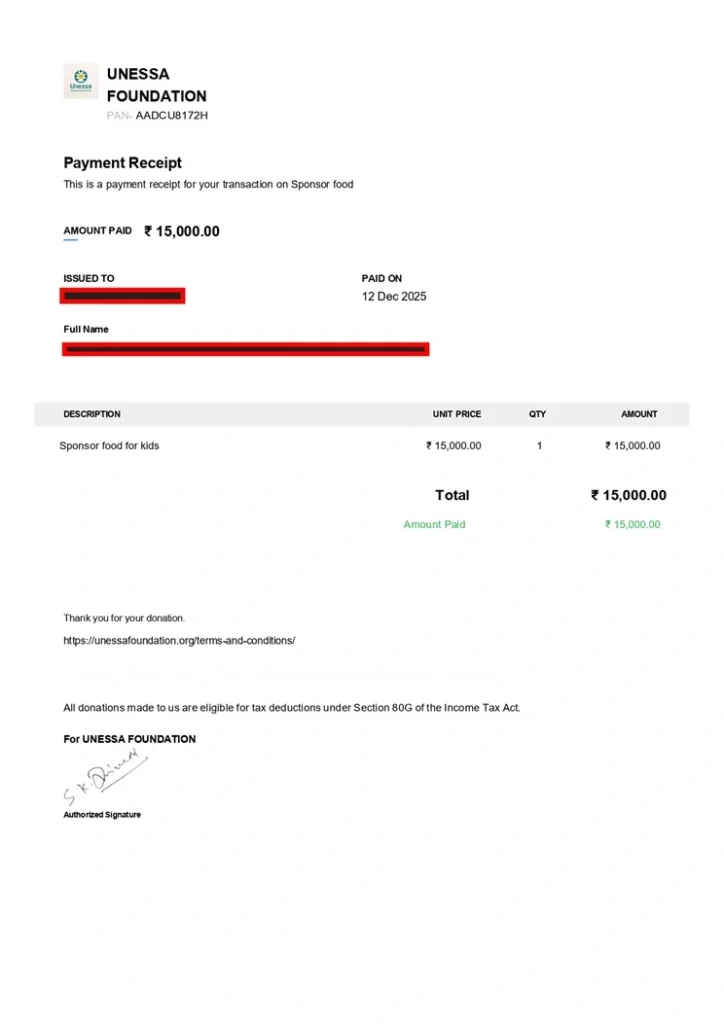
- Request a donation receipt with the NGO’s PAN, 80G certificate number, and receipt date
- Claim the deduction in Schedule 80G of your ITR in the relevant financial year
CSR Under Section 135
Companies with net worth above Rs 500 crore, turnover above Rs 1,000 crore, or net profit above Rs 5 crore are required to spend 2% of average net profit on CSR. Nutrition and hunger are qualifying CSR categories. Corporate donors can allocate CSR funds to certified nutrition NGOs and claim the expenditure as a CSR deduction under the Companies Act.
7. FAQ — People Also Ask
How do I donate to fight child malnutrition in India?
Visit a verified nutrition NGO’s website (such as Unessa Foundation), use their online donation portal or UPI link, verify their 80G status, and request an allocation report confirming how your donation will be used.
How much does it cost to treat a malnourished child?
Community-based SAM treatment costs Rs 2,600–3,600 per child. Prevention costs Rs 600–1,000 per child per year. Inpatient NRC treatment costs Rs 4,000–8,000 per admission.
Which NGO is best for child malnutrition donations in India?
Evaluate using: recovery rate data above 75% for SAM, published cost-per-child figures, independent third-party evaluation, 80G certification, and overhead below 20%. Unessa Foundation meets all these criteria.
Is donating to child malnutrition charities tax deductible in India?
Yes. Donations to 80G-registered NGOs are deductible under Section 80G of the Income Tax Act. Retain your donation receipt with the NGO’s PAN and 80G certificate number for your ITR filing.
8. Conclusion
Donating to fight child malnutrition is not an act of charity. It is a high-return, measurable investment in human capital — funded with verified precision, producing documented outcomes in weeks, and compounding its impact across decades through the children it reaches.
The case for acting today rather than later is not emotional. It is biological. The developmental windows during which nutrition shapes a child’s brain, immune system, and body are open now — and closing with each month that passes.
Give monthly. Give to organisations that publish their outcomes. And give knowing that your Rs 500 funds a month of micronutrient supplements, growth monitoring, and nutrition education for a specific child who needs it now.