
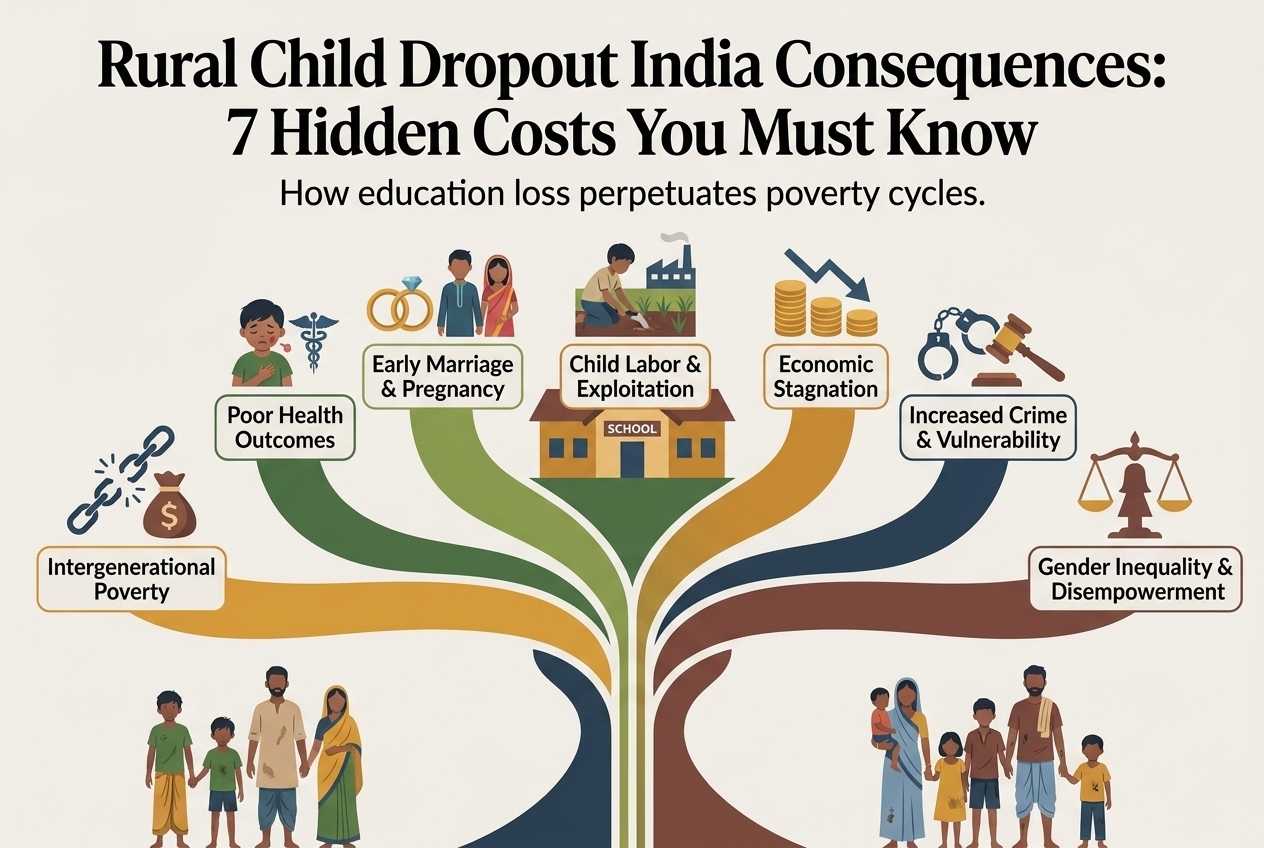

Rural child dropout india consequences are not always visible at first glance—but they shape the future of millions of children across the country.
In many villages, dropping out of school is not a sudden decision. It happens slowly. A child misses a few classes. Then a few more. Eventually, school becomes something they used to attend, not something they are part of anymore.
For some families, it feels like a necessary choice. For children, it often becomes a turning point that limits their future.
This blog explores what really happens after a child drops out, why it continues to happen in rural India, and how organisations like Unessa Foundation are working to change this reality.
India's School Dropout Crisis: How Bad Is It Really?
At a national level, enrollment numbers may look encouraging. But when we look deeper, a different picture emerges—one where many children leave school long before completing their education.
In rural areas, dropout rates are significantly higher due to a combination of economic, social, and educational challenges.
📊 Dropout Reality Snapshot
Stage of Education
Dropout Trend (Rural India)
Primary School
Relatively low but rising in poor regions
Upper Primary
Noticeable increase
Secondary School
Highest dropout rates
The transition from primary to secondary school is where most children fall behind. This is often the point where education starts competing with survival. And this is where the real problem begins.
The Hidden Consequences of Early School Dropout in Rural Areas
When a child drops out, the impact goes far beyond education. It affects every aspect of their life—often in ways that are not immediately visible.
⚠️ What Happens After Dropping Out
- Limited job opportunities in the future
- Increased likelihood of low-income or unstable work
- Higher risk of entering child labour
- Reduced confidence and social mobility
But these are only the surface-level effects.
🔍 Long-Term Impact on Life
A child who leaves school early often enters adulthood without the skills needed to improve their situation. This creates a cycle where poverty continues across generations
In many cases:
- Education stops → income remains low
- Income remains low → next generation also struggles
📉 Before vs After Dropping Out
Aspect
Before Dropout
After Dropout
Opportunities
Open and expanding
Severely limited
Confidence
Developing
Declines over time
Future Prospects
Flexible
Restricted
Social Mobility
Possible
Difficult
This is the real meaning of rural child dropout india consequences—not just leaving school, but losing opportunities.
Why Rural Children Drop Out: The Root Causes No One Addresses
To solve the problem, we need to understand why it happens.In most cases, dropping out is not about lack of interest. It is about circumstances.
🔑 Key Reasons Behind Dropout
1. Financial Pressure
Families often rely on children to contribute to income
2. Lack of Awareness
Education is sometimes seen as less valuable compared to immediate earnings.
3. Distance and Accessibility
Schools may be far, making daily travel difficult.
4. Poor Learning Experience
If children don’t understand lessons, they gradually lose interest.
5. Family Responsibilities
Especially for girls, household duties can lead to dropout.
These challenges rarely exist alone. They overlap, making it harder for children to stay in school.
How Unessa Foundation Is Keeping Children in School
Addressing dropout requires more than awareness—it requires action at the ground level. Unessa Foundation focuses on practical, sustainable solutions that directly impact children and their families.Instead of a one-size-fits-all approach, the work begins by understanding the local reality of each community.
🌱 What Makes the Approach Effective
- Focus on foundational learning so children don’t fall behind
- Engage parents and communities to build awareness
- Provide consistent support, not one-time intervention
- Encourage interactive learning to keep students interested
When children begin to enjoy learning and families see its value, the chances of dropout reduce significantly.
👉 Learn more through the Unessa Foundation Mission
What You Can Do to Help Reduce Child Dropout in India
The problem may seem large, but change begins with small actions.
💙 Ways You Can Contribute
Support education programs through donations
Volunteer your time or skills
Spread awareness about rural education challenges
👉 Contribute through the Unessa Foundation Donate
How Dropping Out of School Shapes a Child’s Identity and Confidence
When a child leaves school early, the impact is not limited to education alone. It slowly begins to shape how they see themselves and their place in the world. In school, children are exposed to new ideas, friendships, and opportunities to express themselves. When that environment disappears, so does a major source of growth and confidence.
Over time, children who drop out may begin to feel left behind as they watch their peers continue their education. This comparison often leads to self-doubt, making them believe they are not capable or that education was never meant for them. Without guidance or encouragement, this mindset becomes difficult to change.
The absence of a structured learning environment also affects communication skills and decision-making abilities. Children are less likely to voice their opinions or explore new opportunities because they have not been given the space to develop these skills. As they grow older, this lack of confidence can limit their ability to seek better work, continue learning, or improve their situation.
This is one of the most overlooked aspects of rural child dropout india consequences—it does not just reduce opportunities, it changes how a child thinks about their own potential.
The Generational Impact of School Dropout in Rural India
The effects of school dropout rarely end with one child. In many cases, they extend into the next generation, creating a cycle that is difficult to break. When a child grows up without completing their education, their ability to secure stable and well-paying work becomes limited. This directly affects the financial condition of the family they build in the future.
As a result, their children often grow up in similar circumstances, facing the same challenges and limitations. Education may once again take a backseat to survival, and the cycle continues. Without intervention, this pattern repeats across generations, making it harder for entire communities to progress.
Beyond financial impact, there is also a lack of educational guidance at home. Parents who did not complete their own education may struggle to support their children academically or understand the long-term importance of schooling. This creates an environment where dropping out becomes more common and less questioned.
Breaking this cycle requires consistent effort, awareness, and support at the community level. Addressing rural child dropout india consequences is not just about helping one child stay in school—it is about changing the future of families and communities as a whole.
Conclusion
The decision to leave school may seem small in the moment, but its impact lasts a lifetime. The true weight of rural child dropout india consequences is seen not just in lost education, but in lost confidence, limited opportunities, and cycles of poverty that continue across generations.
Yet, this is not a problem without hope. With the right support, awareness, and consistent intervention, children can stay in school and build a future that looks very different from the past. Efforts across India, supported by research on education challenges in rural India (https://www.education.gov.in), highlight how critical it is to focus on both access and quality of learning.
Change begins when we choose to act. Whether it is through supporting education initiatives, spreading awareness, or contributing resources, every effort helps keep one more child in the classroom.
FAQ — People Also Ask
1. Why do rural children drop out of school in India?
Rural children often drop out due to financial pressure, family responsibilities, lack of access to quality education, and low awareness about the long-term value of schooling. These factors make it difficult for families to prioritize education over immediate survival needs.
2. What are the long-term consequences of dropping out of school in rural India?
The long-term rural child dropout india consequences include limited job opportunities, low income potential, reduced confidence, and a higher risk of poverty continuing across generations. It also affects overall community development.
3. How does school dropout affect rural communities in India?
When many children drop out, it slows down social and economic progress in rural areas. It leads to a less skilled workforce, lower income levels, and fewer opportunities for growth within the community.
4. At what stage do most children drop out in rural India?
Most children in rural India tend to drop out during the transition from primary to secondary education. This is often when financial pressure increases and academic difficulty rises.
5. How can NGOs help reduce school dropout in rural India?
NGOs help by improving learning quality, supporting families, creating awareness about education, and providing consistent on-ground support. They play a crucial role in ensuring children stay engaged and continue their education.