

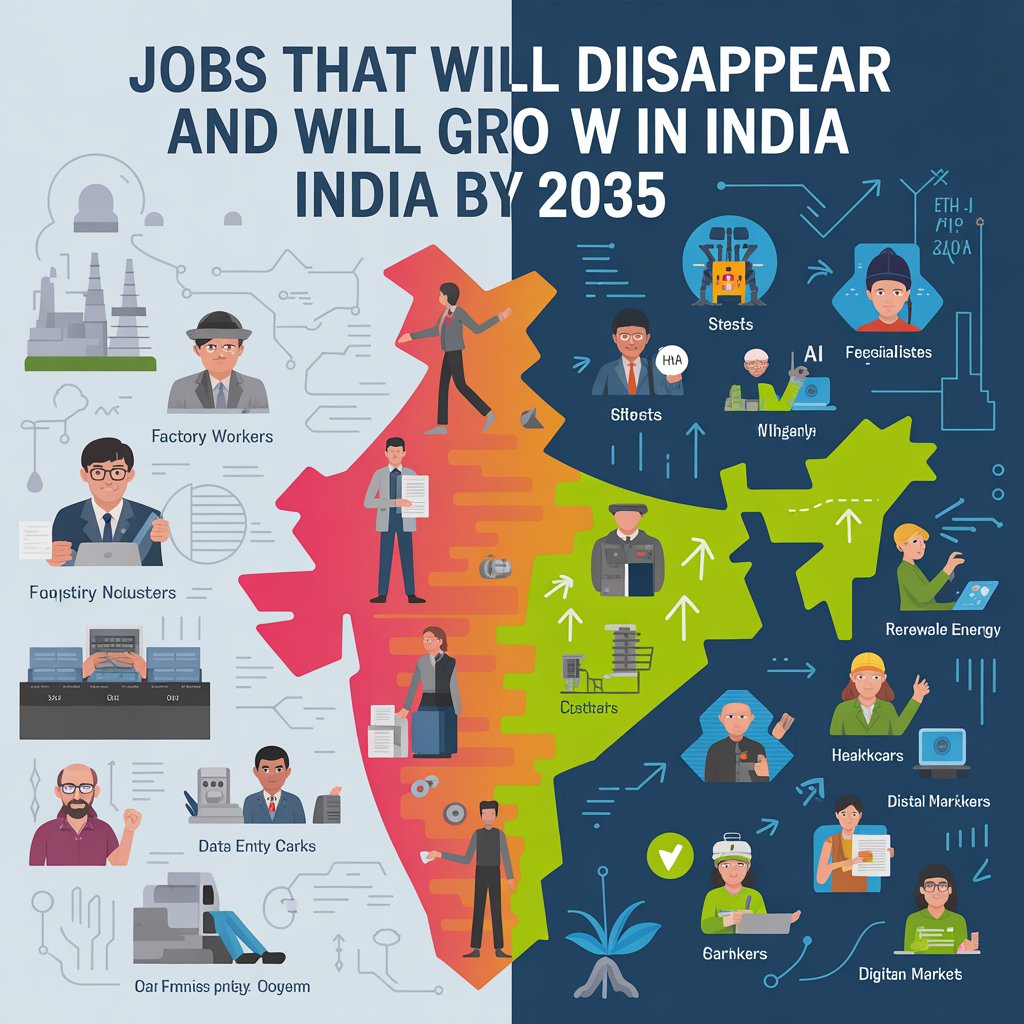


India’s job market is changing faster than ever. With automation, artificial intelligence, digital transformation, and changing industry demands, many traditional roles are expected to decline, while new career opportunities are rapidly emerging. Understanding Jobs That Will Grow has therefore become essential for students planning their future.
For students, parents, and young professionals, this creates one big question: which jobs are safe for the future, and what are the Jobs That Will Grow in India by 2035?
Understanding this shift is important because the careers students prepare for today may look very different by 2035, making it even more important to focus on Jobs That Will Grow.
This blog explores the jobs that may disappear, the careers that are expected to grow, and how students can prepare for the future by focusing on Jobs That Will Grow.
Why the Job Market in India Is Changing
India’s job market is undergoing a major transformation, and this change is happening faster than ever before. The way companies hire, the kind of roles they create, and the skills they expect from candidates are all evolving due to technology, economic shifts, and changing industry demands. This shift is directly shaping the Jobs That Will Grow in the coming years.
One of the biggest reasons behind this change is the rise of automation and artificial intelligence (AI), which is playing a major role in defining the Jobs That Will Grow by 2035.
Businesses across India are increasingly adopting:
- AI-powered tools
- automation software
- cloud platforms
- digital workflows
- data analytics systems
to improve efficiency and reduce repetitive manual work.
Because of this, many traditional roles that relied on routine tasks are slowly being replaced or redefined, while new roles are being created in technology, analytics, and digital operations. This transformation is one of the strongest indicators of the Jobs That Will Grow in India by 2035. Employers in India increasingly expect strong tech talent to drive AI and digital growth, which further highlights the Jobs That Will Grow in the future job market.
Another major reason is the growing skill gap.
Many students still graduate with strong theoretical knowledge but limited practical exposure. Recent reports show that only about 42.6% of Indian graduates are considered employable, mainly because industry expectations are shifting faster than academic systems.
This means companies are now looking for candidates who can bring more than just degrees. They want people who are adaptable, digitally skilled, and ready to learn continuously.
At Unessa Foundation, this shift is especially important because students—particularly underprivileged children—must be prepared not only for today’s jobs but also for the careers that will emerge in the future.
Another major factor is the growth of new-age industries.
Sectors such as:
- artificial intelligence
- cybersecurity
- renewable energy
- healthcare technology
- digital marketing
- education technology
are expanding rapidly, creating new job roles that barely existed a few years ago. By 2030, nearly 63 out of every 100 workers in India may need reskilling or upskilling to stay relevant.
Insight:
The job market is no longer degree-driven alone; it is becoming skill-driven and adaptability-driven.
Case Study:
A student trained only in textbook-based learning may struggle in a role that requires digital tools and real-world problem-solving, while another student with practical skills and internships is more likely to succeed.
This reflects how the Indian job market is shifting from qualification-based hiring to capability-based hiring.
Lesson:
The future job market will reward students who continuously learn, adapt, and build practical skills beyond academics.
👉 Click here to know about Will AI Replace Teachers in the Future? Truth Explained
Jobs That May Disappear in India by 2035
As India moves rapidly toward automation, artificial intelligence, and digital systems, some jobs that rely heavily on repetitive tasks are expected to decline significantly by 2035. This does not mean these roles will vanish overnight, but their demand may reduce as companies adopt faster and more cost-effective technologies.
The jobs most at risk are those based on routine, predictable, and manual digital work.
These may include:
- data entry operators
- basic telecalling roles
- cashiers and billing staff
- routine customer support jobs
- clerical and administrative processing roles
- simple bookkeeping and accounting tasks
- repetitive manufacturing roles
Reports and industry analyses have already pointed out that roles like data entry, telecalling, and basic customer service are among the most vulnerable as AI tools and chatbots become more common.
For example, many companies now use:
- AI chatbots for customer queries
- automated billing systems
- resume screening software
- self-checkout machines
- robotic process automation (RPA) for office tasks
This reduces the need for large teams handling repetitive work.
In India, this shift is especially important because many entry-level jobs traditionally started from such roles. Students and young professionals who rely only on routine-task skills may face stronger competition and fewer opportunities in the future.
At Unessa Foundation, this makes skill-based education even more important, especially for underprivileged students who need future-ready career guidance.
The focus should now move from task-based jobs to thinking-based skills.
Insight:
Jobs involving repetitive and rule-based tasks are the first to be affected by automation and AI.
For instance, a 2025 report highlighted that routine jobs such as data entry and telecalling are already at risk in India as businesses adopt AI-driven systems.
Case Study:
A company that earlier hired multiple executives for basic customer support now uses an AI chatbot for handling common queries, reducing the need for entry-level support staff.
This shows how technology is quietly replacing roles that involve predictable workflows.
Practical Tip:
Students should avoid building careers only around repetitive tasks and instead focus on skills such as:
- communication
- digital tools
- analysis
- creativity
- technical adaptability
Lesson:
The jobs that may disappear are not necessarily entire professions, but the repetitive tasks within them. The future belongs to those who can adapt and upskill continuously.
Jobs That Will Grow in India by 2035
While some traditional jobs may decline, India is also expected to witness significant growth in several future-ready career fields by 2035. As technology, healthcare, education, and sustainability continue to evolve, new job roles will emerge that require specialized skills and human intelligence.
Students who start preparing for these careers today will have a stronger advantage in the coming years.
High-growth careers may include:
- AI and machine learning specialists
- data analysts
- cybersecurity experts
- software developers
- healthcare professionals
- renewable energy engineers
- digital marketing specialists
- UX/UI designers
- mental health professionals
- education technology experts
These roles require problem-solving, creativity, technical knowledge, and human decision-making.
For students supported by Unessa Foundation, this shift highlights the importance of future-ready learning and skill development.
With businesses increasingly relying on AI tools, cloud systems, and data-driven decisions, roles such as software developers, AI engineers, and cybersecurity experts will continue to see strong demand.
For example, companies across industries—from banking to healthcare—are already investing heavily in data security and intelligent systems.
This means students with technical and analytical skills will have excellent career opportunities.
At the same time, healthcare jobs are also expected to grow rapidly.
India’s growing population and increased awareness about health and wellness will create demand for:
- doctors
- nurses
- physiotherapists
- lab technicians
- healthcare administrators
- mental health professionals
Similarly, the renewable energy sector will become increasingly important as India expands its focus on solar, wind, and sustainable energy solutions.
This may create roles such as:
- solar energy engineers
- environmental consultants
- sustainability analysts
- energy management professionals
At Unessa Foundation, this future shift is especially important because students, particularly underprivileged children, need early exposure to skill-based education that aligns with tomorrow’s job market.
Preparing students only for traditional roles may limit their opportunities, whereas guiding them toward future-ready careers can help create long-term stability and growth.
Insight:
The jobs that will grow the most are those that combine technology, human intelligence, and problem-solving.
Case Study:
A student who learned basic coding and data analysis during college was able to secure an internship in a growing tech company, while peers who focused only on theoretical exams struggled to find opportunities.
This shows how early skill-building can directly improve future employability.
Practical Tip:
Students should start building at least one future-focused skill such as coding, digital marketing, data analysis, or communication from an early stage.
Lesson:
The careers that grow by 2035 will reward adaptability, technical learning, and continuous upskilling rather than degrees alone.
Healthcare and Education Will Continue to Grow
Not all future jobs are technology-based.
India will continue to see strong growth in sectors such as:
- healthcare
- nursing
- physiotherapy
- teaching
- educational technology
- counseling
With India’s growing population and increasing awareness around health and education, these fields are likely to remain highly relevant.
At Unessa Foundation, this is especially meaningful because education remains one of the strongest sectors for long-term social impact and employment.
Lesson:
Jobs that improve human well-being and learning are likely to remain strong in the future.
Human Skills Will Become More Valuable
Even in a technology-driven future, human skills will remain essential.
These include:
- communication
- leadership
- emotional intelligence
- critical thinking
- creativity
- teamwork
Machines can automate tasks, but they cannot fully replace human judgment, empathy, and innovation.
This is why students should focus on both technical and soft skills.
Practical Tip:
Develop one technical skill and one soft skill together.
For example:
- coding + communication
- design + presentation
- analytics + teamwork
How Students Should Prepare for 2035
Students preparing for the future should focus on:
- digital literacy
- adaptability
- project-based learning
- internships
- communication skills
- continuous upskilling
At Unessa Foundation, preparing underprivileged children for future careers means going beyond textbooks and helping them build long-term employability.
Insight:
The future belongs to learners who continuously upgrade themselves.
Conclusion
By 2035, India’s job market will look very different from today.
Many repetitive jobs may decline, but new opportunities in technology, healthcare, education, and sustainability will continue to grow.
For students, the key is not fear—it is preparation.
At Unessa Foundation, empowering students with future-ready skills is the best way to ensure they thrive in the changing world of work.
Final Thought:
Jobs may change, but skills, adaptability, and continuous learning will always remain valuable.
Frequently Asked Questions
Which jobs may disappear in India by 2035?
Jobs involving repetitive tasks such as data entry, basic telecalling, and routine manual processing may decline.
Which jobs will grow the most?
AI, cybersecurity, healthcare, education technology, and renewable energy jobs are expected to grow strongly.
How can students prepare for future jobs?
Students should focus on skill-based learning, digital literacy, and continuous upskilling.