
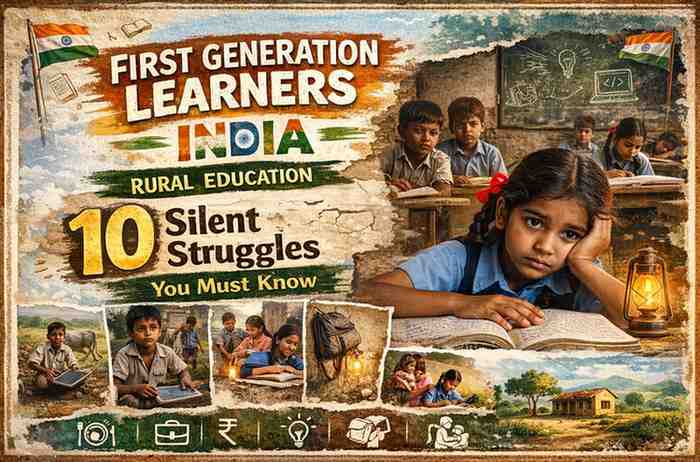

First generation learners india rural education is a reality that often goes unnoticed, yet it quietly shapes the lives of millions of children across the country. For these children, stepping into a classroom is not just about learning subjects—it is about entering a world that no one in their family has experienced before. At home, there are no textbooks lying around, no one to explain difficult concepts, and no guidance on how to prepare for exams or build study habits. Every lesson they learn, every doubt they face, and every challenge they overcome is something they must navigate on their own.
What makes this journey even more difficult is that education, which should feel empowering, can sometimes feel isolating. While other students may receive support, encouragement, and direction from their families, first-generation learners often rely entirely on what happens inside the classroom. When they do not understand something, there is no one to turn to after school hours. Over time, this gap begins to affect not just their academic performance but also their confidence and motivation.
At the same time, these children carry a silent responsibility. They are often seen as the hope for a better future for their families, expected to achieve something that previous generations could not. This expectation, combined with a lack of support, creates a unique kind of pressure that is rarely acknowledged. Their struggles are not always visible, but they are deeply felt.
In this blog, we take a closer look at who first-generation learners are, the challenges they face both inside and outside the classroom, how the absence of a supportive learning environment at home impacts their growth, and how Unessa Foundation is working at the grassroots level to ensure that these children are not left to face this journey alone.
education challenges in rural India → https://www.education.gov.in
Who Are First-Generation Learners and Why Do They Matter?
A first-generation learner is a child whose parents have never received formal education. This means the child is the first in their family to step into a classroom. At first glance, this might seem like a positive step forward—and it is. But it also comes with unique challenges.
Unlike other students, first-generation learners do not have:
- Academic guidance at home
- Support with schoolwork
- Exposure to learning habits
Aspect
First-Generation Learners
Other Students
Academic Support
Minimal or none
Available at home
Exposure to Education
Limited
Familiar environment
Learning Confidence
Often low
Relatively higher
Guidance for Future
Unclear
More structured
These differences may seem small, but over time they create a significant gap in learning and confidence. This is why first generation learners india rural education deserves focused attention.
The Unique Challenges First-Generation Students Face in India
The challenges faced by these learners go beyond academics. They are emotional, social, and environmental. In school, these students are often expected to perform at the same level as others, despite having very different starting points. They struggle not because they lack ability, but because they lack support.
⚠️ Key Challenges They Experience
- Difficulty understanding lessons without reinforcement at home
- Fear of asking questions due to lack of confidence
- Pressure to contribute to household responsibilities
- Limited awareness about career paths
But the biggest challenge is invisible—the feeling of being alone in the learning process. Over time, this can lead to frustration. When a child repeatedly fails to understand lessons, they may begin to believe that education is not for them. This is how many potential learners slowly drift away from school.
How the Absence of a Learning Environment at Home Affects These Children
For most students, learning does not end when school ends. It continues at home—through revision, discussion, and support. But for first-generation learners, this environment is often missing.
🏠 What a Missing Learning Environment Looks Like
- No quiet space to study
- No one to help with homework
- No exposure to books or educational discussions
- Limited encouragement for academic growth
This creates a gap between effort and outcome. A child may attend school regularly, but without reinforcement at home, concepts remain unclear. Over time, this affects performance and confidence.
📉 Impact of Home Environment
Factor
With Support at Home
Without Support
Understanding
Strong
Weak
Confidence
High
Low
Academic Progress
Consistent
Irregular
Motivation
Sustained
Declining
Unessa Foundation's Support System for First-Generation Learners
Recognising these challenges, Unessa Foundation focuses on building support systems where they are missing the most. Instead of expecting children to adapt to the system, the approach is to adapt the system to the child.
🌱 How Support Is Provided
Unessa Foundation creates learning environments that go beyond textbooks.
Students receive:
- Extra academic support
- Interactive learning sessions
- Encouragement to participate and express
Teachers and volunteers play a key role in filling the gap left at home. They guide students, answer questions, and provide the support these children often lack.
👉 Learn more through the Unessa Foundation Mission
Over time, this consistent support helps students:
- Build confidence
- Improve understanding
- Stay engaged in school
The Emotional Journey of First-Generation Learners
Beyond academics, there is an emotional journey that often goes unnoticed in the lives of these children. They carry expectations from their families and are often seen as the hope for a better future, yet they do not always have the tools or support needed to achieve it easily. Along the way, they experience moments of self-doubt, hesitation, and even fear of failure, especially when they struggle to keep up without guidance. However, their journey is not defined only by these challenges. There are also powerful moments of breakthrough—the first time a child solves a problem independently, speaks confidently in class, or realises that they are capable of learning and growing. These moments, though small, become turning points that shape their confidence and motivation. With the right support and encouragement, these positive experiences begin to happen more often, gradually transforming not just their academic performance but also how they see themselves and their potential.
How You Can Support a Child Who Has No Educational Role Model at Home
Change becomes possible when more people choose to be part of the solution.
💙 Ways You Can Help
- Support education initiatives through donations
- Volunteer your time or skills
- Encourage awareness about rural education challenges
Even a small effort can provide the support a child needs to continue learning.
👉 Contribute through the Unessa Foundation Donate
When Education Feels Like a Lonely Journey: The Hidden Isolation of First-Generation Learners
For many first-generation learners, the challenge of education is not just about understanding subjects—it is about navigating an entire journey without guidance. While other students may go home to parents who can explain concepts, help with assignments, or simply encourage them during difficult times, these children often face silence instead of support. Their questions remain unanswered, their doubts unresolved, and their struggles unseen.
This sense of isolation can slowly build over time. A child may sit in a classroom, surrounded by peers, yet feel completely alone in their learning experience. When they do not understand a lesson, they carry that confusion with them beyond school hours, knowing there is no one at home who can help clarify it. The next day, when the class moves forward, they are already one step behind.
What makes this even more challenging is that these children often do not express their struggles openly. Instead, they internalize their difficulties. They may begin to believe that they are not capable, that others are naturally better, or that education is simply not meant for them. This mindset, once formed, can become a barrier that is harder to break than any academic difficulty.
At the same time, the absence of a learning culture at home means that education does not always feel like a shared priority. There are no discussions about school, no routine around studying, and no reinforcement of what is being taught. For a child, this creates a disconnect between school and home, making learning feel like something temporary rather than something that shapes their future.
However, even within this loneliness, there is resilience. Many first-generation learners continue to show up, continue to try, and continue to push through challenges despite the lack of support. Their determination is often quiet but incredibly strong.
When the right support system is introduced—whether through teachers, mentors, or organisations like Unessa Foundation—this loneliness begins to fade. A child who once struggled alone starts to feel seen, heard, and guided. Questions are answered, doubts are addressed, and learning becomes a shared experience rather than a solitary one.
This transformation is not just academic; it is deeply personal. It changes how children perceive education, how they view their own abilities, and how they approach challenges in the future. Addressing this hidden isolation is essential, because education should never feel like a journey a child has to walk alone.
When Education Feels Like a Lonely Journey: The Hidden Isolation of First-Generation Learners
In many rural households, education is not just a personal milestone—it is a turning point that can reshape the direction of an entire family. When a child becomes the first to attend school, they carry more than books; they carry the possibility of change.
At first, the impact may seem small. A child learns to read a signboard, write their name, or solve a simple problem. But these small changes begin to build something much bigger over time.Education introduces a new way of thinking.
A child who goes to school starts to question, understand, and observe the world differently. They begin to see opportunities where earlier there were only limitations. This shift in mindset is where the real transformation begins.
🌱 How One Educated Child Impacts the Family
- They help younger siblings with studies
- They introduce basic awareness about health, money, and daily decisions
- They influence parents to value education more
- They become a source of guidance within the household
These changes may not happen overnight, but they slowly reshape the environment at home. Conversations begin to change. Priorities shift. Education starts becoming a shared value instead of an individual effort.
📊 Before vs After Education in a Family
Aspect
Before Education
After One Child Is Educated
Awareness
Limited
Improved understanding of opportunities
Decision-Making
Based on survival needs
More informed and future-focused
Support for Children
Minimal
Increased encouragement for schooling
Aspirations
Short-term
Long-term goals begin to form
What makes this transformation powerful is that it creates a ripple effect. One child’s progress influences others in the family. Siblings are more likely to stay in school. Parents begin to prioritise education. Over time, this spreads into the community. However, this journey is not without challenges.
Many first-generation learners face obstacles such as financial pressure, lack of academic support, and social expectations. Without guidance, the risk of dropping out remains high. This is where consistent support becomes crucial.
When organisations like Unessa Foundation step in, they do more than just support a child—they strengthen the entire ecosystem around them. By providing learning support, mentorship, and encouragement, they help ensure that the child’s education continues despite the challenges.
🔄 The Ripple Effect of Education
- One child goes to school
- Family begins to see value in education
- Siblings follow the same path
- Community mindset slowly changes
- A new generation grows with better opportunities
FAQ — People Also Ask
1. What are first-generation learners in rural India?
First-generation learners are children whose parents have never received formal education. In rural India, these students are often the first in their families to attend school, making their learning journey more challenging due to a lack of guidance at home.
2. What challenges do first-generation learners face in rural education?
They face multiple challenges such as lack of academic support at home, low confidence, difficulty understanding lessons, and limited exposure to educational resources. These factors make it harder for them to keep up with regular classroom learning.
3. Why is support important for first generation learners india rural education?
Support is crucial because these learners do not have a learning environment at home. With proper guidance, mentorship, and encouragement, they can overcome their challenges and continue their education successfully.
4. How does being a first-generation learner affect a child’s confidence?
Without support, children may feel isolated and develop self-doubt when they struggle to understand concepts. However, with the right help, they can build confidence and actively participate in learning.
5. How can NGOs help first-generation learners in rural India?
NGOs provide academic support, mentoring, and interactive learning environments. They also work with families and communities to create awareness about the importance of education, helping children stay in school.