
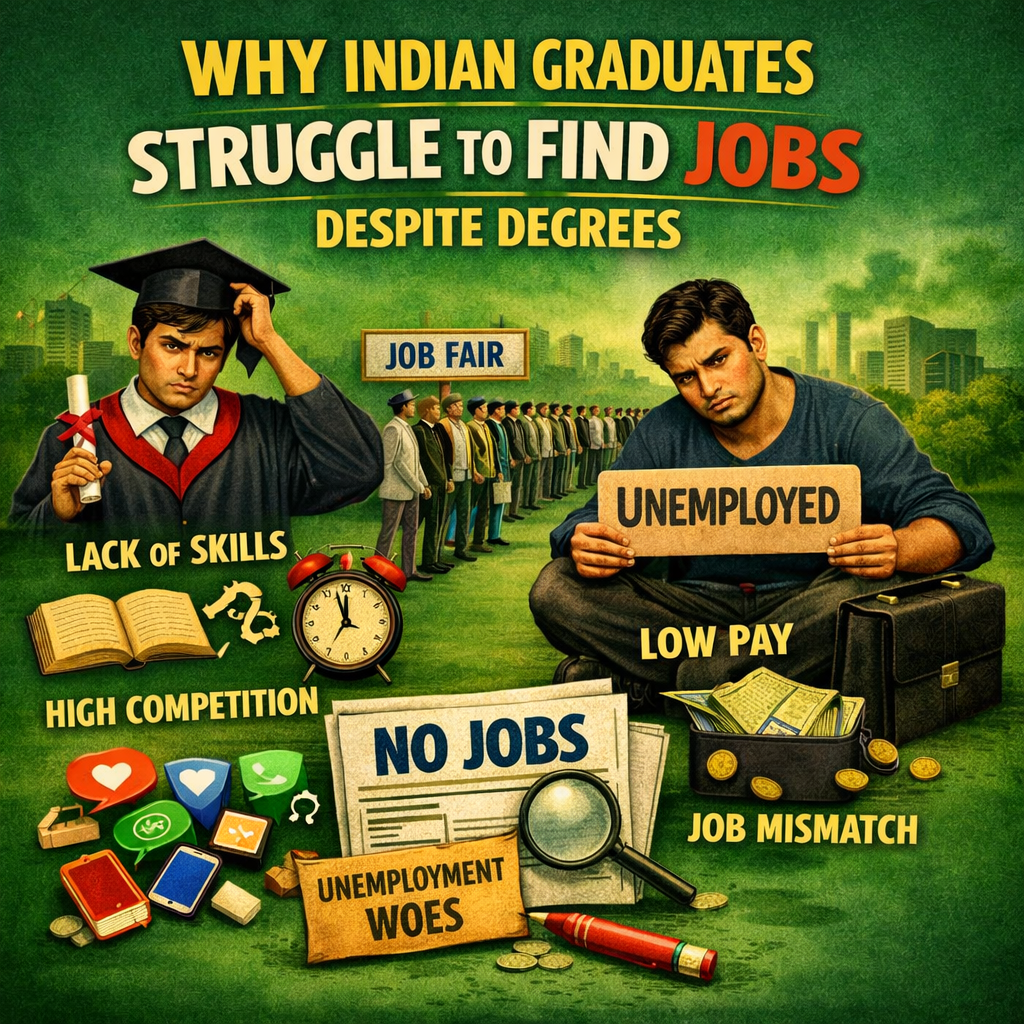

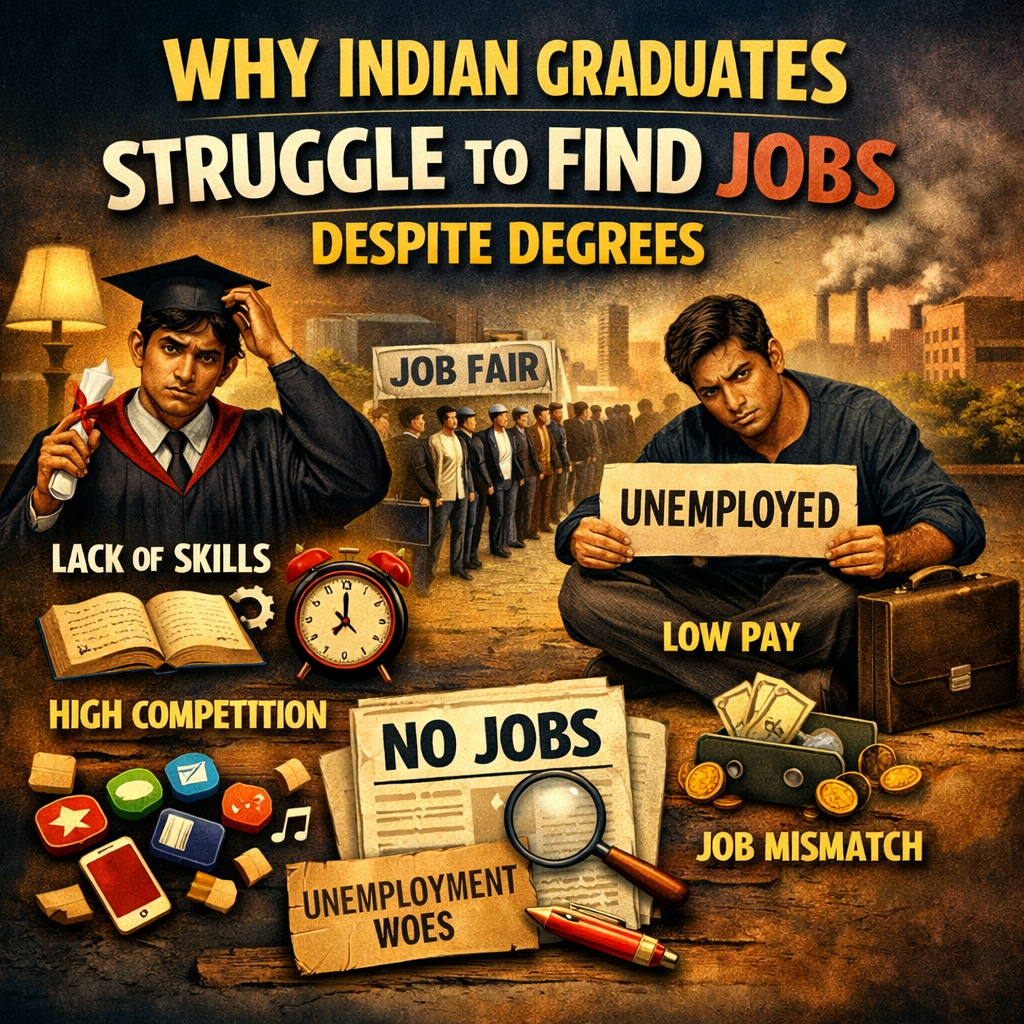
Every year, India produces millions of graduates from engineering colleges, universities, management institutes, and professional courses. Yet one difficult question continues to dominate discussions among students, parents, educators, and employers: why do Indian graduates struggle to find jobs despite degrees?
For many students, earning a degree is seen as the final milestone before entering a stable career. Families invest years of savings, students spend countless nights preparing for exams, and institutions celebrate graduation ceremonies as a symbol of success. However, the reality often looks very different.
Thousands of graduates spend months—or even years—searching for employment opportunities, facing repeated rejections despite holding valid academic qualifications. This issue is no longer limited to one stream; it affects engineering, commerce, arts, management, and even professional degree holders.
This blog explores the deeper reasons behind why Indian graduates struggle to find jobs, the structural gaps in the education system, and what practical solutions can help bridge the divide between degrees and employability.
The Degree–Employment Paradox in India
India’s education system has traditionally emphasized degrees as proof of competence. A student who completes graduation is generally considered “qualified” for employment.
However, the modern job market evaluates candidates differently.
Today, employers assess:
- real-world problem-solving
- adaptability
- communication
- tool familiarity
- practical knowledge
- workplace readiness
A degree may open the door, but it no longer guarantees selection.
This mismatch has created what many experts call the degree–employment paradox: students are academically qualified but professionally underprepared.
Case Study:
A graduate with a B.Tech degree in Computer Science applied to 40 companies over six months. Despite strong academic scores above 8 CGPA, he failed multiple technical interviews because he had no project portfolio and limited practical coding exposure.
Lesson:
Academic performance and employability are no longer identical. Employers value evidence of applied skills.
Pro Tips:
- Build proof of skills through portfolios and internships
- Focus on job-role-specific capabilities
👉 Click here to know about India School Curriculum Relevance to Jobs: Critical Gaps Every Student Must Know
Skill Gap Between Education and Industry
One of the biggest reasons why Indian graduates struggle to find jobs despite degrees is the widening skill gap.
Many colleges still focus heavily on theory-based teaching methods. Students often learn concepts for exams rather than applications for industry.
For example, students may spend an entire semester studying database theory, normalization, and ER models, yet never get the opportunity to work on real SQL projects, live datasets, or query optimization tasks. Similarly, management students often learn business frameworks and case theories in classrooms but rarely gain hands-on exposure to actual tools used in corporate environments, such as CRM platforms, data dashboards, or project management software.
Engineering students, on the other hand, may memorize formulas, derivations, and concepts for examinations without ever applying them to real industrial problems, prototypes, or field-based challenges. This growing gap between academic learning and workplace expectations is one of the main reasons Indian Graduates Struggle to Find Jobs.
Employers today are not just looking for degrees; they expect candidates who can contribute from day one with practical skills, problem-solving ability, and confidence in handling real tasks. When students graduate without internships, project experience, or tool-based knowledge, Indian Graduates Struggle to Find Jobs even after earning respectable marks. The issue becomes more serious when companies prioritize hands-on expertise over textbook knowledge, causing Indian Graduates Struggle to Find Jobs across multiple sectors, including IT, management, and core engineering.
In many cases, Indian Graduates Struggle to Find Jobs because their education has prepared them more for exams than for employment. As industries evolve rapidly, Indian Graduates Struggle to Find Jobs when their skills do not match current market demands. This is exactly why Indian Graduates Struggle to Find Jobs despite holding valid and recognized degrees.
This creates a direct gap between what colleges teach and what companies need.
Case Study:
A mid-sized software company interviewed 100 fresh engineering graduates. Only 18 candidates could solve real-world logic problems, and fewer than 10 had experience with version control tools like Git.
Lesson:
The curriculum often prepares students for marks, not for employment.
Pro Tips:
- Learn current tools used in your industry
- Supplement college education with self-learning
- Practice project-based application
Lack of Practical Exposure
A major employability issue in India is limited hands-on exposure.
Many graduates finish college without:
- internships
- live projects
- industrial training
- case-based learning
- team collaboration experience
Employers often prefer candidates who have at least some practical understanding of workplace environments.
Without exposure, graduates struggle in interviews when asked:
- “Tell us about a project you worked on”
- “How did you solve a challenge?”
- “What tools have you used?”
Case Study:
A commerce graduate with excellent marks applied for finance roles but lacked internship experience in Excel, MIS reporting, and financial software tools. Less academically strong candidates with internship exposure were selected instead.
Lesson:
Experience—even small internships—often outweighs theoretical excellence.
Pro Tips:
- Take short internships during semester breaks
- Volunteer for practical work in NGOs or startups
- Build mini projects independently
Soft Skills and Communication Deficiency
Technical knowledge alone is not enough.
One overlooked reason why Indian Graduates Struggle to Find Jobs is poor soft skills.
Employers highly value:
- communication clarity
- confidence
- teamwork
- problem articulation
- professionalism
Many candidates fail interviews not because they lack knowledge, but because they cannot communicate it effectively, which is another major reason Indian Graduates Struggle to Find Jobs.
This issue is especially common in first-generation learners and underprivileged students who may not have access to communication development opportunities, causing Indian Graduates Struggle to Find Jobs even after gaining technical qualifications.
Case Study:
A technically strong engineering graduate cleared written rounds in three companies but was rejected in HR interviews due to weak communication and inability to explain project logic clearly. This shows why Indian Graduates Struggle to Find Jobs during the final selection stages.
Lesson:
Being skilled is important, but being able to express skills is equally critical, otherwise Indian Graduates Struggle to Find Jobs despite strong academic performance.
Pro Tips:
- practice mock interviews
- improve structured speaking
- focus on clarity over accent
Rising Competition and Market Realities
India’s youth population is one of the largest in the world.
Every year, millions of graduates compete for a limited number of quality jobs.
This supply-demand imbalance makes employment extremely competitive.
For one entry-level position, companies may receive hundreds or thousands of applications.
As a result, employers raise expectations.
A degree that was once enough is now only the minimum requirement.
Case Study:
A graduate applied for an analyst role that received over 2,000 applications within 48 hours. The shortlisted candidates had certifications, internships, and strong project portfolios.
Lesson:
Competition demands differentiation.
Pro Tips:
- create a strong LinkedIn profile
- earn role-specific certifications
- showcase measurable projects
The Role of Technology and Automation
Technology has changed entry-level hiring dramatically.
Tasks once performed by fresh graduates are increasingly automated through:
- AI tools
- automation software
- analytics dashboards
- workflow platforms
This reduces low-skill job opportunities.
Graduates who rely only on degree-based knowledge may find themselves replaced by automation.
Case Study:
A company reduced entry-level data entry hiring by 60% after implementing AI-based process automation tools.
Lesson:
Routine roles are shrinking; analytical and adaptive roles are growing.
Pro Tips:
- learn AI-assisted workflows
- focus on problem-solving roles
- upskill continuously
Financial and Social Impact on Youth
Graduate unemployment is not just an economic issue—it is also a social challenge.
Extended unemployment leads to:
- reduced confidence
- financial dependency
- mental stress
- family pressure
- delayed career growth
For underprivileged youth, this challenge becomes even more severe.
A degree often represents hope for upward mobility. When employment does not follow, it impacts both individual and family stability.
This is where educational NGOs and social initiatives play a transformative role.
Case Study:
A first-generation graduate from a low-income family remained unemployed for eight months after graduation. After joining a skill-based mentorship program, she secured a junior analyst role within three months.
Lesson:
Guidance and structured support significantly improve employability outcomes.
Pro Tips:
- seek mentorship early
- participate in skill development programs
- stay consistent with applications
Solutions for Students, Institutions, and Society
The solution to why Indian graduates struggle to find jobs despite degrees requires collective action.
For Students
- focus on skills over marks alone
- gain internships
- improve communication
- build portfolios
For Colleges
- industry-aligned curriculum
- mandatory internships
- project-based learning
- placement readiness training
For Employers
- hire for potential
- invest in fresher training
- create apprenticeship models
For Society and NGOs
- bridge access gaps
- mentor underprivileged youth
- offer employability workshops
Case Study:
Institutions that integrated industry mentorship programs saw placement rates improve by more than 35%.
Lesson:
Structured intervention works.
Pro Tips:
- start employability preparation in first year
- do not wait until final semester
The Role of NGOs and Skill Development Initiatives
Organizations like UNESSA Foundation play a critical role in addressing educational inequality and employability challenges.
By supporting underprivileged children and students with:
- education access
- career awareness
- mentorship
- foundational learning
- skill development pathways
such institutions help create long-term employability transformation.
Education should not end at degrees—it should empower livelihoods.
Conclusion
The reason Indian graduates struggle to find jobs despite degrees is not because education has no value.
The real issue lies in the disconnect between education and employability.
Degrees provide knowledge, but skills create opportunities.
The future belongs to graduates who combine:
- education
- practical exposure
- communication
- adaptability
- continuous learning
For India to unlock its youth potential, education must move from qualification-based learning to capability-based development.
👉 Click here to know about Why Today’s Students Are Losing Focus Faster Than Ever: Shocking Reasons You Must Know
Frequently Asked Questions
Why do Indian graduates remain unemployed after college?
Because of skill gaps, lack of practical exposure, communication issues, and rising competition.
Is degree alone enough to get a job in India?
No. Employers increasingly prioritize practical skills and job readiness.
How can students improve employability?
Through internships, certifications, project portfolios, and communication training.
Why is this issue serious for underprivileged students?
Because unemployment impacts both financial stability and social mobility.