

Malnutrition effects on children are not temporary problems — they are lifelong consequences that begin in the earliest stages of development. A child who experiences malnutrition in the first two years of life is not simply a child who was hungry. They are a child whose brain was built with insufficient materials, whose immune system was assembled with missing components, and whose body was asked to grow without the raw inputs that growth requires.
The effects of malnutrition on children are not temporary inconveniences that nutrition can later correct. Many are permanent. Understanding what hunger actually does to a developing body and mind is the most powerful argument for prevention — and for the urgency of intervention when prevention has failed.
Quick Insight: Research shows that malnourished children earn, on average, 10–17% less as adults than their well-nourished peers — even when education and socioeconomic background are controlled for. The effects of childhood malnutrition follow a person for life.
1. The Developmental Window That Changes Everything
The first 1,000 days — from conception to the second birthday — represent the most critical period of human development. During this window, the brain forms 1 million new neural connections per second. The immune system establishes its foundational architecture. Organ systems are built and calibrated.
Malnutrition during this window does not merely slow growth. It fundamentally alters the developmental trajectory of every major body system — with consequences that persist across decades.
After this window, the brain retains significant plasticity, and nutritional intervention can improve outcomes substantially. But it cannot fully recover what was lost during the critical developmental period.
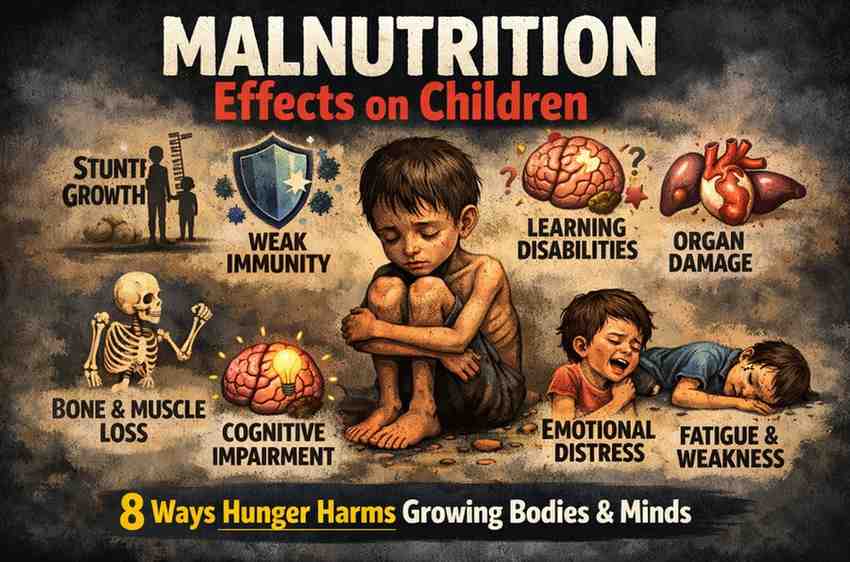
Malnutrition Effects on Children: 8 Critical Impacts
Effect 1: Irreversible Brain Damage and Reduced Intelligence
The brain is the most nutritionally demanding organ in the body. It requires adequate protein, iron, zinc, iodine, and essential fatty acids during critical growth periods. Deficiency of any of these during the first 1,000 days produces measurable, permanent reductions in brain volume, neural connectivity, and cognitive capacity.
Iron deficiency alone — affecting 50%+ of Indian children under 5 — reduces IQ by an estimated 5–10 points on average, with greater effects in children with severe or prolonged deficiency. This is not a recoverable deficit. The neural connections that were not formed during the critical window cannot be formed with the same efficiency after it closes.
Effect 2: Stunted Physical Growth
Stunting — low height-for-age — is the most widely measured effect of chronic malnutrition. Over 148 million children under 5 are stunted globally. Beyond height, stunting reflects compromised development of organs, including the gut (reduced absorptive surface area), heart (reduced cardiac capacity), and kidneys (reduced filtration efficiency).
Stunted children who later become obese adults — a pattern increasingly common as food environments improve while stunting-related organ damage remains — face dramatically elevated risks of cardiovascular disease, diabetes, and metabolic syndrome.
Effect 3: Compromised Immune System
Malnutrition and infection form the most destructive feedback loop in global child health. Malnutrition impairs both innate immunity (physical barriers — skin, gut lining) and adaptive immunity (antibody production, T-cell function). Malnourished children are more susceptible to infection, experience more severe infections, and recover more slowly.
This immune compromise means that routine childhood illnesses — diarrhoea, pneumonia, measles — which are manageable inconveniences in well-nourished children become potentially fatal events in malnourished ones. 45% of all child deaths globally have malnutrition as a contributing cause.
Effect 4: Impaired Learning and School Performance
The cognitive effects of malnutrition manifest directly in the classroom. Children with iron-deficiency anaemia show reduced attention span, shorter working memory, and lower scores on standardised tests than matched peers. Children who experienced stunting in early childhood are significantly more likely to repeat grades, leave school early, and fail to reach their cognitive potential despite adequate learning opportunities in later years.
In India, ASER data consistently shows that children from nutritionally vulnerable households perform worse on literacy and numeracy assessments — even when school access, quality, and attendance are comparable. Malnutrition is an invisible but measurable classroom disadvantage.
Effect 5: Delayed Motor Development
Adequate nutrition is required for myelination — the formation of the protective sheath around nerve fibres that enables rapid, coordinated motor signals. Malnutrition during infancy delays myelination, producing delayed sitting, standing, walking, and fine motor development milestones.
Motor delays are not merely physical inconveniences. They reduce the range of exploratory experiences available to a developing child — limiting the environmental stimulation that drives further cognitive development. Physical and cognitive development are inseparable in early childhood.
Effect 6: Psychological and Behavioural Effects
Chronic malnutrition in early childhood is associated with higher rates of anxiety, depression, and conduct disorders in later childhood and adolescence. The mechanisms are both biological — malnutrition alters stress-response systems and neurotransmitter production — and social: malnourished children are smaller, develop more slowly, perform worse academically, and often experience shame, stigma, and reduced self-esteem as a result.
Research from Bangladesh and Guatemala shows that adults who experienced severe malnutrition before age 2 score measurably higher on anxiety and depression scales even when current nutritional status and socioeconomic conditions are controlled for.
Effect 7: Reduced Adult Productivity and Lifetime Earnings
The World Bank estimates that malnutrition costs countries 2–3% of GDP annually through reduced productivity, higher healthcare costs, and lower educational attainment. At the individual level, stunted individuals earn 10–17% less than non-stunted peers with similar education, because their cognitive capacity, physical stamina, and health status are all compromised by early nutritional damage.
This economic penalty is not fully compensated by subsequent educational investment. A child who was well-nourished and then educated outperforms a child who was malnourished and then given the same education — because the neurological foundation on which education builds was differently constructed.
Effect 8: Increased Risk of Non-Communicable Disease in Adulthood
The Barker hypothesis — now supported by decades of epidemiological evidence — shows that children who experienced nutritional deprivation in utero and early infancy are programmed for metabolic efficiency. When food later becomes available, this programming predisposes them to obesity, hypertension, type 2 diabetes, and cardiovascular disease.
India is currently experiencing the highest rate of increase in type 2 diabetes globally — a pattern that is, in part, the lagged consequence of the malnutrition epidemic of previous decades.
Reflective Question: If the effects of malnutrition on children persist across decades, producing adults with lower earnings, higher disease burden, and reduced potential — what is the true cost of underfunding malnutrition prevention? And who pays it?
3. The Intergenerational Transmission of Malnutrition's Effects
The effects of malnutrition do not stop at the individual. A malnourished girl who grows into a stunted, anaemic woman delivers a low-birth-weight infant with a compromised nutritional start. That infant is more likely to be malnourished, stunted, and cognitively impaired in turn.
This intergenerational cycle means that the effects of today’s malnutrition are compounded in the next generation — creating a biological inheritance of disadvantage that economic improvement alone cannot interrupt.
Breaking the intergenerational cycle requires addressing malnutrition in adolescent girls and women of reproductive age — not only in young children.
4. Which Effects Are Reversible — And Which Are Not
Largely Reversible with Early Intervention (before 24 months)
- Moderate wasting — with therapeutic nutrition support
- Some micronutrient deficiency effects — with supplementation and dietary change
- Mild motor delays — with stimulation and improved nutrition
Partially Reversible with Sustained Support
- Immune function — improves significantly but may not fully normalise
- Some cognitive deficits — catch-up growth in cognitive scores is documented but rarely complete
Largely Irreversible After the Critical Window
- Stunting occurring before 24 months — height deficit largely permanent
- IQ reduction from severe iron deficiency before 2 years
- Organ-level damage from severe acute malnutrition
This irreversibility profile makes the case for prevention unambiguously. Once the developmental window closes, the best intervention available is damage limitation — not restoration.
5. A Case Study: The Long Shadow of Early Malnutrition
Background
A longitudinal study tracking 180 children from a tribal district of Jharkhand from birth to age 12 found that children who had been stunted by age 2 scored, on average, 14 points lower on standardised cognitive assessments at age 8 than non-stunted children from the same community.
Challenge
he stunted children had received catch-up nutrition support from ages 3–5 and had attended the same schools as non-stunted peers. Their diets at age 8 were comparable in quality. The teachers, the curriculum, the school quality — all controlled. Yet the cognitive gap persisted.
Outcome and Lesson
The nutritional support provided after age 3 partially narrowed the gap — stunted children who received supplementation scored higher than stunted children who did not. But the gap with never-stunted children did not close. The study concluded that the neurological architecture built in the first 2 years was the limiting factor — and that interventions delivered after the critical window, while beneficial, could not fully replicate what early adequate nutrition would have produced.
This finding is not a reason for despair — it is a reason for redesigning investment priorities toward the first 1,000 days.
6. FAQ — People Also Ask
What are the long-term effects of malnutrition in children?
Long-term effects include permanent cognitive impairment, stunted growth, compromised immune function, reduced adult earnings, psychological disorders, and increased risk of non-communicable disease in adulthood. Many effects are irreversible after the first 1,000 days.
How does malnutrition affect brain development?
Malnutrition impairs brain development by depriving the growing brain of protein, iron, zinc, iodine, and essential fatty acids during critical developmental windows. This reduces brain volume, neural connectivity, and cognitive capacity — permanently in severe cases.
Does malnutrition affect intelligence?
Yes. Iron deficiency alone is estimated to reduce IQ by 5–10 points on average. Severe protein-energy malnutrition in early childhood produces measurable, lasting reductions in cognitive function even when children later receive adequate nutrition.
Can a malnourished child fully recover?
Partial recovery is achievable — particularly with early intervention before 24 months. Full recovery to the developmental potential that adequate early nutrition would have produced is not achievable for most forms of severe or prolonged early malnutrition.
7. Conclusion
The effects of malnutrition on children are not a temporary inconvenience. They are a permanent dimming of potential — measured in IQ points, height centimetres, lifetime earnings, and years of healthy life lost to preventable disease.
Understanding these effects changes how we think about malnutrition funding. It is not a welfare expenditure. It is an investment in human capital that, if not made during the critical developmental window, cannot be made with equivalent returns at any later time.
Organisations like Unessa Foundation understand this urgency — which is why their programmes are designed around the first 1,000 days, maternal nutrition, and community-level prevention rather than emergency treatment alone.
The cost of allowing malnutrition to proceed is permanent. The cost of preventing it is manageable. The choice is one of priorities — not resources.