
COMMUNITY & GIVING
NGO Expansion: 5 Helpful Checks for Planning Responsibly
NGO expansion should follow a clear understanding of community needs and the organisation's capacity. A new location needs more than an announcement: it requires people, resources and a reliable delivery arrangement.
Published by Unessa Foundation · Editorial update: 4 November 2026
Before adding a location, confirm local responsibilities, supervision, costs and the route for community feedback. Set a limited initial scope and review whether the team can sustain it alongside existing commitments.
For the delivery responsibilities behind an NGO plan, read small NGO operational planning.
A small NGO may want to deepen an existing programme or work in another location. Limited people, funds and supervision make the choice consequential. This guide considers internal capacity, partnerships, technology, community participation, evidence and fundraising as six related planning areas.
The organisation examples are starting points for research, rather than a promise that the same approach will work in every community.
Why Scaling Matters for Small NGOs
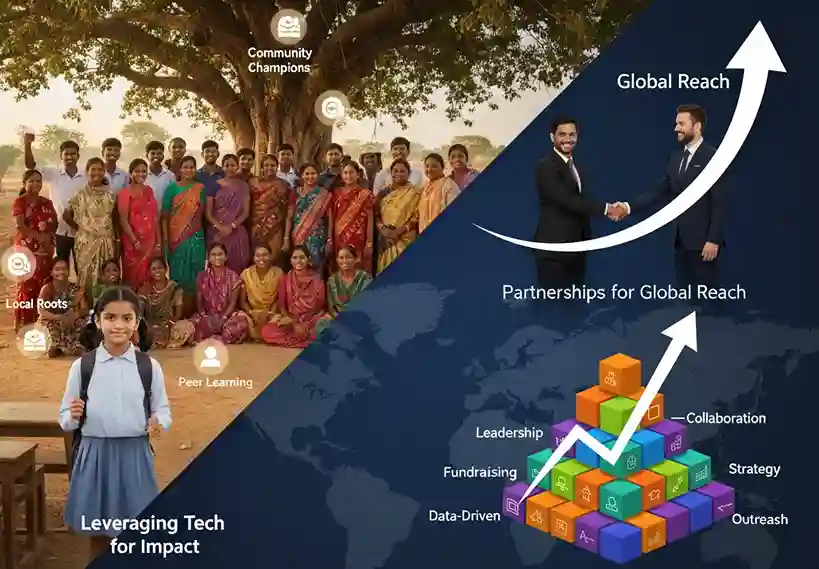
For local nonprofits, scaling the mission isn’t just about bigger numbers; it’s about deeper and wider community change. Many successful organizations transitioned from serving a single block to transforming lives across entire regions, showing that NGO expansion can be both local and global.
Drives greater impact and resource mobilization as NGOs grow
Unlocks funding opportunities by demonstrating successful scaling models
Inspires staff and volunteers by sharing positive stories of progress
1. Strengthening Foundations: Internal Capacity Building
Before expanding, assess leadership, staff responsibilities, training and the ability to supervise another location. QUEST is a Maharashtra education organisation to research for its work with teachers and learning settings. Its programme description is a starting point, not independent proof that a particular management change caused growth.
Key tips:
Invest in leadership training for existing staff
Create a second line of management for seamless delegation
Systematically plan organizational restructuring before scaling
Real-Life Example: QUEST’s Capacity Leap
When reviewing QUEST or another organisation, distinguish the districts reported as served, the reporting period and the actual programme model. Reaching some districts is different from providing a service throughout a state. Ask which staffing, training and funding arrangements support the reported reach.
2. Embracing Collaboration and Partnerships
No NGO expands alone. Building coalitions with governments, private sector, and other NGOs multiplies resources and amplifies reach. The Bangladesh Rural Advancement Committee (BRAC), one of Asia’s largest NGOs, has demonstrated that partnerships, whether additive (geographical/activities) or multiplicative (supporting parallel organizations), drive scaling success.
Actionable Ways to Collaborate:
Join or form local and international coalitions
Co-create projects and share resources with partners
Seek out government affiliations for program endorsement
Case Study: BRAC’s Dual Expansion
BRAC’s published Graduation scaling work describes adapting an approach with governments and partners. This illustrates expansion through other delivery systems as well as direct programming. Check responsibilities, context and actual evidence instead of assuming that independent replication or withdrawal of oversight works automatically.
3. Leveraging Technology for Outreach
Digital transformation has become a major game-changer for NGO expansion. Small organizations now use websites, social media, and email campaigns to amplify their voice far beyond their physical presence
Practical technology choices:
Invest in a mobile-responsive, SEO-optimized website
Use social media storytelling to reach younger generations
Track and analyze impact data to justify and guide expansion
Example: Educate Girls India
Educate Girls’ 2024 published document describes community mobilisation and Team Balika volunteers supporting girls’ enrolment and retention. When examining technology’s role, check the actual data process, period and measured outcome rather than attributing enrolment entirely to analytics or digital outreach.
4. Developing Peer Learning & Community Champions
Expansion isn’t just vertical, it’s about depth within communities. Organizations like QUEST and others grew by recruiting local community champions and using peer-learning models.
Best Practices:
Identify and train local ambassadors who mirror target community values
Facilitate community-led workshops and learning sessions
Document and share community stories to build trust and credibility
Example: Local Champions in Action
Use an education initiative such as QUEST as a prompt to ask how local educators and community members participate, what preparation they receive and who remains responsible for quality. Peer learning and ownership are planning themes to examine, rather than assumed proof of sustainability or reduced oversight needs.
5. Focusing Programs for Measured Impact
Small NGOs often fall into the trap of doing too much. Instead, leading organizations focus their programs, use regular monitoring and evaluation, and show tangible results to supporters and donors.
Tips for Focused Impact:
Collect and publish clear, quantifiable impact metrics
Narrow program offerings for consistent evaluator and donor messaging
Use annual impact reports as a fundraising and partnership tool
Example: Data-Driven Success at Educate Girls
For Educate Girls or another programme, examine enrolment, attendance and learning as different measures. Check the period, sample, method and report behind each finding. Donor confidence should rest on what the evidence establishes, rather than a general assertion of sharp improvement.
6. Sustainable Fundraising & Financial Planning
Sustained growth demands robust fundraising strategies. Successful NGOs nurture relationships with major donors, use crowdfunding for campaigns, and even develop small income-generating activities.
Fundraising Techniques:
Create a diverse portfolio of donor types (individuals, corporates, grants)
Launch online campaigns using compelling storytelling and visual evidence
Invest in transparency by sharing financial reports with stakeholders

Unessa Foundation activity: a volunteer and children working with paper learning materials in Vadodara.
SUPPORT CHILDREN’S EDUCATION
Help learning become a regular part of a child’s life.
Support Unessa Foundation’s education programmes and volunteer-led learning activities.
Unessa Foundation: connect funding with actual delivery
For an education organisation such as Unessa Foundation, a responsible expansion discussion should connect published programme scope with staffing, supervision, local need and funding. Donors can ask which activities and locations their contribution supports, what reporting is available and how a continuing commitment will be maintained.
Expansion milestones and donor communications are useful reporting topics. They do not, by themselves, establish donor-retention rates or prove that an organisation has secured future funding.
5 practical checks for ngo expansion
- Confirm the local need before expansion.
- Identify delivery and supervision responsibilities.
- Budget for continuing operations.
- Distinguish a one-off activity from an active centre.
- Review a limited initial scope before scaling.
Evidence and support: keep the scope clear
Distinguish a proposed partnership, a one-off activity and a regularly operating centre. Publish locations and programme claims in terms that match the actual arrangements, and evaluate the new work before promising wider coverage.
The education donation buttons lead to Unessa’s education campaign. They do not fund every third-party provider, item or service mentioned here. Read the programme information and confirm any allocation or service condition important to you before giving.
Conclusion: NGO expansion and next steps
NGO expansion can mean deeper local work, a new geography or a partnership through another institution. Match the choice to community need, staff capacity, supervision, evidence and a realistic funding plan.
Research QUEST, BRAC’s scaling work and Educate Girls through their own reports. Their experiences can inform questions; they do not guarantee that every small organisation can reproduce a particular result.
Sources and further reading
Frequently asked questions
What should an NGO confirm before expanding to another city?
Identify the actual need, delivery model, responsible local contacts, resources and safeguarding arrangements. Distinguish a proposed chapter from an operating programme, and confirm the organisation can sustain the activity before announcing availability.
How should an NGO describe a new location publicly?
State whether the activity is proposed, being prepared or currently operating, with the relevant contact and scope. An interested volunteer or planned venue should not be described as a functioning centre before arrangements are confirmed.
How can small NGOs expand their impact?
Start with the local need, clarify delivery and supervision, strengthen staff capacity, examine partnerships and collect useful evidence. Expansion can mean improving the current programme as well as adding a place; compare what the team can sustain.
What are the best ways to scale an NGO?
Useful areas to examine include staff preparation, clear responsibilities, realistic funding, suitable technology, partnerships and evidence-informed decisions. The best mix depends on the actual programme and community.
Should NGOs focus on local or global impact?
Neither local nor international expansion is automatically best. Establish the need, delivery capacity, legal requirements and funding for the proposed scope. A strong local programme can remain the right choice, or inform a carefully planned partnership elsewhere.
Successful NGO scaling examples?
QUEST, BRAC and Educate Girls provide different organisations and models to research. Read their primary programme descriptions and dated reports, distinguishing direct delivery, partnerships, enrolment, learning and other outcome measures.
Affordable ways to scale a nonprofit?
Peer learning, a limited pilot, appropriate digital communications and volunteer participation can be considered. Include staff time, safeguarding, access and reporting costs rather than assuming that a digital or volunteer-led approach is free.
Continue reading

Related guide

Related guide
Support children’s learning with Unessa Foundation.