

In 1948, the global community made a promise through the United Nations by declaring education a fundamental human right under the Universal Declaration of Human Rights. Four decades later, the Convention on the Rights of the Child reinforced this commitment. In India, this promise was transformed into enforceable law through the Right to Education Act in 2009.
And yet, in 2025, an estimated 244 million children worldwide remain out of school.
This contradiction exposes a hard truth: legal recognition does not guarantee real-world access.
The right to education for every child is one of the most widely accepted rights globally. But acceptance is not the same as implementation. Across countries, including India, millions of children are still denied meaningful access to learning — not because laws are missing, but because systems fail to deliver.
Even in India, where the Right to Education Act is considered one of the strongest legal frameworks globally, over 6 million school-age children remain out of school, and millions more attend school without gaining basic literacy and numeracy skills. This gap between law and lived reality is the central problem we must confront.
Quick Insight: Even in India — with one of the world’s strongest legal frameworks for children’s right to education — over 6 million school-age children remain out of school and millions more attend without actually learning. The law exists. Its implementation is still incomplete.
1. What the Right to education for every child Actually Means Legally
The right to education is not just about attending school. It is a comprehensive legal and moral framework that defines what education should look like for every child.
At the international level, institutions like UNESCO have outlined clear principles under global education initiatives. At the national level, India’s Right to Education Act (2009) gives these principles legal force.
Legally, the right to education includes four core dimensions:
1. Free Education
No child should be denied schooling because of financial constraints. Governments are obligated to eliminate tuition fees and hidden costs that prevent access.
2. Compulsory Education
It is not optional for the state to provide education. Governments must ensure that every child is enrolled and attending school.
3. Quality Education
Education must meet minimum standards — including trained teachers, safe infrastructure, and appropriate curriculum. Simply enrolling children is not enough.
4. Non-Discrimination
Every child — regardless of caste, gender, religion, disability, or socioeconomic status — must have equal access to education.
The framework is clear and widely accepted. But the real challenge lies in implementation.
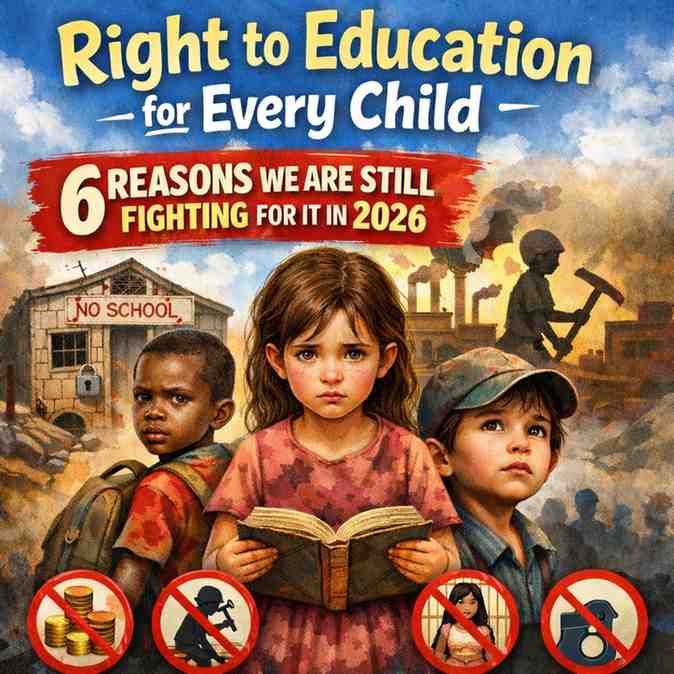
2. 6 Reasons the Fight for Every Child's Right to Education Is Not Over
Reason 1: Millions of Children Remain Completely Excluded
Despite 15 years of the Right to Education Act, over 6 million children in India are still not in school. These are not children who fell through cracks in an otherwise functional system. They represent systematic failure to reach the most marginalised — tribal communities, children with disabilities, migrant children, and girls in conservative regions.
Reason 2: Enrollment Does Not Equal Education
India’s gross enrollment ratios look impressive on paper. The learning data tells a different story. ASER 2023 found that only 57% of Class 5 students could read a Class 2 text. Children are technically enrolled — their right to education on paper is technically met — but their right to actually learn is routinely violated.
Reason 3: Quality Is Unequally Distributed
The right to education, as practiced, is not the same right for a child in South Delhi and a child in rural Jharkhand. Resource allocation, teacher quality, infrastructure, and curriculum are all vastly unequal across economic and geographic lines. The right exists on paper. Its quality is distributed by class.
Reason 4: Girls Face Structural Barriers That Laws Cannot Fully Address
Despite legal equality, girls in large parts of India face social, cultural, and economic pressures that effectively deny their right to education. Child marriage — still practiced in many states — is incompatible with educational participation. Cultural norms about female education remain powerful in areas where legal enforcement is weak.
Reason 5: Children in Conflict and Disaster Zones Lose Their Rights Entirely
The right to education does not function in conflict-affected areas. Schools are targets. Teachers flee. Families prioritise survival over schooling. In areas affected by Naxal conflict, cyclones, floods, or communal violence, children’s educational rights are suspended by circumstance — often for years.
Reason 6: Disability Exclusion Remains Severe
India’s Sarva Shiksha Abhiyan and Rights of Persons with Disabilities Act both mandate inclusive education. In practice, the vast majority of children with disabilities either attend segregated special schools or receive no formal education at all. Their right to education is acknowledged in law and denied in daily practice.
Reflective Question: If the right to education is a legal right, why are we still framing it as a charitable cause? Who is responsible for enforcement — and who is failing in that responsibility?
3. Where the Right to Education Is Most at Risk
Globally, the right to education is most at risk in:
- Sub-Saharan Africa — where post-conflict recovery, population growth, and resource constraints leave millions without school access
- South Asia — where caste discrimination, gender barriers, and migration undermine universal enrollment
- Conflict zones — where the 69 million children in areas of active conflict face systematic educational disruption
- Slum and informal settlement areas — where internal migration creates administrative gaps in enrollment
- Children with disabilities globally — who face exclusion across all income levels and geographies
4. What Meaningful Implementation Looks Like
The gap between the right to education on paper and its reality in practice requires specific implementation actions:
Adequate Resource Allocation
UNESCO recommends allocating at least 4-6% of GDP and 15-20% of total government expenditure to education. India spends approximately 2.9% of GDP — among the lowest for a G20 economy. Without adequate funding, the right to education is an unfunded mandate.
Teacher Accountability Systems
High teacher absenteeism rates — documented at 25% in rural government schools in some Indian states — represent a systemic violation of children’s right to quality education. Accountability mechanisms that monitor and address absenteeism are essential.
Last-Mile Delivery
The right to education cannot be fulfilled by schools that do not reach the most excluded communities. Mobile schools, residential programmes for tribal and migrant children, and digital learning supplementation for remote areas are all necessary components of genuine universal access.
5. A Case Study: When Rights Meet Reality in Assam
Background
In a district of Assam with significant tribal population, the Right to Education Act had technically been implemented — schools existed within 1 kilometre of every habitation. Government records showed enrollment rates above 90%.
Challenge
A field assessment revealed that 40% of enrolled children had not attended school in the previous month. The primary barriers: seasonal flooding that cut off school access for 3 months annually, language of instruction (Assamese) different from the community’s primary language (Bodo), and absence of female teachers in a community where mixed-gender instruction was culturally unacceptable.
Actions Taken
A civil society organisation — working alongside Unessa Foundation’s programme model — intervened with: temporary learning spaces elevated above flood plains, Bodo-language literacy materials for foundational classes, and recruitment of community women for teacher training.
Outcome
Effective attendance rose from 60% to 83% within two years. Reading outcomes in Bodo improved significantly — a baseline assessment had shown near-zero literacy; follow-up assessment showed 61% of children reading at grade level.
Lesson
The right to education is not fulfilled by the existence of a school within 1 kilometre. It is fulfilled when every barrier between a child and meaningful learning has been identified and addressed. This requires civil society organisations willing to do what governments cannot do at scale.
6. The Role of Civil Society in Holding Governments Accountable
Governments define policies — but implementation often depends on civil society.
Organizations like Unessa Foundation play a crucial role by:
1. Reaching the Last Mile
They work in areas where government systems struggle to operate effectively.
2. Innovating Solutions
They experiment with new models that can later be scaled.
3. Ensuring Accountability
They highlight gaps, advocate for change, and hold institutions responsible.
👉 Click here to know more about : Right to Education
7. FAQ — People Also Ask
What is the right to education?
The right to education is a fundamental human right — enshrined in the UDHR, UNCRC, and national legislation in over 180 countries — that guarantees every child free, compulsory, quality education without discrimination.
Why is the right to education still not universal in 2025?
Because legal frameworks alone cannot overcome resource constraints, discrimination, cultural barriers, conflict, teacher quality deficits, and geographic inaccessibility. Enforcement requires funding, institutional capacity, and political will that many governments lack or choose not to deploy.
What is India's Right to Education Act?
India’s Right to Education Act (2009) guarantees free and compulsory education for all children aged 6-14, mandates minimum school quality standards, and prohibits discrimination in school admissions.
Who is responsible for ensuring the right to education is upheld?
Primary responsibility lies with national and state governments. Civil society organisations, international agencies, and communities all play supplementary roles — but cannot substitute for state accountability.
8. Conclusion
The right to education for every child is not in question. It is legally settled, morally obvious, and economically documented as among the highest-return investments any society can make.
What is in question is the political will to fund it, the institutional capacity to deliver it, and the social commitment to ensure it reaches every child — including those who are most expensive and difficult to reach.
Organisations like Unessa Foundation exist precisely because that political will is incomplete. They fill the gap between the right as written and the right as lived.
The fight is not over. It will not be over until every child — regardless of birth — receives an education worthy of their intelligence and potential.