
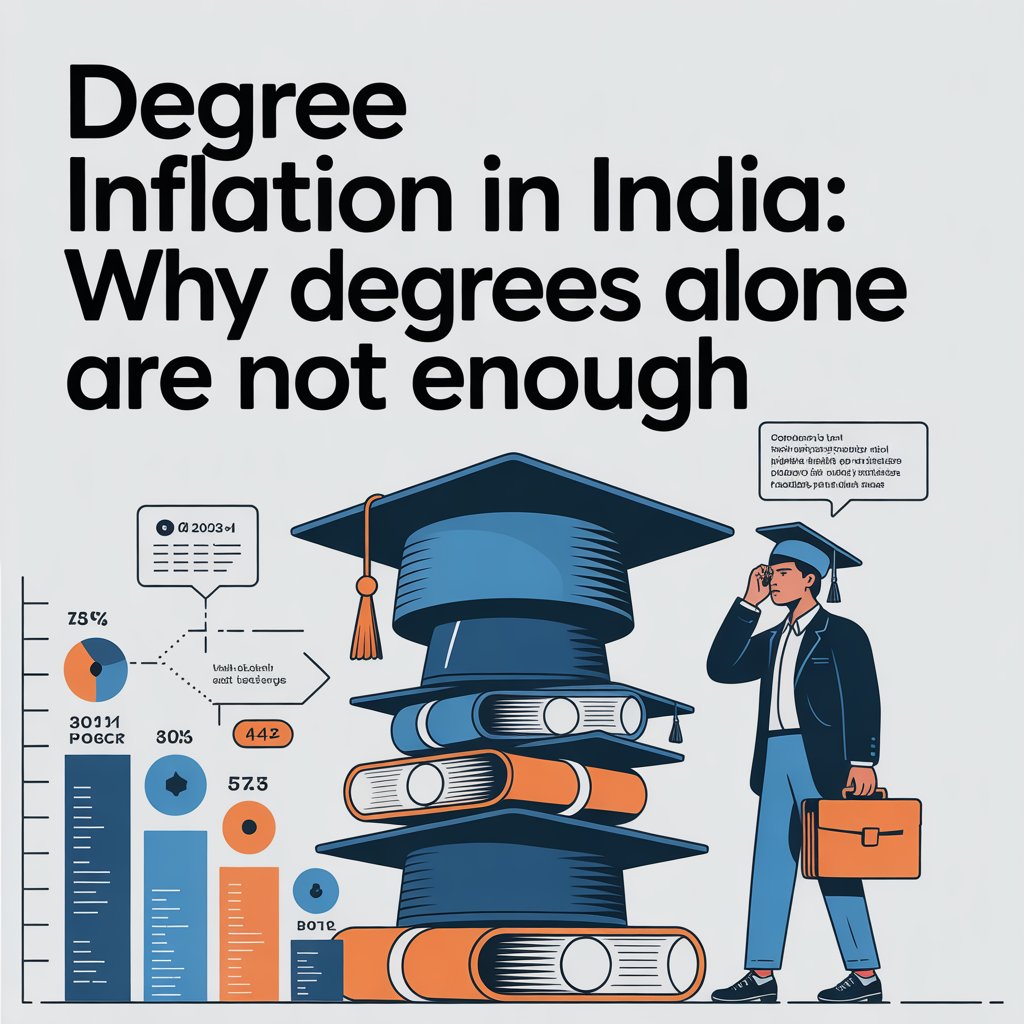


Degree Inflation in India: Why Degrees Alone Are Not Enough
India produces millions of graduates every year, yet a large percentage of them continue to struggle in securing stable employment. This creates confusion and frustration because higher education is traditionally seen as the direct path to career success.
The real issue is not always lack of education—it is often the growing mismatch between academic degrees and real-world employability.
This blog explores why degrees alone are no longer enough in India, what employers actually expect, and how students can prepare for long-term career success.
👉 Click here to know about Why Indian Graduates Struggle to Find Jobs Despite Degrees
Degrees Are Becoming Common, Not Competitive
One of the biggest reasons behind the growing employability crisis in India is that academic degrees are no longer rare. Over the past decade, access to higher education has increased significantly, and millions of students now graduate every year from colleges and universities across the country.
Students commonly complete degrees such as:
- B.Tech
- BBA
- B.Com
- BA
- BCA
- MBA
While this increase in educational access is a positive sign for the country, it has also created a new challenge: degrees alone no longer help candidates stand out.
Earlier, earning a bachelor’s degree itself was seen as a major achievement and often provided a strong competitive edge in the job market. Employers viewed degree holders as skilled, disciplined, and job-ready.
Today, however, the situation has changed.
A single job opening may receive hundreds or even thousands of applications from candidates holding the exact same degree. When everyone has similar academic qualifications, the degree stops being a unique strength and instead becomes only a basic eligibility requirement.
This is one of the clearest signs of degree inflation in India.
For example, an entry-level office role that previously accepted diploma holders may now attract applicants with bachelor’s and even master’s degrees. Despite the higher qualifications, the job role itself may not have changed significantly.
This means the competition is no longer based on “who has a degree,” but rather on who brings additional value beyond the degree.
That additional value often includes:
- communication skills
- internships
- technical proficiency
- project experience
- confidence in interviews
- practical problem-solving ability
As a result, students who rely only on academic qualifications often find themselves struggling, even after years of hard work.
Many graduates are surprised when they realize that their degree alone is not enough to secure interviews or placements.
The reality is that employers now use degrees as the first filter, not the final decision-maker.
Insight:
A degree today acts as an entry ticket, not a guarantee of success.
It may help your resume get shortlisted, but it does not automatically make you the strongest candidate.
Real Example:
Imagine two students applying for the same job.
Both hold a B.Tech degree.
One student only has academic marks.
The other has:
- an internship certificate
- two live projects
- strong communication skills
- familiarity with industry tools
Even if both students hold the same degree, the second candidate is far more likely to be selected.
This clearly shows that degrees are becoming common, while competitiveness now depends on the skills built around them.
Lesson:
In today’s job market, the real question is no longer “Do you have a degree?”
It is “What can you do with your degree?”
Employers Want Skills, Not Just Certificates
In today’s job market, employers are no longer impressed by certificates alone. While degrees and academic qualifications are still important, they are now seen as only one part of a candidate’s profile.
What truly matters is whether the student can apply their knowledge in real-world situations.
Many students believe that once they complete graduation or earn a professional certificate, job opportunities will automatically follow. However, recruiters today look far beyond marksheets and certificates.
They want to know:
- Can this candidate solve problems independently?
- Can they communicate clearly?
- Can they work effectively in a team?
- Can they adapt to new tools and technologies?
- Can they handle practical work responsibilities?
This shift is especially visible in sectors such as IT, digital marketing, finance, customer support, and management roles.
For example, a student may hold a degree in computer science, but if they cannot build a small project, explain basic coding logic, or work with modern tools, employers may hesitate to hire them.
Similarly, in business-related roles, a degree in management is useful, but companies also expect skills such as:
- presentation ability
- communication confidence
- spreadsheet handling
- problem analysis
- decision-making
This is why many graduates feel confused when they are rejected despite having the required qualifications.
The reason is simple: a certificate shows completion, but skills show capability.
A certificate tells the employer what you studied.
A skill tells the employer what you can actually do.
This difference is what makes employability so challenging for many students in India today.
Insight:
The modern workplace values performance more than possession of certificates.
A candidate who can demonstrate practical ability is often preferred over someone who only has strong academic credentials.
Real Example:
Consider two candidates applying for a digital marketing role.
Both hold the same degree.
The first candidate only has a certificate.
The second candidate has:
- basic SEO knowledge
- experience using WordPress
- understanding of social media campaigns
- sample content portfolio
Even if their academic qualifications are identical, the second candidate is more likely to be selected because they bring job-ready skills.
This reflects the growing shift from qualification-based hiring to skill-based hiring.
Practical Tip:
Alongside your degree, focus on developing at least one practical skill that directly aligns with your target career path.
For example:
- coding for tech roles
- communication for client-facing roles
- design tools for creative roles
- data analysis for business roles
Lesson:
Degrees may help you get noticed, but skills help you get hired.
The Education and Employment Gap
One of the biggest reasons many students continue to struggle even after completing their education is the growing gap between what is taught in classrooms and what is expected in the real world. This difference between academic learning and practical workplace requirements is known as the education and employment gap.
Many students spend years studying theory, writing exams, and completing assignments, yet when they enter the job market, they often realize that employers are looking for a completely different set of abilities.
In many colleges and institutions, the focus still remains heavily on:
- theoretical concepts
- textbook definitions
- memorized answers
- semester-based scoring
- examination performance
While these are important for academic success, they do not always prepare students for actual workplace challenges.
For example, a student may score excellent marks in computer science but struggle when asked to build a real-world application, explain project logic, or collaborate on a team task.
Similarly, a commerce or management student may understand business concepts academically but find it difficult to handle spreadsheets, client communication, presentations, or problem-solving situations in a professional setting.
This is where the real problem begins.
Students often believe that completing the syllabus means they are fully prepared for their future careers. However, employers today expect candidates to demonstrate applied knowledge, not just theoretical familiarity.
This gap becomes even wider for students from underprivileged backgrounds who may have limited access to internships, workshops, mentorship, or digital exposure.
At Unessa Foundation, this issue is especially important because education should not stop at classroom learning. True learning must prepare students for life, employment, and long-term growth.
This is why bridging the education and employment gap is essential for creating meaningful opportunities, especially for children and young learners who need both academic support and career readiness.
Insight:
Education should not only help students pass exams; it should help them succeed beyond them.
A student who understands concepts but cannot apply them in practical situations often faces difficulty during placements, interviews, and workplace tasks.
Case Study:
A graduate in engineering completed four years of academic study with strong marks and subject knowledge. However, during placement interviews, the student struggled to explain real-world applications of classroom concepts and lacked confidence in presenting project work.
After receiving guidance in communication, practical projects, and interview preparation through educational support initiatives like those encouraged by Unessa Foundation, the student was able to improve job readiness and secure an entry-level role.
This shows that education alone is not enough unless it is connected to practical outcomes.
Practical Tip:
Students should regularly ask themselves:
- Where is this concept used in real life?
- How can I apply this knowledge practically?
- Which skill does this subject help me build?
This simple habit can help convert theoretical learning into employable capability.
Lesson:
The future of education lies not just in degrees, but in preparing students to confidently step into the world of work.
Soft Skills Are Often Ignored
One of the most overlooked reasons why many students struggle even after completing their education is the lack of soft skills. While academic knowledge and technical understanding are important, they alone are often not enough to succeed in interviews, workplaces, or even higher studies.
Many students focus all their attention on marks, syllabus completion, and exam performance, but very little time is spent developing the skills that help them present their knowledge effectively.
Soft skills include:
- communication skills
- confidence
- teamwork
- problem articulation
- time management
- professionalism
- adaptability
- leadership
These skills may not always be directly tested in written exams, but they play a major role in real-life success.
For example, a student may know the correct answer to an interview question, but if they cannot explain it clearly, the employer may assume they lack understanding.
Similarly, in group discussions, presentations, or workplace meetings, the ability to communicate ideas confidently often matters as much as technical knowledge.
This is why many graduates feel confused when they are rejected despite having strong academic records.
The issue is not always lack of knowledge.
Often, it is the inability to communicate that knowledge effectively.
This challenge is even more common among students from underprivileged backgrounds who may not have had enough opportunities to practice spoken communication, presentations, or confidence-building activities.
At Unessa Foundation, this is an important area of focus because education should empower students not only with knowledge but also with the confidence to use it in real-world situations.
Developing soft skills helps students become more prepared for:
- interviews
- internships
- teamwork-based projects
- leadership opportunities
- professional environments
Insight:
Knowing the answer is not enough; presenting it clearly is equally important.
A student with average technical knowledge but strong communication skills can often outperform a more knowledgeable student who struggles to express ideas.
Case Study:
A final-year engineering student consistently scored well in written exams but faced rejection in multiple placement interviews.
After guidance and practice sessions focused on communication, body language, and mock interviews—similar to the developmental support encouraged by Unessa Foundation—the student became more confident in explaining projects and technical concepts.
Within a few weeks, the student successfully cleared the interview process and secured a job offer.
This clearly shows how ignored soft skills can become the deciding factor between rejection and success.
Practical Tip:
Students should regularly practice:
- explaining concepts aloud
- participating in group discussions
- speaking in front of peers
- mock interview sessions
Degrees Without Practical Exposure Create Weak Profiles
Another major reason many students struggle in today’s job market is the lack of practical exposure. A degree may show that a student has completed academic requirements, but employers also want proof that the student can apply that knowledge in real situations.
Many students finish graduation without building any hands-on experience through:
- internships
- live projects
- workshops
- volunteer work
- presentations
As a result, their resume often looks similar to thousands of other candidates with the same degree.
For example, two students may both hold a B.Tech degree, but one has worked on real projects and completed an internship, while the other only has academic marks. Naturally, the first student is more likely to stand out.
This is because practical exposure helps students develop job-ready skills such as problem-solving, communication, and teamwork.
At Unessa Foundation, encouraging students to gain real-world learning experience is essential because education should prepare them not only for exams but also for future careers.
Insight:
A degree tells employers what you studied, while practical exposure shows what you can do.
Case Study:
A BBA graduate with strong marks but no internship experience struggled to secure interviews. After taking part in a short practical training program and working on small projects, the student’s profile became stronger and more competitive.
Lesson:
In today’s competitive environment, experience often adds more value than marks alone.
The Impact on Underprivileged Students
The effects of degree inflation and the growing education-employment gap are even more serious for students from underprivileged backgrounds. For many families, earning a degree is seen as the ultimate symbol of success and the primary path to a better future.
Parents often invest their limited resources, time, and hopes into their children’s education with the belief that a degree will automatically lead to stable employment and financial security.
However, the reality is often far more challenging.
Even after completing their education, many students continue to struggle because they may not have had access to the additional support systems that make education truly effective, such as:
- communication skill development
- career guidance
- digital literacy
- practical exposure
- mentorship
- interview preparation
This creates a situation where the student has the qualification but not always the confidence or skills needed to compete in today’s job market.
For underprivileged students, this gap can feel even wider because they may be first-generation learners in their families. Without guidance, they may not know how to build resumes, prepare for interviews, or develop practical skills beyond academics.
This is where the role of Unessa Foundation becomes deeply meaningful.
By focusing on education for underprivileged children, skill development, and confidence-building initiatives, Unessa Foundation helps ensure that students are not only educated but also empowered for long-term success.
The goal is not just to help students pass exams or earn degrees, but to help them build the confidence and capabilities needed for real opportunities.
Insight:
For underprivileged students, education must become a pathway to opportunity, not just a certificate.
Case Study:
A first-generation graduate from a low-income family completed a commerce degree but lacked confidence in spoken English and interview communication. Through skill-building support and mentorship programs aligned with the mission of Unessa Foundation, the student improved communication skills and successfully secured an entry-level job.
This shows how the right support can transform education into employability.
Lesson:
Degrees create hope, but support, guidance, and practical skills turn that hope into reality.
The Future Belongs to Skill-Based Learning
The future of education and employment is no longer centered only around degrees—it is increasingly driven by skills. As industries evolve and technology continues to reshape the way people work, employers are placing greater importance on what a candidate can do rather than only what they have studied.
In today’s rapidly changing world, job roles are becoming more dynamic. New tools, technologies, and work methods are emerging every year, which means students must be prepared to continuously learn and adapt.
This is why skill-based learning is becoming the foundation of future success.
Skills that are highly valued today include:
- communication and presentation
- digital literacy
- problem-solving
- critical thinking
- teamwork
- adaptability
- technical tools and software knowledge
For example, a student with a degree in computer science may still need practical coding skills, project-building experience, and familiarity with industry tools to remain competitive.
Similarly, students from non-technical fields must also build transferable skills such as confidence, analytical thinking, and workplace communication.
At Unessa Foundation, this shift toward skill-based learning is especially important because true education should prepare students for the future, not just for exams.
By focusing on both academic learning and life-ready skills, students from underprivileged backgrounds can gain stronger opportunities for long-term growth and independence.
Conclusion
In today’s world, degrees alone are no longer enough. Along with academic qualifications, students need practical skills, confidence, and real-world exposure to succeed.
At Unessa Foundation, the focus is not just on education, but on preparing students—especially underprivileged children—for a better future through skill-based learning and personal growth.
Final Thought:
A degree may open the
Frequently Asked Questions
What is degree inflation in India?
Degree inflation in India refers to the growing situation where degrees have become common, making them less effective as a competitive advantage in the job market.-+
Why are degrees alone not enough today?
Degrees provide academic knowledge, but employers also look for practical skills, communication, confidence, and real-world experience.
What skills do employers value the most?
Employers usually value skills such as communication, problem-solving, teamwork, digital literacy, and adaptability.
How does Unessa Foundation help students?
Unessa Foundation supports students, especially underprivileged children, by focusing on education, skill development, confidence building, and career readiness.