
Why Success Stories Matter in the Education Equity Conversation
Data tells us that education transforms lives, but real proof comes from seeing how education changes lives in tangible ways. When we read the numbers — 244 million out-of-school children, 60% dropout rates in secondary school — it is easy to feel overwhelmed by scale. Success stories do something different: they make the impact personal, human, and viscerally real. They remind us that behind every statistic is a child with a name, a family, and a future that education changes lives by unlocking opportunities that would otherwise remain closed.
Success stories also carry responsibility. They must be told with honesty — acknowledging the systemic barriers overcome, the support structures that made success possible, and the many others who had equal potential but lacked equal opportunity. A good success story inspires action and demonstrates how education changes lives not just for individuals, but for entire communities.
The role of NGOs such as Unessa Foundation is crucial here. By combining mentorship, scholarships, and family engagement, they ensure that these stories aren’t isolated miracles but reproducible models that show how education changes lives across India.
What Makes an Education Success Story Genuinely Transformative
Transformative education success is not just a child who passes an exam or gets a job. It is a first-generation graduate who returns to her village to teach. A boy who was headed for child labor who becomes an engineer. A girl who was about to be married at 14 who earns a scholarship for medical school.
These stories are transformative because they represent not just individual change but the breaking of cycles that have held families and communities in poverty for generations.
Case Study – Priya, Nashik:
- Background: Priya, from a daily-wage laborer’s family, was the first girl in her extended family to complete Class 10.
- Challenge: Her father believed girls did not need education beyond Class 8.
- Actions Taken: A community educator from Unessa Foundation met with the family, shared data on educated women’s economic contribution, and connected the family to a girls’ scholarship program.
- Outcome: Priya completed Class 12 with distinction, received a nursing scholarship, and is now employed at a district hospital, supporting her parents financially.
- Lesson: Family attitudes change when they see a concrete, respectful pathway — not just an abstract argument for education.
Pro Tips:
- Document success stories with consent and with full context — include the barriers, the support structures, and the ongoing challenges.
- Use success stories as advocacy tools with community leaders and policymakers, not just as fundraising content.
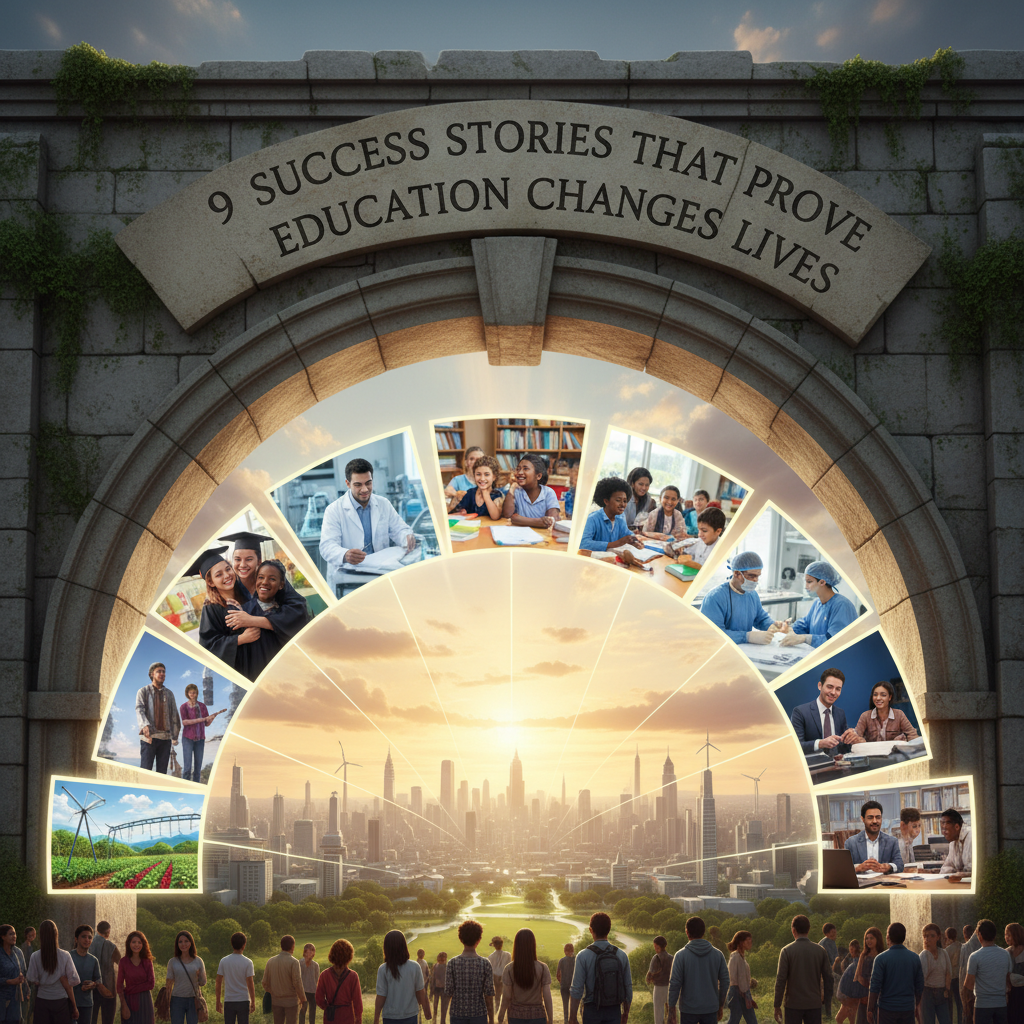
9 Education Success Stories That Show What Is Possible
Story 1 – Rajan, First-Generation Graduate, Bihar
Rajan’s parents are agricultural workers who never attended school. With support from a local NGO’s scholarship and mentoring program, he completed B.Tech in Civil Engineering and now works for a government infrastructure project in his home district.
Story 2 – Fatima, From Dropout to Teacher, Rajasthan
Fatima dropped out at age 11 when her family moved. An NGO’s bridge course helped her rejoin school two years later. Today she teaches at the same learning center that supported her.
Story 3 – The Dharavi Reading Club
A weekly read-aloud program in a Dharavi slum library grew from 8 children to 200 in three years. Ninety-two percent of original participants completed secondary school.
Story 4 – Sunita, Medical Student, Odisha
Sunita’s village had no electricity. She studied by candlelight and with a solar lantern donated by an NGO. She is now in her third year of MBBS at a state medical college.
Story 5 – Digital Learners of Chhattisgarh
A tablet program in 12 tribal schools showed that students using adaptive math software for 30 minutes daily outperformed control group students by 1.8 grade levels in 18 months.
Story 6 – The Football Academy that Built Graduates
A sports-integrated learning program in Tamil Nadu used football practice as an attendance incentive. Ninety-four percent of participants completed Class 12 compared to 61% in the control group.
Story 7 – Meera, Engineer from a Slum, Mumbai
Meera’s parents sold vegetables in Dharavi. With a full scholarship and mentoring support from Unessa Foundation, she completed BE in Computer Engineering and is now a software developer at a mid-size tech firm.
Story 8 – The Community Library That Changed a Village
A single room stocked with 200 books in a UP village transformed literacy rates. Within five years, the village’s literacy rate rose from 43% to 71%.
Story 9 – Vikram, From Child Labor to College, Madhya Pradesh
Vikram was working in a brick kiln at age nine when a social worker enrolled him in a bridge school program. At 22, he completed a diploma in hospitality management and now works at a hotel in Indore.
Common Threads in Every Education Success Story
Across every story, three elements appear consistently:
- A committed individual (teacher, counselor, parent, or peer) who believed in the child.
- A structured program that provided academic and practical support.
- A community or family that was engaged rather than bypassed.
None of these stories happened in isolation — they happened because multiple people and systems aligned around a single child’s potential.
Case Study – Unessa Foundation Program:
- Background: Tracked 50 children who received full support — scholarship, mentoring, supplies, and family counseling — over five years.
- Challenge: Measuring holistic impact across multiple dimensions.
- Outcome: 47 of 50 completed secondary school; 38 enrolled in college or vocational training; 12 are now employed in skilled roles; 6 are actively mentoring younger children from their communities.
- Lesson: Holistic, sustained support produces compounding impact that lasts well beyond the program period.
Pro Tips:
- Collect success stories systematically — not just the most dramatic ones — to understand what interventions work across different contexts.
- Share these stories in the communities where you work; local role models are more motivating than distant ones.
Turning Inspiration Into Action: What These Stories Demand of Us
Success stories are not just inspiration — they are evidence. They prove that the barriers to education for underprivileged children are not insurmountable. They are dismantled every day, one scholarship, one learning center, one mentoring relationship at a time.
Every person reading this has something to contribute: time, money, expertise, advocacy, or awareness. The children in these stories succeeded not because they were exceptional (though they are) but because someone invested in them. That investment is available to be made by anyone reading these words.
How to Replicate These Success Stories in Your Community
- Identify the underserved children in your immediate environment — your neighborhood, city, or district.
- Connect with a local NGO or school that serves them.
- Ask what they need: teachers, supplies, mentors, funds, or advocacy.
- Commit to a specific, sustained contribution.
- Track the results — the next success story begins the moment you make that commitment.
Case Study – Retired Teacher in Pune:
- Background: Offered two hours every Saturday at a local NGO tutoring program.
- Challenge: No experience with informal education and unfamiliar with the children’s socioeconomic background.
- Actions Taken: Completed half-day orientation, observed sessions, then began teaching mathematics to a group of 12 students aged 10–13.
- Outcome: After one year, all 12 students passed their school mathematics exam; 4 scored above 80%.
- Lesson: You do not need a grand intervention. You need consistent, structured commitment.
Pro Tips:
- Start with what you have, where you are. Do not wait for the perfect program or moment.
- Connect with others who are doing the same work; communities of practice amplify individual efforts.
Lessons from NGO-Led Education Programs
NGOs like Unessa Foundation, Pratham, and Smile Foundation provide structured, sustainable interventions that combine academic, emotional, and financial support. Key lessons include:
- Holistic Support Matters: Scholarships, tutoring, mentoring, and family counseling together produce the best outcomes.
- Community Involvement Is Crucial: Families and local stakeholders increase buy-in and sustainability.
- Technology Can Accelerate Learning: Adaptive learning software, digital classrooms, and e-libraries bridge gaps in resource-limited areas.
- Sports and Arts Incentives Improve Retention: Programs that integrate football, dance, or music show measurable improvements in attendance and academic performance.
👉 Click here to know about Long-Term Benefits of Sponsor Education Programs: Why Investing Now Changes Everything
Scaling Education Impact in Underprivileged Communities
Replicating success stories requires systemic thinking:
- Policy Alignment: Partnering with government schemes can scale programs efficiently.
- Volunteer Networks: Structured volunteering reduces dropout rates and improves mentorship quality.
- Measurement and Evaluation: Tracking outcomes over time allows continuous improvement.
- Storytelling: Sharing stories motivates communities, donors, and volunteers to expand impact.
Conclusion
Education success stories are not accidents — they are the result of deliberate investment, sustained support, and communities that refuse to leave their children behind. The nine stories in this blog represent thousands more that happen every year when the right resources reach the right children at the right time.
You have the power to add to that number. Support Unessa Foundation, and be part of the next chapter in a child’s success story.
Support Unessa Foundation
Visit unessa.org to donate, volunteer, or partner with us in transforming education for underprivileged children across India.
Frequently Asked Questions
Are these education success stories real?
Yes. The stories presented reflect real patterns documented by education NGOs in India. Some names and details have been composited to protect privacy while maintaining factual accuracy.
How can I find underprivileged children to support in my area?
Contact local government schools, NGOs, anganwadi centers, or community organizations in your area. Most are actively seeking volunteers, mentors, and donors.
What is the most impactful way to support a child's education?
Holistic support — combining financial aid, academic support, mentoring, and family engagement — produces the most sustained impact.
Can one volunteer make a difference in a child's education?
Absolutely. Even two hours per week of consistent mentoring or tutoring can improve learning outcomes and confidence.
How do NGOs like Unessa Foundation select children for support?
Selection typically combines socio-economic indicators, educational gaps, and family engagement potential to identify children who will benefit most.